
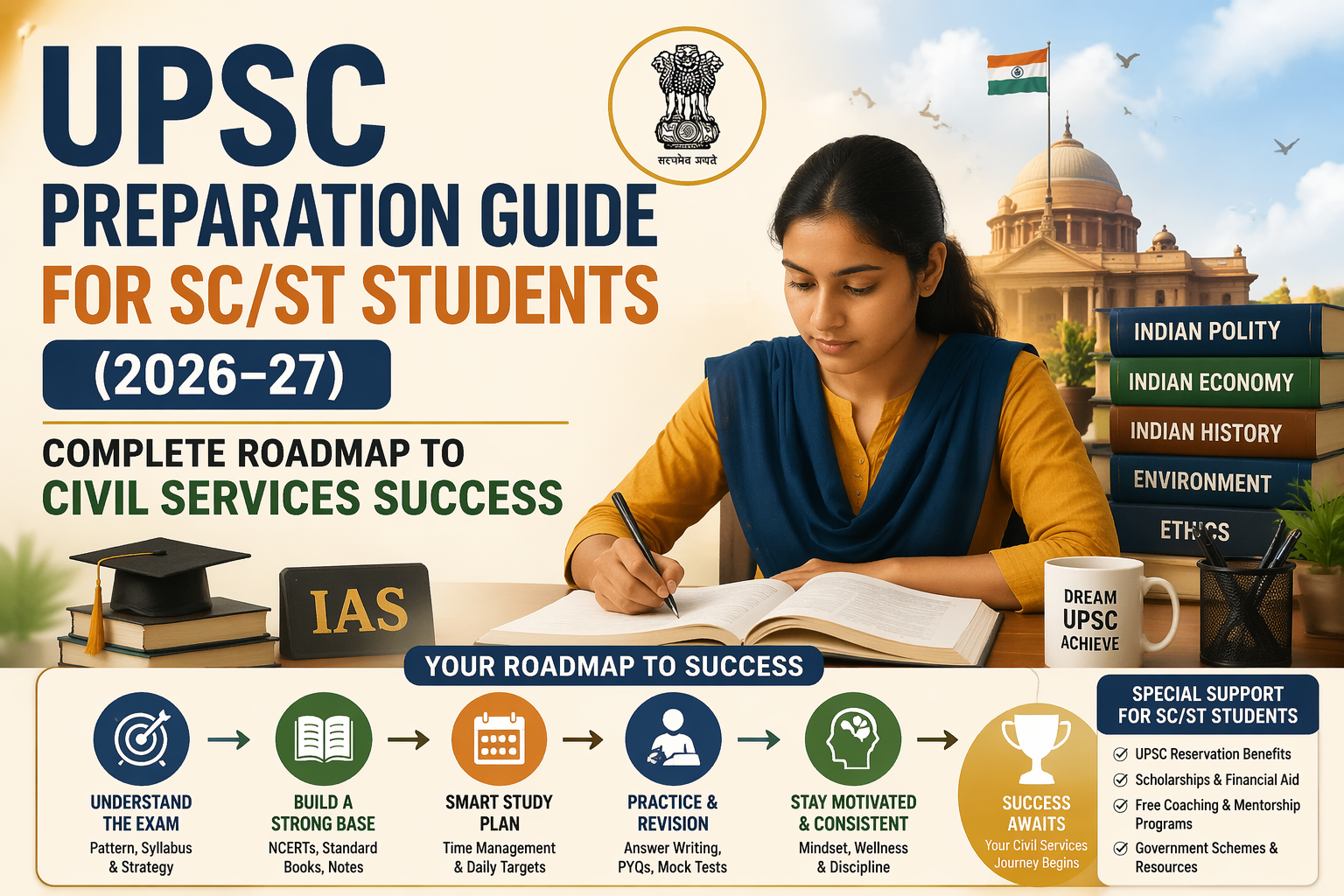
If you are an SC or ST aspirant dreaming of becoming an IAS, IPS, or IFS officer, this guide, “upsc preparation guide sc st students,” is written specifically for you. Not as a watered-down version of general UPSC advice, but as a targeted, honest, and actionable roadmap that accounts for the unique advantages, challenges, and resources available to Scheduled Caste and Scheduled Tribe candidates.
Let’s get into it.
Who Is This Guide For?
This guide is for SC/ST aspirants who are either just starting their UPSC journey or looking to optimize their ongoing preparation. Whether you are from a rural village in Jharkhand, a tribal belt in Chhattisgarh, or an urban setting in Chennai, this guide will help you understand your benefits, build your strategy, and leverage every resource available to you.
Section 1: UPSC Reservation Benefits for SC/ST — Know Your Advantages
Before building a preparation strategy, it is essential that every SC/ST aspirant fully understands the constitutional protections and examination benefits that apply to them.
Age Relaxation
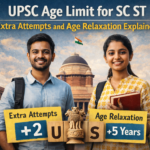
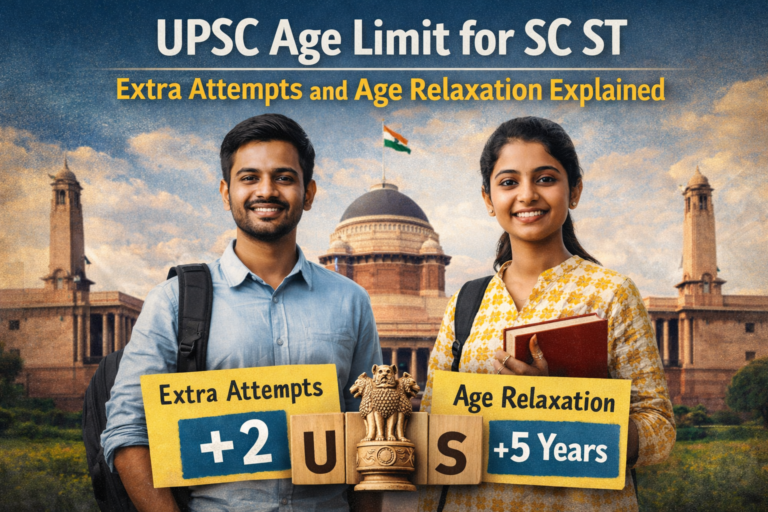
General category candidates must complete their UPSC attempts before turning 32. SC/ST candidates get a 5-year relaxation, meaning the upper age limit is 37 years. This is not a small privilege — it gives you five extra years to mature in your preparation, recover from setbacks, and attempt the exam with greater depth of knowledge.
Unlimited Attempts
This is arguably the single biggest advantage. General category candidates are allowed 6 attempts, OBC candidates are allowed 9 attempts, and SC/ST candidates have no limit on the number of attempts, as long as you are within the age limit of 37 years. This removes the psychological pressure of “this is my last chance” that haunts general category aspirants.
Reserved Vacancies
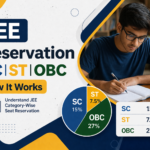
UPSC follows a reservation policy for SC, ST, OBC, EWS, and PwBD candidates to promote social equality and provide equal opportunities to candidates from diverse backgrounds. SC candidates have 15% of seats reserved, while ST candidates have 7.5% reserved across civil services posts.
Lower Cutoff Marks
Cutoff marks for SC/ST candidates in Prelims, Mains, and the final merit list are lower than those of general category candidates. This does not mean the exam is easier — it means you are competing against a smaller, category-specific pool for a defined set of reserved seats.
Fee Waiver
Women and candidates belonging to SC/ST/PwD categories are usually provided fee waivers or concessions during the application. Always check the official UPSC notification to confirm fee exemptions for the current cycle.
Important Note: Being from SC/ST does not make cracking UPSC easy. As one SC candidate who cleared the exam noted on a public forum, “Quality expected from a candidate is still very high. SC candidates will have to work as hard as GM or an OBC since one cannot quantify preparation in terms of marks.” The advantages give you a safety net — they do not replace hard work.
Section 2: Understanding the UPSC Exam Structure (The Foundation)
The UPSC Civil Services Examination (CSE) is conducted to recruit officers for the IAS, IPS, IFS, and other services. The exam comprises three stages — Prelims, Mains, and the Personality Test (Interview) — designed to test knowledge, aptitude, decision-making, and leadership skills.
Stage 1 — Prelims: Two objective papers. General Studies Paper I (100 questions, 200 marks) and CSAT (80 questions, 200 marks). CSAT is qualifying in nature — you only need 33%.
Stage 2 — Mains: Nine papers, of which seven are merit-based. Essay, General Studies I–IV, Optional Subject Paper I & II, plus two qualifying language papers. The marks obtained in Mains (1750 marks) are combined with the Interview marks (275 marks) to determine the final ranking, making the total score 2025 marks.
Stage 3 — Interview: A 20–30 minute Personality Test assessing your analytical ability, leadership qualities, and suitability for public service — not a re-test of knowledge.
Section 3: Step-by-Step UPSC Preparation Strategy for SC/ST Aspirants
Step 1: Know the Syllabus Before Anything Else
Print or save the complete UPSC syllabus from the official website (upsc.gov.in). Every topic you study, every book you read, every newspaper article you note — must map back to this syllabus. This is non-negotiable.
The Preliminary stage tests students on current affairs, history, geography, polity, economy, science, comprehension, and logical reasoning. The Mains Exam syllabus is more extensive and includes additional topics like internal security, disaster management, world history, social issues, ethics, an essay, and an optional subject.
Step 2: Build Your Foundation with NCERTs
Do not skip this step even if you are a postgraduate. NCERTs from Class 6 to 12 across History, Geography, Polity, Economy, and Science are the bedrock of UPSC preparation.
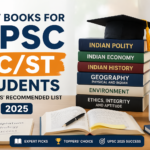
Resources for Prelims include NCERTs (Class 6–12), Bipin Chandra for History, GC Leong for Geography, Laxmikanth for Polity, Ramesh Singh for Economy, and Yojana magazine for Current Affairs.
Once NCERTs are done, move to standard reference books. Do NOT collect dozens of books. One solid book per subject, read thoroughly and revised multiple times, beats ten books read superficially.
Step 3: Master Current Affairs Daily
Build a habit of reading Current Affairs daily: start reading newspapers like The Hindu and The Indian Express, and magazines like Yojana and Kurukshetra to stay updated with current affairs and issues.
For SC/ST aspirants who may be first-generation UPSC aspirants, building this newspaper-reading habit can feel unfamiliar. Start with 30 minutes a day and increase gradually. Focus on editorials, government policies, tribal affairs, welfare schemes, and Supreme Court judgments — these appear repeatedly in both Prelims and Mains.
Step 4: Choose Your Optional Subject Wisely
The optional subject (two papers of 250 marks each) can be a game-changer. Choose based on three factors: genuine interest, availability of good study material, and overlap with General Studies. Popular optional subjects include Public Administration, Geography, Sociology, Anthropology, and History. Anthropology and Tribal Studies, in particular, can be highly relatable and easier to connect with for ST aspirants from tribal communities.
Step 5: Develop Answer Writing from Month 3 Onwards
A well-structured answer should start with a clear introduction that outlines main points, use bullet points or subheadings in the body to organize thoughts, address all parts of the question, and end with a strong conclusion that summarizes key arguments.
Practice one answer per day from Month 3. Join a test series by Month 6. This single habit separates UPSC qualifiers from those who fail despite knowing the content.
Step 6: Take Mock Tests Religiously
Mock tests help you identify strengths and weaknesses, improve time management under timed conditions, and familiarize you with the exam structure.
After each mock test, spend as much time analyzing your performance as you did attempting it. Identify patterns in your mistakes — factual errors, silly mistakes, or comprehension gaps — and address them systematically.
Section 4: Financial Aid & Free Coaching Schemes for SC/ST Aspirants
This is where SC/ST candidates have a massive, often underutilized advantage. Multiple government schemes provide free or heavily subsidized coaching specifically for you.
Central Government Schemes
1. Free Coaching Scheme by the Ministry of Social Justice and Empowerment. The objective of this scheme is to provide coaching of good quality for economically disadvantaged Scheduled Castes (SCs) to enable them to appear in competitive examinations for obtaining appropriate jobs in Public/Private Sector or for securing admission in reputed technical and professional higher education institutions. Family income must be ₹8 lakh or less per year.
2. IGNOU UPSC Free Coaching (Dr. Ambedkar Centre of Excellence) IGNOU extends an invitation for applications from Scheduled Caste candidates seeking free coaching for both the UPSC IAS Prelims and Mains examinations. This program offers comprehensive UPSC CSE coaching to Scheduled Caste candidates completely free of charge. Candidates must pass an entrance examination to be admitted.
State Government Schemes
Several states offer scholarships for UPSC aspirants, helping local students access quality coaching. These initiatives focus on providing financial aid and free coaching for UPSC aspirants from different backgrounds.
Key state schemes include:
- Delhi — Jai Bhim Mukhyamantri Pratibha Vikas Yojana: SC/ST candidates can receive up to ₹1 lakh in coaching support. Students with family income below ₹2 lakh get 100% fee coverage.
- Rajasthan — Mukhyamantri Anuprati Coaching Yojana: Free coaching for SC, ST, OBC, and EWS candidates.
- Tamil Nadu — All India Civil Services Coaching Centre (AICSCC): Originally founded in 1966 specifically to support SC/ST candidates, this residential coaching centre provides structured UPSC training at no cost to eligible candidates.
- Jharkhand, Chhattisgarh, and Arunachal Pradesh: Dedicated tribal welfare departments run free UPSC coaching programs for ST candidates from these states.
- Maharashtra: Selected candidates receive a monthly stipend of ₹10,000 to cover coaching fees and living expenses.
Action Step: Visit your state’s Social Welfare or Tribal Affairs department website immediately and check current scheme notifications. Many of these schemes have limited seats and specific application windows.
Section 5: Common Challenges SC/ST Aspirants Face & How to Overcome Them
Challenge 1 — Being a First-Generation Aspirant
Many SC/ST UPSC aspirants are the first in their families to pursue civil services. There is no inherited network, no family guidance on strategy, and often a lack of awareness about resources.
Solution: Join online UPSC communities on Telegram and YouTube. Seek out IAS/IPS officers from SC/ST backgrounds (several document their journeys publicly) and use their roadmaps as a template. Organizations like the Dalit IAS/IPS Officers’ Association also provide mentorship.
Challenge 2 — Financial Constraints During Preparation
UPSC preparation can take 1–3 years with high costs for coaching, materials, and urban living.
Solution: Exhaust all government scholarship options listed above before spending personal funds. Platforms like Drishti IAS, BYJU’s IAS, and YouTube channels (StudyIQ, Vision IAS) offer extensive free content. NCERT books are free online. You do not need ₹1.5 lakh coaching to crack UPSC.
Challenge 3 — Language and Communication Barriers
Some SC/ST aspirants, particularly from rural or tribal areas, may have studied in regional-medium schools and find English-medium UPSC preparation challenging.
Solution: UPSC Mains can be written in any of the 22 scheduled languages under the 8th Schedule of the Constitution. You do not need to write in English. Many IAS toppers have written Mains in Hindi, Tamil, Telugu, and other regional languages. The interview is also conducted in your preferred language.
Challenge 4 — Mental Pressure and Imposter Syndrome
The psychological weight of being from a marginalized community in a highly competitive exam can be overwhelming.
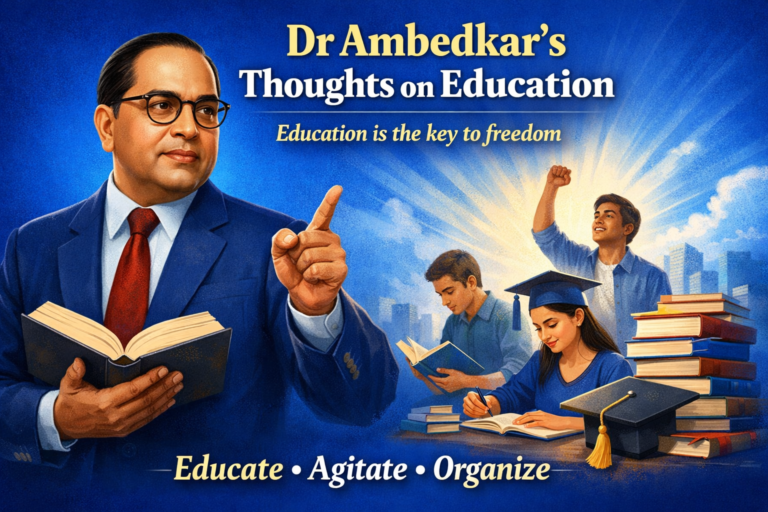
Solution: Remember that reservation is a constitutional right, not charity. B.R. Ambedkar, himself an SC icon and the chief architect of the Indian Constitution, understood that equal access to opportunity requires structural support. You belong in this exam. Your lived experience of social reality is actually an asset in understanding India’s governance challenges.
Section 6: Ideal Study Plan for SC/ST Aspirants (12-Month Timeline)
Months 1–3 (Foundation Phase): Complete NCERT books for all subjects. Understand the UPSC syllabus in depth. Start daily newspaper reading. Apply for all relevant government scholarship schemes.
Months 4–6 (Reference Book Phase): Move to standard reference books, subject by subject. Begin noting important facts and making short notes. Start solving previous years’ Prelims papers.
Months 7–9 (Mains Preparation Phase): Start structured answer writing practice. Cover GS I–IV deeply. Finalize the optional subject and complete its syllabus.
Months 10–11 (Revision & Test Series Phase): Attempt full-length mock tests weekly. Revise short notes. Strengthen current affairs of the last 12 months.
Month 12 (Final Push): Focus entirely on revision, mock tests, and mental preparation. Do not start new topics.
People Also Ask: FAQs on UPSC for SC/ST Students
Q1. How many attempts do SC/ST candidates get in UPSC? SC/ST candidates have unlimited attempts until they reach the maximum age limit of 37 years. This is significantly more than the 6 attempts allowed for general category candidates.
Q2. What is the age limit for SC/ST candidates in UPSC? SC/ST Candidates can attempt UPSC until the age of 37 years. The general category limit is 32 years.
Q3. Is there free UPSC coaching for SC/ST students? Yes. Various initiatives like state coaching schemes, government programs, and NGO support reduce the financial burden and improve success chances for SC/ST, OBC, and EWS candidates. The Ministry of Social Justice, IGNOU’s DACE, and multiple state governments run free schemes.
Q4. Can SC/ST students write UPSC Mains in a regional language? Yes. UPSC allows candidates to write Mains in any language listed in the 8th Schedule of the Indian Constitution. The interview can also be given in your preferred language.
Q5. Is UPSC really easy for SC/ST candidates? No, the reservation benefits provide structural support, but the examination demands the same quality of knowledge, writing, and thinking from all candidates. Reserved category candidates must put in the same preparation effort.
Q6. What optional subject is best for ST candidates from tribal areas? Anthropology is widely considered highly suitable for tribal aspirants due to the overlap with lived experience, available study material, and consistent performance of Anthropology optionals in UPSC results.
Q7. Which government scheme provides free UPSC coaching for SC students? The Central Sector Scheme of Free Coaching by the Ministry of Social Justice and Empowerment covers SC candidates with family income up to ₹8 lakh per year. IGNOU’s Dr. Ambedkar Centre of Excellence also provides completely free coaching to SC candidates.
Final Word: Your Caste Is Not Your Ceiling
India’s civil services need officers who understand the ground reality of marginalized communities — their struggles, aspirations, and the systemic barriers they face. As an SC or ST aspirant, you bring that perspective organically. The UPSC exam is not just a career gateway for you; it is an opportunity to shape policy from the inside.
Use every benefit available to you — age relaxation, unlimited attempts, free coaching schemes, and state scholarships. But do not stop at benefits. Build your knowledge deep, your writing sharp, and your conviction firm.
Thousands of SC/ST candidates have cracked UPSC and are serving as IAS, IPS, and IFS officers today. You can be next.
Sources: UPSC Official Website (upsc.gov.in), Ministry of Social Justice and Empowerment, Testbook, Vajiramandravi, PWOnlyIAS, CollegeDekho, IGNOU DACE, SPM IAS Academy.