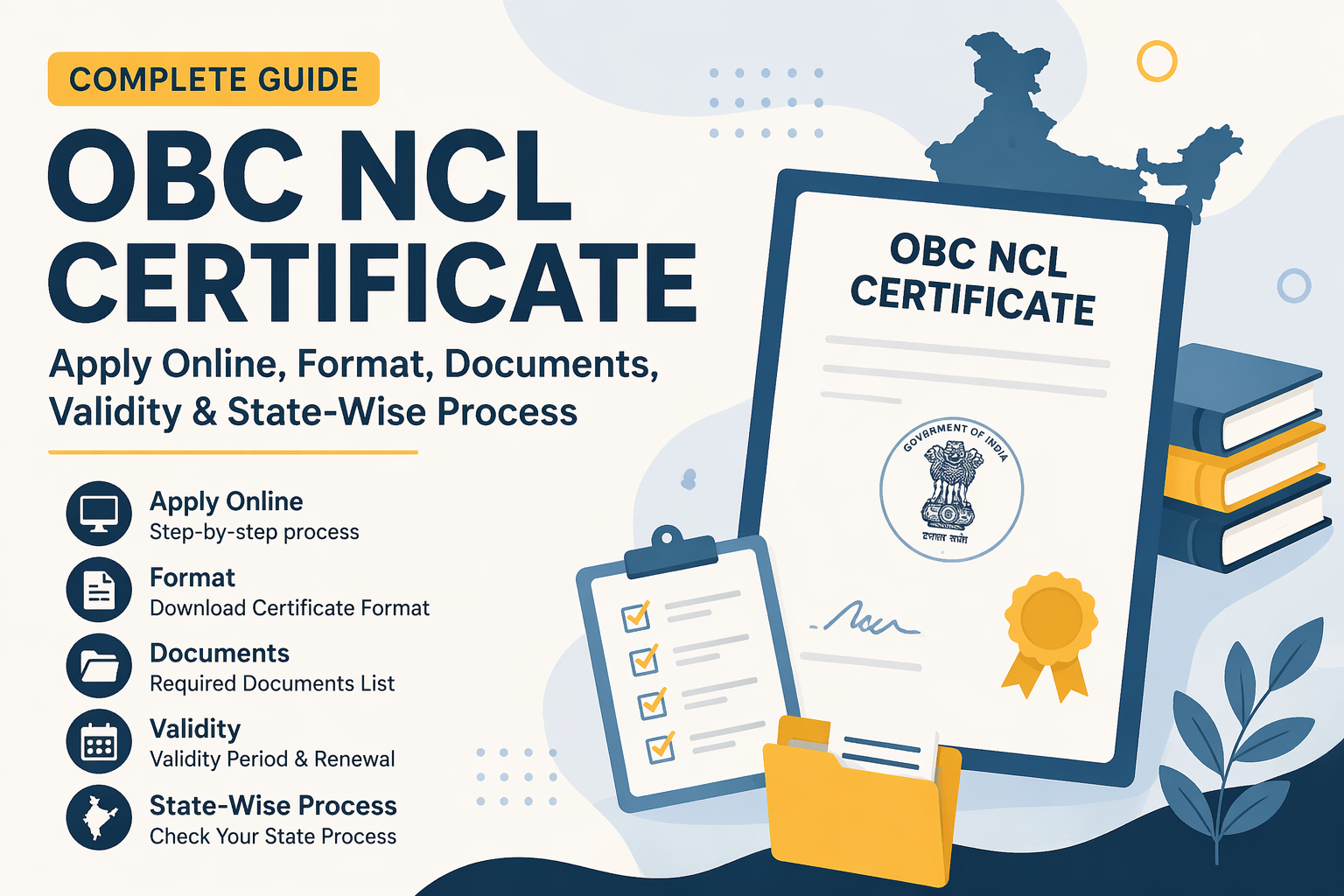
If you belong to the Other Backward Classes (OBC) category and want to avail of reservation benefits in government jobs, college admissions, or competitive exams, the OBC NCL Certificate is the single most important document you need. Yet, thousands of candidates lose out every year simply because they didn’t have the right certificate, or their certificate was expired or in the wrong format.
This comprehensive guide covers everything — what the OBC NCL certificate is, who qualifies, how to apply online, documents required, state-wise process, format, validity, and the most common mistakes to avoid. Let’s break it all down in plain, simple language.
OBC NCL stands for Other Backward Classes – Non-Creamy Layer. The OBC NCL certificate is an official government document that proves two things at once:
That you belong to a caste listed under the OBC (Other Backward Classes) category.
That your family falls under the Non-Creamy Layer — meaning you are NOT among the economically well-off section of OBCs.
In simple words, just being OBC is not enough to get reservation benefits. You also need to prove that your family is not financially advanced. That proof is the OBC NCL certificate.
The Non-Creamy Layer concept was introduced by former Prime Minister V. P. Singh in 1993, following the implementation of the Mandal Commission report. The idea was to ensure that the real benefits of the reservation reach those who genuinely need it, not those who are already well-placed in society.
OBC vs OBC NCL – What’s the Difference?
This confuses a lot of people, so let’s make it crystal clear:
An OBC certificate only confirms your caste — it proves you belong to a backward class community.
An OBC NCL certificate confirms both your caste AND your income/employment status — it proves you belong to the non-creamy layer section of OBC.
For most central government jobs, national entrance exams (UPSC, SSC, JEE, NEET, CAT), and central universities, you specifically need an OBC NCL certificate. A plain OBC certificate won’t do. This is one of the most overlooked distinctions among applicants.
What is the Creamy Layer and Non-Creamy Layer?
Think of the OBC community as being divided into two groups:
Creamy Layer — OBC individuals who are economically and socially advanced. They do NOT get reservation benefits.
Non-Creamy Layer (NCL) — OBC individuals from economically weaker backgrounds. They ARE entitled to reservation benefits.
The income limit to qualify for the Non-Creamy Layer is ₹8,00,000 (8 lakh rupees) per year from all sources combined (excluding agricultural income). If your parents’ annual income crosses ₹8 lakh, you fall in the Creamy Layer and are not eligible for OBC reservation benefits.
Who is Eligible for OBC NCL Certificate?
To qualify for an OBC NCL certificate, you need to meet all of the following conditions:
You must be a citizen of India.
Your caste must be listed in the Central Government’s OBC list (for central jobs/exams) or the State Government’s OBC list (for state jobs/exams).
Your parents’ combined annual income from all sources must be less than ₹8 lakh per year (agricultural income is excluded).
Your parents should be employed in Group C or Group D of Central Government services, or in Group II, III, or IV of State Government services.
Who is NOT Eligible?
If your parents are Group A officers (IAS, IPS, IFS), you are not eligible.
If either parent was promoted to Group B before the age of 40, you are not eligible.
If your parents’ income from salary and other non-agricultural sources exceeds ₹8 lakh annually for three consecutive years, you are not eligible.
If your caste appears in the State’s BC/MBC list but NOT in the Central OBC list, you cannot apply for a central-level OBC NCL certificate.
One important point: income from farming or agricultural activities is not counted when calculating the ₹8 lakh limit. So farmers whose non-agricultural income is below ₹8 lakh can still qualify.
Benefits of OBC NCL Certificate
Why is this certificate so valuable? Here’s what it unlocks for you:
27% reservation in central government jobs and public sector undertakings.
27% quota in admissions to central universities, IITs, IIMs, NITs, AIIMS, and other top institutions.
Age relaxation of 3 years in government competitive exams (UPSC, SSC, Railways, Banking, etc.).
Additional attempts in exams like the UPSC Civil Services.
Fee concessions in government exams and educational institutions.
Access to government scholarships meant for backward class students.
Benefits under various central welfare schemes for OBC communities.
In short, this one document can open doors that would otherwise remain closed. Missing or losing this certificate means you compete in the general/unreserved category, which is significantly more competitive.
OBC NCL Certificate Format – What Does It Look Like?
The Central Government has prescribed a specific format for the OBC NCL certificate. The format is standardized and must be used for all central jobs and entrance exams.
The certificate typically includes:
Full name of the applicant (Sri/Smt/Kum.)
Son/Daughter of (parent’s name)
Village/Town and District/Division of residence
State of residence
Community name as recognized in the OBC list
Reference to the relevant Government Resolution under which the community is recognized
A declaration that the applicant does not belong to the Creamy Layer
Date of issue and signature of the issuing authority
The official format is available on the NCBC website (ncbc.nic.in) and is also provided by most exam bodies like JEE Advanced, UPSC, and SSC in their official notifications.
For state-level jobs and exams, each state may have a slightly different certificate format. Always check the relevant job/exam notification to confirm which format is required.
Who Can Issue the OBC NCL Certificate?
The following authorities are competent to issue the OBC NCL certificate (as per Central Government rules):
District Magistrate / Additional District Magistrate / Collector / Deputy Commissioner
Sub-Divisional Officer of the area where the candidate or their family resides
The key point: a certificate issued by an authority below the rank of Tehsildar is not valid for central government purposes. Many candidates make this mistake and get rejected during document verification.
Documents Required for OBC NCL Certificate
While the exact list can vary slightly by state, here are the documents commonly required:
Aadhaar Card (Identity proof of applicant)
Caste certificate of the applicant (or of a parent/blood relative from the paternal side)
Income certificate of parents (issued by a revenue authority)
Self-declaration/affidavit on stamp paper (in some states)
School leaving certificate or birth certificate (for age proof)
Employment certificate of parents (if working in government service)
Some states, like Delhi, also require attestation by an MP, MLA, Councillor, or a Gazetted Officer.
How to Apply for OBC NCL Certificate Online – Step by Step
Most states have moved to online portals, making the process faster and more transparent. Here’s the general process:
Step 1: Identify the right portal. First, decide whether you need a Central OBC NCL certificate or a State OBC NCL certificate. For central jobs and national exams, you need the Central format issued by your state’s revenue authority. Visit your state’s e-district portal or revenue department website.
Step 2: Register on the portal. Create an account using your mobile number and email ID. Keep your login credentials safe.
Step 3: Fill the application form. Look for options like “Apply for Caste Certificate” or “Apply for NCL Certificate.” Fill in all details carefully — name, address, caste, parent details, income details — exactly as they appear on your documents. Even a small spelling error can cause rejection.
Step 4: Upload documents. Scan and upload all required documents in the specified file format and size. Poor-quality scans or wrong file types can delay your application.
Step 5: Submit and note the reference number. After submitting, you’ll receive an acknowledgment receipt with a reference/application number. Save this — you’ll need it to track your application status.
Step 6: Verification by Tehsildar/Revenue Officer. Your application is reviewed by the Tehsildar or Revenue Officer, who may call you for document verification if needed.
Step 7: Download the certificate. Once approved, you can download the OBC NCL certificate PDF from the portal. Processing usually takes 15 to 30 working days, depending on your state and district.
How to Check OBC NCL Certificate Status Online
After applying, you can track your application status:
Go to the official website of your state’s Revenue Department or e-District portal.
Look for the “Backward Classes Welfare Department” or “Certificate Status” section.
Enter your application/reference number and other required details.
Your current application status will be displayed.
You can also check the status by visiting the Tehsildar’s office in person or calling the concerned department’s helpline number.
How to Download OBC NCL Certificate
Once your certificate is issued:
Log in to the official portal where you applied.
Go to the “My Applications” or “Download Certificate” section.
Enter your application number.
Download the OBC NCL Certificate PDF.
Print it on good-quality paper. Keep multiple copies.
OBC NCL Certificate Validity – How Long Is It Valid?
This is critical, and many candidates miss this point:
Central Government OBC NCL certificates are valid for only 1 year from the date of issue.
Some state governments issue certificates valid for 2 to 3 years (state-level jobs and admissions).
For exams like SSC CGL, the NCL certificate must be dated within 1 year of the application closing date — not the exam date or joining date.
Pro tip: If you’re applying for a competitive exam, always get a fresh NCL certificate close to the application deadline. Since recruitment processes often take 12 to 18 months, you may need to renew the NCL certificate before document verification, even if your original certificate was valid when you applied.
Your caste certificate, however, does not need to be renewed — only the NCL certificate needs annual renewal because income can change from year to year.
State-Wise OBC NCL Certificate Process
OBC NCL Certificate – Bihar
Candidates from Bihar can apply through the RTPS Bihar portal (serviceonline.bihar.gov.in). Bihar is one of the states with a well-developed online system for caste and income certificates. You can apply, track the status, and download your OBC NCL certificate online. Bihar-issued certificates for central government purposes must follow the Central Government format and be issued by a Tehsildar or higher authority.
OBC NCL Certificate – Delhi
In Delhi, the certificate is issued by the Sub-Divisional Magistrate (SDM) of your area or at the Office of the Deputy Commissioner. You can also apply online through Delhi’s e-district portal. No fee is required. Documents must be attested by an MP, MLA, Councillor, or Gazetted Officer. Applicants must also provide proof of continuous stay in Delhi since 1993.
OBC NCL Certificate – Jharkhand
In Jharkhand, the application is processed through the Jharsewa portal (jharsewa.jharkhand.gov.in). Candidates can apply online, upload documents, and download the certificate once approved.
OBC NCL Certificate – Karnataka
Karnataka processes OBC NCL certificates through the Nadakacheri / Karnataka One portal. The certificate is issued by the Revenue Department (Tahsildar level).
OBC NCL Certificate – Tamil Nadu
Tamil Nadu has its own OBC list, which may differ from the Central OBC list. For central jobs, you need the Central format certificate. The process involves submitting documents to the VAO (Village Administrative Officer), who gets it countersigned by the RI (Revenue Inspector) and Tahsildar. A Rs. 20 stamp paper affidavit from a Notary is also needed.
OBC NCL Certificate – Telangana
Telangana residents can apply through the Meeseva portal or at their nearest Meeseva center. The Meeseva system is designed to make government certificate services accessible to citizens at the local level.
OBC NCL Certificate – Assam
In Assam, OBC NCL certificates are issued by the Circle Officer or Sub-Divisional Officer. The state has a portal for online applications through the Assam e-District system.
OBC NCL Certificate for Central Government – Important Points
If you’re applying for a central government job or national exam, keep these points in mind:
Your caste must be in the Central OBC list, not just the state list.
The certificate must explicitly state that you “do not belong to the Creamy Layer.” Without this phrase, the certificate is invalid for central purposes.
The certificate must be issued by an authority not below the rank of Tehsildar.
The OBC NCL certificate must be in the prescribed Central Government format (available at ncbc.nic.in or in the exam notification).
The certificate must be issued from your home state (domicile state), not from the state where you currently study or work. For example, if you’re from Bihar but studying in Delhi, get your certificate from the Bihar revenue authorities.
Common Mistakes to Avoid
Here are the top mistakes that lead to certificate rejection:
Using an expired certificate — NCL certificates are valid for only 1 year. Always check the issue date.
Using a state OBC list for a central job — Your caste must be in the Central OBC list for central government purposes.
Caste name spelling mismatch — The caste name on the certificate must exactly match the spelling in the official OBC list.
Certificate issued by the wrong authority — Below Tehsildar rank is not accepted for central purposes.
Missing “Creamy Layer” declaration — The certificate must clearly state you don’t belong to the creamy layer.
Incorrect income details — SSC and UPSC cross-verify income data with tax records. Providing wrong income figures can lead to serious consequences.
Applying from the wrong state — Always apply in your home/domicile state.
Frequently Asked Questions (FAQs)
Q. What is an OBC NCL certificate? The OBC NCL certificate is a government document that certifies that a person belongs to the Other Backward Classes (OBC) category AND falls under the Non-Creamy Layer — meaning their family income is below ₹8 lakh per year and their parents don’t hold top-level government positions.
Q. What is OBC Non-Creamy Layer (NCL)? OBC Non-Creamy Layer refers to the economically and socially disadvantaged section within the OBC community. These are people whose parents earn less than ₹8 lakh annually and are not in high-ranking government or professional positions. They are eligible for OBC reservation benefits.
Q. How to apply for the OBC NCL certificate? You can apply online through your state’s e-district or revenue department portal, or visit your local Tehsildar’s office. Submit the required documents (caste certificate, income certificate, ID proof, residence proof), fill in the application form, and submit. Processing takes 15–30 working days.
Q. Can I apply for NCL if I am OBC? Yes, if you are OBC AND your parents’ annual income is below ₹8 lakh AND your parents are not in Group A government service, you can apply for the NCL certificate. Being OBC is the first condition; the income and employment criteria are additional requirements.
Q. Is the OBC certificate and OBC NCL certificate the same? No. An OBC certificate only proves your caste. An OBC NCL certificate proves both your caste and your non-creamy layer eligibility. For most central government benefits, you specifically need the OBC NCL certificate.
Q. How long is the OBC NCL certificate valid? For central government purposes, it is valid for 1 year from the date of issue. Some states allow 2–3 years for state-level purposes.
Final Thoughts
The OBC NCL certificate is not just a piece of paper — it’s your passport to reservations in education and government employment that you are legally entitled to. Getting it right the first time saves you months of delays and potential rejection of your job or admission application.
To summarize: check your eligibility, gather your documents, apply through the official portal of your state, ensure the certificate is in the Central Government format (for central purposes), and renew it every year before applying to exams and jobs.
Don’t leave this important step for the last moment. Start the process early, double-check every detail, and hold on to your OBC NCL certificate as one of your most valuable documents.
For the latest updates on OBC lists and certificate formats, visit the official National Commission for Backward Classes website at ncbc.nic.in.