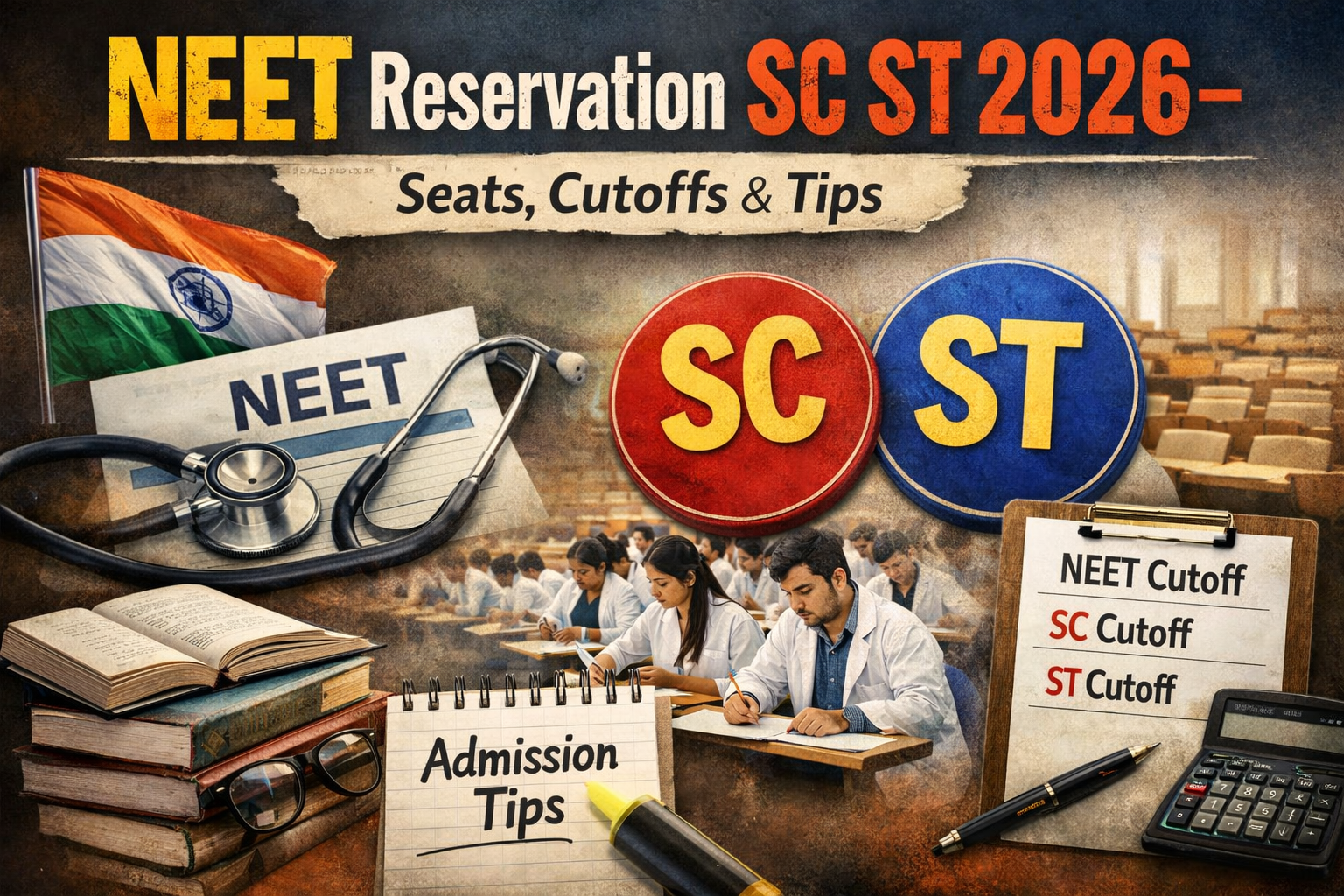
If you are an SC or ST student preparing for NEET 2026, you have real, built-in advantages that can get you into an MBBS seat with fewer marks than General category students.
15% of all government medical seats are reserved for SC. 7.5% are reserved for ST. Your qualifying cutoff is lower. Your admission cutoff is lower. And the reservation applies to both All India Quota and state quota seats across India.
This article “NEET Reservation SC ST 2026” explains everything about the exact percentages, how many seats it means in real numbers, what scores you need, and what documents you must carry to counselling.
1. Does NEET have a reservation? — The Clear Answer
Yes — NEET absolutely has reservations for SC, ST, OBC, EWS, and PwD candidates.
The NEET Reservation Criteria 2026 will be the same as last year — 15% for SC, 7.5% for ST, 27% for OBC-NCL, 10% for EWS, and 5% horizontal for PwD. Reservation applies at both the qualifying cutoff stage (eligibility for counselling) and the admission stage (actual seat allotment).
The reservation applies to:
15% All India Quota (AIQ) seats in government medical colleges — filled through central MCC counselling
85% State Quota seats — filled through individual state counselling bodies
Both levels of reservation benefit SC/ST students. The AIQ follows the central government reservation rules. State quota follows state-level reservation rules — which can be equal to or higher than central norms.
NEET reservation 2026 for OBC is 27 per cent, for SC is 15 per cent, for ST is 7.5 per cent, and for EWS is 10 per cent.
Category
Reservation %
Who Qualifies
SC
15%
Scheduled Caste — valid SC certificate
ST
7.5%
Scheduled Tribe — valid ST certificate
OBC-NCL
27%
OBC Non-Creamy Layer — NCL certificate required
EWS
10%
General category, family income ≤ ₹8 lakh
PwD
5% (horizontal)
Benchmark disability ≥ 40% — applies across all above categories
UR/General
40.5%
No reservation — merit only
This means that in the AIQ, 59.5% of the seats are reserved (15% SC + 7.5% ST + 27% OBC + 10% EWS = 59.5%) for different categories.
This means only 40.5% of AIQ seats are for unreserved/General candidates. The majority of seats — 59.5% — go to reserved categories.
3. What Are AIQ and State Quota Seats?
This is the most important concept to understand about NEET admission.
15% All India Quota (AIQ): These are seats in government medical colleges that are open to students from any state in India. The MCC (Medical Counselling Committee) fills them through national-level counselling. Reservation here follows central government rules (SC 15%, ST 7.5%, OBC-NCL 27%, EWS 10%).
85% State Quota: These seats are filled by individual state counselling bodies. Candidates must meet domicile requirements for their state. For admission to 15% AIQ, seats will be allotted irrespective of the domicile NEET criteria. While for 85% state quota seats, candidates need to fulfill the domicile and other eligibility conditions set by the respective authority.
State quota reservation rules vary by state — many states have the same central percentages, some have additional local reservations.
Key fact: Candidates from Jammu & Kashmir and Ladakh are generally not eligible for the 15% AIQ seats. They must submit a self-declaration form during registration if they choose to participate in AIQ counselling.
4. How Many Seats Are Reserved for SC in NEET?
There are a total of 1,18,000 MBBS seats in India across more than 780 medical colleges — around 56,000 seats from government colleges and around 58,000 seats from private colleges.
Applying SC 15% to government college seats (56,000): Approximately 8,400 MBBS seats are reserved for SC students in government medical colleges across India.
Applying ST 7.5% to government college seats: Approximately 4,200 MBBS seats are reserved for ST students in government medical colleges.
Additionally, with reservations in private college AIQ seats:
Category
Government Seats (approx)
Private College AIQ Seats
SC (15%)
~8,400
Additional 15% of AIQ private seats
ST (7.5%)
~4,200
Additional 7.5% of AIQ private seats
OBC-NCL (27%)
~15,120
Additional 27% of AIQ private seats
Reports suggest that MBBS seats may reach around 1.28 lakh in NEET 2026, with additional postgraduate medical seats also increasing.
5. NEET Reservation Cutoff 2026 — Two Types Explained
Students often confuse two completely different cutoffs. Understanding the difference saves a lot of stress.
Type 1 — Qualifying Cutoff: The minimum score to appear in NEET counselling. This is low. Even scoring 107 marks qualifies SC/ST students for counselling. But it does NOT guarantee a seat.
Type 2 — Admission Cutoff: The actual score needed to get an MBBS seat in a specific college. This is much higher. This is what you should target in preparation.
The qualifying cutoff is the minimum score to appear in counselling (e.g., 137 marks for General). The admission cutoff is the actual score needed to secure an MBBS seat in a specific college, which is much higher (550–650+ for government colleges).
6. NEET 2026 Qualifying Cutoff — Category Wise
NEET Cutoff 2026 is different for each category — for the General category 50th percentile, while for the reserved category, it is the 40th percentile.
Category
Qualifying Percentile
Expected Qualifying Marks 2026
General
50th percentile
~137–140 marks
OBC / SC / ST
40th percentile
~107–136 marks
General PwD
45th percentile
~121–136 marks
SC/ST/OBC PwD
40th percentile
~107–120 marks
These are qualifying marks only — they make you eligible for counselling. They do NOT guarantee any seat.
Historical data confirms: In NEET 2023, the General category cutoff was 720–137, while OBC, SC, and ST categories had cutoffs ranging from 136–107.
7. NEET 2026 Admission Cutoff for Government MBBS
This is the real target. Here are the expected scores needed to actually secure a government MBBS seat:
Category
Expected Score for Govt MBBS 2026
General
600+ marks (out of 720)
OBC-NCL
520–580 marks
SC
450–500 marks
ST
430–480 marks
With 400–450 marks, SC/ST students can explore state quota government seats in several states, as well as private colleges and management quota seats.
Target score for SC/ST students: Aim for 500+ marks to give yourself a strong chance at government MBBS seats in multiple states. Scoring above 500 significantly increases your options during counselling.
8. Is There a Reservation in NEET PG?
Yes — NEET PG (for MD/MS admissions) also has a reservation.
SC and ST candidates receive the same reservation percentage in NEET PG — 15% for SC, 7.5% for ST — in government medical college PG seats. OBC NCL reservation also applies.
Is there a reservation in NEET SS (Super Specialty)? Yes — reservation applies at the super specialty level too, following the same central government reservation policy.
9. Special State Reservations You Should Know
Some states have additional local reservation policies:
Tamil Nadu: The Tamil Nadu government has approved a 7.5% reservation for NEET-qualified students from government schools. This is an extra advantage for Tamil Nadu SC/ST students who studied in government schools.
Victims of Terror Attacks: Spouses and children of terror attack victims have reserved MBBS and BDS seats within the central pool — a specific central government provision.
State Quota Extra Reservations: Many states reserve additional seats for women, sports persons, NCC candidates, and ex-servicemen’s children, within the state quota. SC/ST women especially benefit from combined category reservations in states like Maharashtra, Karnataka, and Rajasthan.
Always check your specific state counselling authority’s website for complete local reservation rules.
10. Why Do SC/ST Get Reservation in NEET?
This question is asked in People Also Ask boxes across Google. Here is the honest, accurate answer.
SC and ST communities face historical social and educational disadvantages in India. The Constitution of India — written by Dr. B.R. Ambedkar himself — provides for reservation under Articles 15(4) and 16(4) as an affirmative action measure.
In medical education specifically, the representation of SC and ST communities among doctors is still far below their proportion in the general population. Reservation corrects this imbalance — ensuring that doctors, specialists, and medical researchers come from diverse communities, especially communities that were denied access to education for generations.
Reservation is not charity. It is a constitutional correction for structural inequality.
11. Documents Required to Claim Reservation in NEET
Candidates have to properly select the category in the NEET application form and have to do proper document verification during the counselling.
Carry originals of all these to MCC and state counselling:
Document
Who Needs It
SC Caste Certificate
SC candidates — issued by Tehsildar/SDM
ST Caste Certificate
ST candidates — issued by Tehsildar/SDM
OBC-NCL Certificate
OBC candidates — “for central govt purposes” clause mandatory
EWS Certificate
EWS candidates — current year income-based
Disability Certificate
PwD candidates — from NTA/MCC approved disability centre
Domicile Certificate
For state quota seats — proves state residency
J&K Self-Declaration Form
J&K/Ladakh candidates applying for AIQ
Critical OBC rule: No, creamy layer OBC candidates do not have reservations, and they are considered under the Unreserved (UR) category. If your family income exceeds ₹8 lakh, you fall under the OBC creamy layer and get no reservation in NEET AIQ.
12. NEET 2026 Preparation Tips for SC/ST Students
Tip 1 — Know Your Real Target Score. Do not stop at 107 marks (qualifying cutoff). Target 500+ marks as your minimum. With 500 marks as an SC/ST student, you have realistic chances in multiple states. With 450 marks, options narrow significantly. Aim high — use reservation as insurance, not as your ceiling.
Tip 2 — Apply for Free Coaching SC/ST students can access free UPSC and competitive exam coaching through the Central Sector Scheme. For NEET specifically, check state government coaching schemes. Delhi’s Jai Bhim Mukhyamantri Pratibha Vikas Yojana covers NEET coaching for SC/ST students.
Tip 3 — Know Both Quotas When you qualify NEET, apply for BOTH AIQ seats (through MCC) AND your state quota seats (through your state counselling). Two separate counselling processes. Two separate opportunities. Do not miss either one.
Tip 4 — Choose Your State Strategically. State quota seats have different cutoffs in different states. An SC/ST student with 450 marks may get a government seat in one state but not another. Research state-wise previous year cutoffs on mcc.nic.in before setting your preferences.
Tip 5 — Keep Documents Ready Well in Advance. Get your caste certificate, income certificate, and domicile certificate well before NEET counselling. Certificates must be valid and from the correct authority. An expired certificate at counselling means you lose your reservation benefit — even after qualifying.
13. Frequently Asked Questions
What is NEET reservation 2026?
NEET reservation 2026 for OBC is 27 per cent, for SC is 15 per cent, for ST is 7.5 per cent, and for EWS is 10 per cent. An additional 5% horizontal reservation applies for PwD candidates across all categories. These percentages apply to 15% All India Quota seats (central counselling through MCC) and 85% State Quota seats (state-level counselling). In AIQ alone, 59.5% of seats are reserved across all categories.
Which seats are reserved in NEET 2026?
Reservation applies to seats in government medical and dental colleges across India — both under the 15% All India Quota (national level) and the 85% State Quota (state level). Based on NEET 2026 scores, admissions to over 1 lakh MBBS and 27,868 BDS seats, 52,720 AYUSH seats, and 603 BVSc & AH seats are offered. SC/ST reservation of 15% and 7.5% applies to all these government college seats.
How many seats are reserved for SC and ST in NEET?
With approximately 56,000 government MBBS seats in India, SC students get 15%, which equals roughly 8,400 seats. ST students get 7.5%, which equals roughly 4,200 seats. With expected MBBS capacity reaching 1.28 lakh in 2026 (government and private combined), the total number of seats available to SC/ST through AIQ and state quota reservations is significantly higher. The exact post-counselling data is published by MCC at mcc.nic.in after each counselling round.
What is NEET reservation cutoff for SC/ST?
NEET cutoff has two components. The qualifying cutoff — minimum marks to appear in counselling — is the 40th percentile for SC/ST, expected around 107–136 marks in 2026. This is very low. The admission cutoff marks needed to actually get a government MBBS seat are much higher. SC/ST students need approximately 450–500 marks for a realistic chance at government MBBS seats. Scoring 500+ gives you options across multiple states. Always target the admission cutoff, not just the qualifying cutoff.
Is there reservation in NEET PG?
Yes. NEET PG (MD/MS) admissions also follow the same central government reservation policy — SC candidates get 15% reservation, ST candidates get 7.5%, and OBC-NCL candidates get 27% of PG medical seats in government colleges. NEET SS (super specialty) admissions also have reservations applied at the same percentages.
Conclusion
NEET 2026 gives SC and ST students a genuine path to becoming doctors — even without the highest scores.
15% of all government MBBS seats are set aside for SC students. 7.5% for ST students. Lower qualifying cutoffs. Lower admission cutoffs. State-level reservations on top of the central quota.
But reservation is not a shortcut — it is a bridge. Use it wisely.
Target 500+ marks. Apply for both AIQ and state counselling. Keep your caste certificate valid. And never mistake the qualifying cutoff (107 marks) for the admission cutoff (450–500 marks).
Dr. B.R. Ambedkar ensured that this system exists in the Constitution. Now your job is to score high enough to use it fully.
If you are an SC or ST student studying in Class 9 or Class 10, the Government of India wants to pay you a scholarship every month. You do not need to be a topper. You do not need to come from a rich school. You just need to be enrolled, belong to a Scheduled…
Girls from SC, ST, and OBC communities face a double barrier in education. First, they face economic hardship that makes fees and books impossible. Second, they often face family pressure to leave school early for marriage or household responsibilities. The Government of India has responded with a system of dedicated girl-only scholarships — separate from,…
After Class 10, many SC and ST students face a silent crisis. Their marks are good. Their dream is clear. But money runs out. College fees, hostel rent, books, bus passes — the costs pile up. And without financial support, thousands of bright students either drop out or never apply to college at all. The…
You just cleared your Class 10 board exam. Now comes the big question: how do you pay for Class 11 and 12? Tuition fees, books, transport, uniform, coaching — the costs add up fast. For many SC and ST families, this is the moment students drop out. But here is the truth: the Indian government…
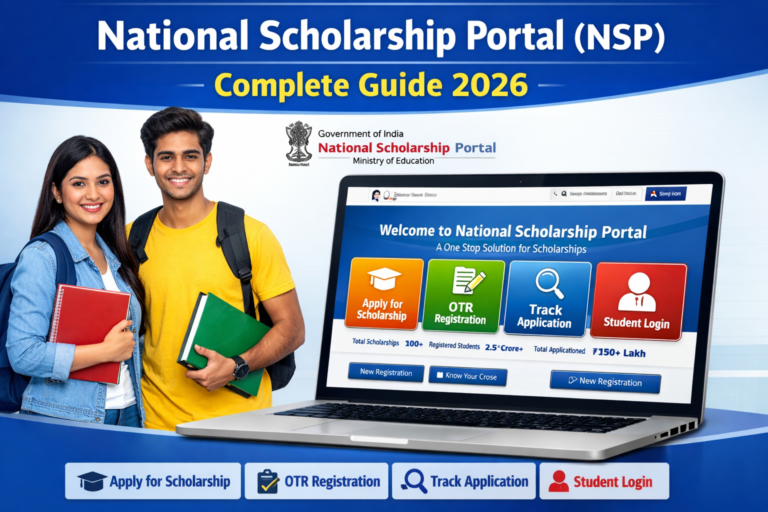
Every year, thousands of SC, ST, OBC, minority, and EWS students miss out on thousands of rupees in government scholarships — not because they are ineligible, but because they do not know where to apply. The answer is one website: scholarships.gov.in — the National Scholarship Portal (NSP). This one portal houses over 140 scholarship schemes…
Getting into MBBS or BDS is already one of the hardest things to do in India. Every year, over 23 lakh students appear for NEET. Only a fraction get a seat. But clearing NEET is just the first challenge. The second — paying for it. Private medical colleges typically cost ₹8–₹25 lakh a year. Management…