If you are an SC, ST, or OBC student preparing for JEE, you have a real, built-in advantage that most students do not fully understand.
Lower qualifying cutoffs. Reserved seats in NITs, IIITs, and IITs. Lower application fees. Home state quota benefits. And access to more total seats than General category students compete for.
This article explains exactly how JEE reservation SC ST OBC works in 2026 — category-wise percentages, qualifying and admission cutoffs, NIT vs IIT rules, what documents you need, and one important rule about OBC certificates that most students get wrong.
1. Does JEE Main Have Reservation? — The Clear Answer
Yes — JEE Main absolutely has reservations for SC, ST, OBC-NCL, EWS, and PwD candidates.
The JEE Main Reservation Criteria 2026 aims to provide fair representation to candidates belonging to different categories such as SC, ST, OBC-NCL, EWS, and PwD. The reservation system ensures that candidates from socially and economically disadvantaged backgrounds get fair access to premier engineering institutions.
Reservation applies to:
All NITs (National Institutes of Technology)
All IIITs (Indian Institutes of Information Technology)
All GFTIs (Government Funded Technical Institutions)
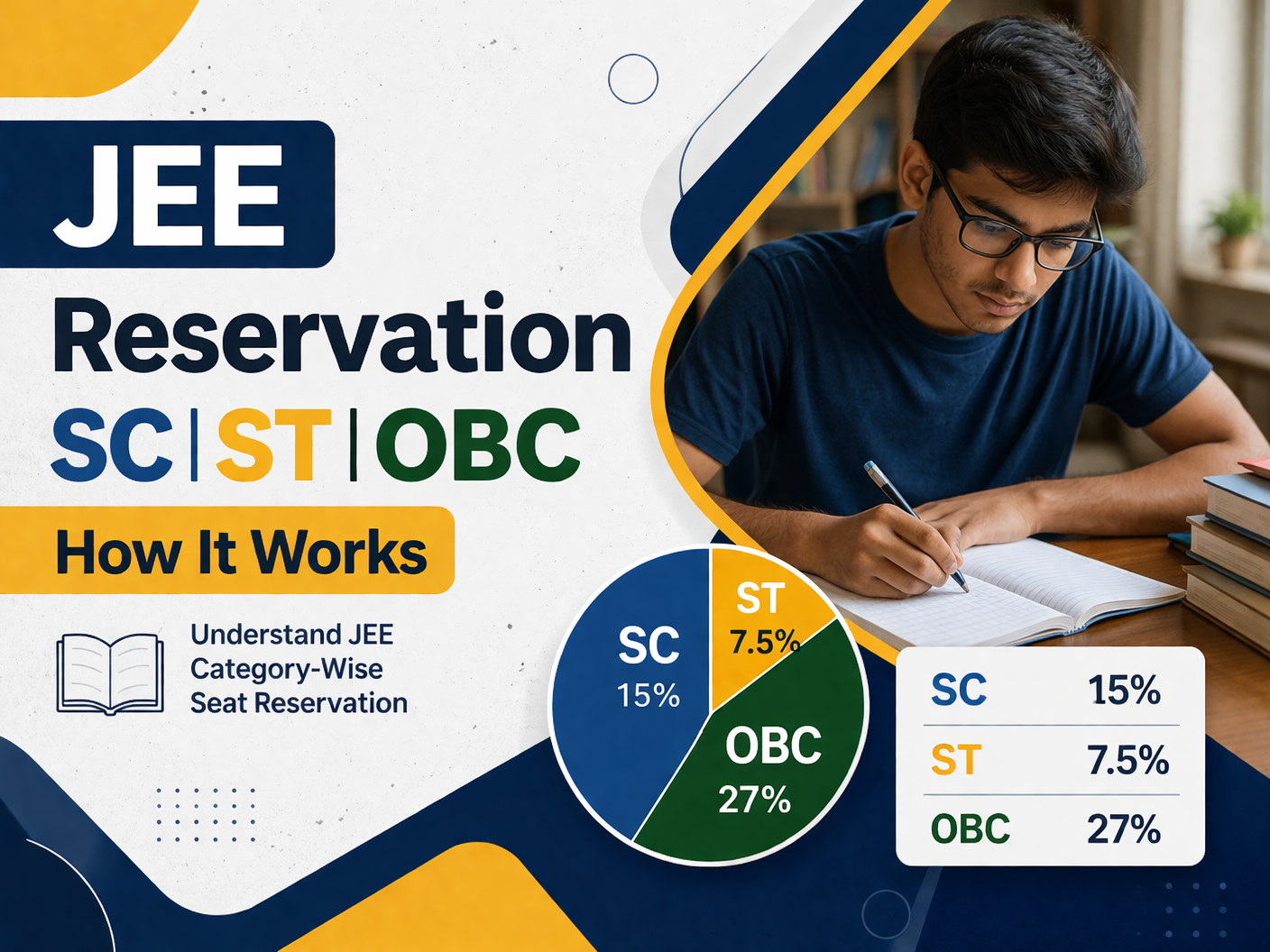
The reserved categories in JEE Main for institutes run by the Central Government include Scheduled Caste (SC) with 15% of seats, Scheduled Tribe (ST) with 7.5%, Other Backward Classes (OBC-NCL) with 27%, General Economically Weaker Sections (GEN-EWS) with 10%, and Persons with Disabilities (PwD) with 5% reservation in each category for candidates having 40% or more disability.
Category
Reservation %
Who Qualifies
OBC (NCL)
27%
OBC Non-Creamy Layer — Central list only
SC
15%
Scheduled Caste — central list caste certificate
ST
7.5%
Scheduled Tribe — central list tribe certificate
EWS
10%
General category, family income < ₹8 lakh
PwD
5% (horizontal)
Disability ≥ 40% — across all categories
General/UR
40.5%
No reservation — merit only
3. How Many Total Seats Can SC/ST/OBC Access?
This is where the real advantage becomes clear.
Reserved candidates also have access to open seats. EWS candidates can compete for a total of 50% seats, OBC for 67%, SC for 55%, and ST candidates for 48% seats.
In plain language: SC students can compete for both the 15% SC-reserved seats AND all the unreserved (40.5%) seats — giving them access to 55% of total seats. OBC students can compete for 27% OBC seats + 27% EWS seats + the unreserved seats + their own category = 67% total accessible seats.
General category students can compete for only 40.5%.
Reserved category students have MORE total seat options than General category students. Use this advantage.
4. JEE Main Qualifying Cutoff 2026 — Category Wise
The qualifying cutoff is the minimum percentile to appear for JEE Advanced and participate in JoSAA counselling for NITs, IIITs, and GFTIs.
Based on last year’s trends and JEE Main 2026 Session 1 difficulty, the expected JEE Main qualifying cutoff 2026 for the General category is projected to be around the 93.5–95.0 percentile. For reserved categories — EWS 80.5–82.5%, OBC 79.5–81.5%, SC 61.5–64%, ST 48–50.5%.
Category
Expected Qualifying Percentile 2026
General
~93.5–95.0 percentile
EWS
~80.5–82.5 percentile
OBC-NCL
~79.5–81.5 percentile
SC
~61.5–64 percentile
ST
~48–50.5 percentile
This is only the qualifying cutoff — it makes you eligible for JoSAA counselling. It does NOT guarantee any seat.
JEE Main 2026 Session 1 result was declared on February 16, 2026. Session 2 is scheduled from April 2 to 9, 2026.
5. JEE Main Admission Cutoff — The Real Target
The admission cutoff is released by JoSAA and shows the actual closing rank at which each NIT/IIIT seat was filled. It varies by institute, branch, category, and home state vs other states.
Here are realistic JoSAA closing rank ranges for SC/ST/OBC students targeting NIT seats:
Category
For Top 15 NITs (CSE/ECE)
For Average NITs (Civil/Mech)
General
~2,000–8,000 rank
~15,000–40,000 rank
OBC-NCL
~5,000–15,000 rank
~25,000–60,000 rank
SC
~15,000–40,000 rank
~50,000–1,50,000 rank
ST
~10,000–30,000 rank
~40,000–1,00,000 rank
These are general estimates. Actual cutoffs depend on the specific NIT, branch, and year.
Key insight: An SC student with Rank 1,50,000 qualifies with 61 percentile, while a General student needs 93 percentile for the same qualifying status. During admission, the SC student’s rank is treated equivalently to approximately 75,000 after category relaxation.
6. NIT Home State Quota — Extra Benefit for Local Students
This is an additional layer of reservation that benefits SC/ST/OBC students who studied in the same state as the NIT they want to join.
Fifty percent of seats in NITs are reserved for candidates from their home state or union territory. The remaining 50% of seats are reserved for candidates from other states. Category reservations (SC, ST, OBC-NCL, EWS, PwD) remain applicable in both quotas.
What “home state” means: You studied Class 12 in the same state where the NIT is located.
Why this matters for SC/ST/OBC students: Your category reservation (SC 15%, ST 7.5%, OBC 27%) applies within BOTH the Home State and Other State quota. So if you are from Maharashtra and applying to NIT Nagpur, you get both the SC/OBC reservation AND the home state advantage. Your closing rank will be even lower than the national category closing rank.
Note: IITs have no home state quota — admission is purely based on JEE Advanced rank with category-wise reservation.
7. Is There Reservation in IITs (JEE Advanced)?
Yes — the same reservation percentages apply in IITs through JEE Advanced.
No, IITs are central government institutions and follow only the All India Quota. There is no Home State or Other State quota in IITs. Admission is purely based on JEE Advanced rank with category-wise reservation (SC 15%, ST 7.5%, OBC-NCL 27%, EWS 10%, PwD 5%).
The top 2.5 lakh JEE Main qualifiers appear for JEE Advanced. Within that, IIT seats are filled category-wise. SC/ST/OBC students need lower JEE Advanced ranks than the General category to secure IIT admission.
8. Female Quota in JEE Mains — What Is It?
Many students search for “female quota in JEE mains” or “girls quota in JEE mains.”
The NTA reservation rules for 2026 do not fix any national percentage for female candidates. Instead, they allow institutes to follow their own internal reservation policies for female candidates.
Each NIT and IIT has its own gender diversity initiatives — some have introduced supernumerary seats for girls (extra seats, not cutting into existing reservations). This varies by institute. Check your specific target college’s admission brochure for details.
SC/ST/OBC girl students benefit from BOTH category reservation AND any institute-level gender diversity policy — making them doubly advantaged.
9. The OBC Central List Rule — Most Students Get This Wrong
This is the single most important rule for OBC students — and most students discover it too late.
Only candidates listed under the Central OBC list are eligible for OBC reservation in JEE Main. Candidates who are only in their state’s OBC list must apply under the General category.
State-specific OBC certificates are not valid unless the caste is also listed in the central OBC list. Candidates failing to meet these conditions will be treated as the General category.
How to check your caste in the Central OBC List: Go to ncbc.nic.in → “OBC List” → Select your state → Search your community name.
If your community appears, you are eligible for the OBC-NCL reservation in JEE. If it does not appear, you must apply in the General category, regardless of your state OBC certificate.
This rule applies equally to SSC CGL, UPSC, NEET, and every other central government exam.
10. Documents Required to Claim JEE Reservation
Reserved category candidates are required to upload their category certificates. SC/ST and PwD certificates are valid for a lifetime. For candidates belonging to the OBC-NCL and EWS categories, their category certificates are valid for 1 year.
Category
Document
Validity
Issuing Authority
SC
Caste Certificate (SC)
Lifetime
Tehsildar / SDM
ST
Caste Certificate (ST)
Lifetime
Tehsildar / SDM
OBC-NCL
OBC-NCL Certificate (Central Govt format)
1 year — must be issued after April 1, 2025
District Magistrate / ADM / Revenue Officer
EWS
Income and Asset Certificate
Current financial year
DM / SDM / Tehsildar
PwD
Disability Certificate (≥40% disability)
Varies
Government hospital medical board
The OBC-NCL certificate must be issued after April 1, 2026 (for JEE Main 2026 counselling). Invalid or missing certificates during counselling will shift the candidate to the General category.
No documents are uploaded during JEE Main registration. You only select your category. Documents are uploaded and verified during JoSAA counselling after you qualify.
11. How JoSAA Seat Allotment Works for Reserved Categories
JoSAA (Joint Seat Allocation Authority) conducts centralised counselling for NIT, IIIT, GFTI, and IIT seats after JEE results.
Here is the step-by-step process:
Step 1 — Register on JoSAA: Go to josaa.nic.in. Register using your JEE Main/Advanced roll number. Confirm your category.
Step 2 — Fill College Preferences: Enter your college and branch preferences in order of priority. You can fill up to 25,000 choices. Fill all of them — more choices = more chances.
Step 3 — Seat Allotment Rounds: JoSAA runs multiple rounds. In each round, seats are allotted category-wise based on your rank and preferences.
Step 4 — Document Verification: Once a seat is allotted, upload your certificates. If your category certificate is rejected, your reservation claim is cancelled, and you drop to the General category.
Step 5 — Report to the Institute: Visit the allotted institute within the deadline. Submit original documents for physical verification. Admission confirmed.
Critical: Category changes are allowed during the JEE Main form correction window, but you must provide valid supporting documents. Once the correction window closes, the category cannot be changed. The category selected in the JEE Main application remains final for JoSAA counselling. Choose your category carefully during registration.
The JEE Main 2026 reservation policy affects more than just seat allocation. It provides benefits such as lower application fees, lower JEE Main cutoffs, and, in some cases, admission fee relaxation for reserved category candidates.
Category
JEE Main Application Fee (India Centres)
General / EWS
₹1,000 (Paper 1 or 2)
OBC-NCL
₹1,000
SC / ST / PwD / Transgender
₹500
All Girls
₹500 (regardless of category)
SC/ST students pay exactly half the application fee — ₹500 vs ₹1,000. Over multiple attempts (JEE allows 3 consecutive years of attempts), this saves ₹1,000 to ₹1,500.
13. Frequently Asked Questions
What is OBC reservation in JEE Main 2026?
OBC-NCL candidates receive 27% reservation in JEE Main 2026, as per the Government of India rules. This applies to all NITs, IIITs, GFTIs, and IITs. The OBC certificate must be from the Central OBC list (not just the state list), issued after April 1, 2025, in the prescribed Government of India format. OBC Creamy Layer candidates are not eligible — family income must be below ₹8 lakh/year. The OBC qualifying cutoff is approximately the 79.5–81.5 percentile in 2026.
What are the reservation criteria for JEE Main?
As per NTA’s reservation policy, seats in NITs, IIITs, and GFTIs are allotted with category-wise provisions for SC, ST, OBC-NCL, GEN-EWS, and PwD candidates. The percentages are: OBC-NCL 27%, SC 15%, ST 7.5%, EWS 10%, PwD 5% horizontal. Additionally, 50% of NIT seats follow the Home State quota for candidates who passed Class 12 from the same state as the NIT.
What is SC/ST reservation policy for JEE Main 2026?
SC and ST categories enjoy 15% and 7.5% seat reservations, respectively, in NITs, IIITs, and GFTIs. The candidate must belong to the Scheduled Caste or the Scheduled Tribe as per the central list issued by the Government of India. The caste or tribe name must appear in the central list, not only in the state list. SC/ST certificates have lifetime validity. The expected qualifying cutoff for SC is ~61 percentile, and for ST is ~48 percentile in 2026.
What is JEE Main Reservation 2026?
JEE Main Reservation 2026 follows central government constitutional guidelines — OBC-NCL 27%, SC 15%, ST 7.5%, EWS 10%, PwD 5% horizontal across all categories, and General/UR 40.5%. JEE Main reservation has been fixed by NTA as per Government of India norms with no changes as of November 2025. These percentages apply to all centrally funded institutes, including NITs, IIITs, GFTIs, and IITs. JoSAA applies these criteria during seat allotment after the results.
Conclusion
JEE reservation is not complicated once you understand the structure. And for SC, ST, and OBC students, it opens doors that pure General merit competition would make much harder to enter.
27% for OBC. 15% for SC. 7.5% for ST. Lower qualifying cutoffs. More total accessible seats. Home state advantage in NITs. Fee waiver. IIT reservation through JEE Advanced.
Use every benefit. But remember three things:
First — Check your caste in the Central OBC list at ncbc.nic.in before selecting OBC. The state list alone is not enough.
Second — Select your category correctly during JEE Main registration. You cannot change it after the correction window closes.
Third — Get your OBC-NCL certificate issued after April 1, 2025 — old certificates are rejected at JoSAA counselling.
Dr. B.R. Ambedkar built Article 15(4) and 16(4) into the Constitution so that these doors would always stay open. Walk through them — correctly, with valid documents, and with the highest score you can achieve.
If you are an SC or ST student studying in Class 9 or Class 10, the Government of India wants to pay you a scholarship every month. You do not need to be a topper. You do not need to come from a rich school. You just need to be enrolled, belong to a Scheduled…
Every year, the Government of India gives 82,000 scholarships to the brightest students from economically weaker families across India — completely free, directly into their bank accounts. This is the Central Sector Scheme of Scholarship (CSSS) — one of the most valuable and least-understood scholarships in India. Most students who qualify for it never apply…
If you belong to the Other Backward Class (OBC) community, the Government of India has multiple scholarships waiting for you right now. Many OBC students do not apply for scholarships because they think scholarships are only for SC/ST students. That is completely wrong. The PM YASASVI Scholarship Scheme 2026 is one of the major education…
If you are an SC or ST student living in Maharashtra, you have access to one of the most comprehensive scholarship systems in India. The MahaDBT portal (Maharashtra Direct Benefit Transfer) — at mahadbt.maharashtra.gov.in — hosts 53 scholarship schemes across 12 government departments, specifically designed for SC, ST, OBC, EBC, VJNT, SBC, and minority students…
After Class 10, many SC and ST students face a silent crisis. Their marks are good. Their dream is clear. But money runs out. College fees, hostel rent, books, bus passes — the costs pile up. And without financial support, thousands of bright students either drop out or never apply to college at all. The…
If you are a student from a Scheduled Caste (SC) or Scheduled Tribe (ST) family, the Government of India has money set aside for you right now. Not a loan. Not an exam you need to crack. Free money — directly into your bank account — to pay your tuition, hostel fees, and living expenses…