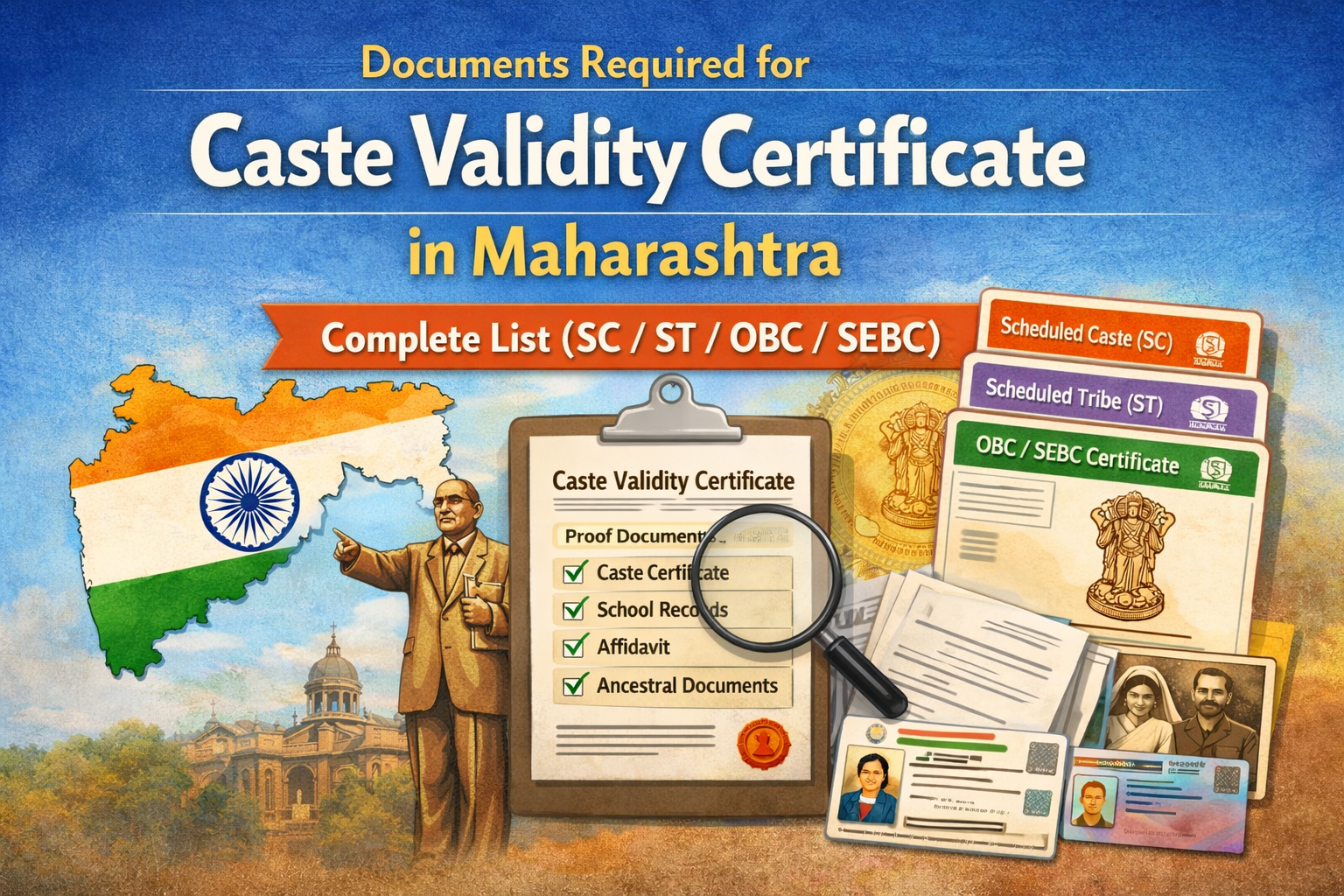
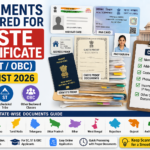
If you belong to a reserved category in Maharashtra — SC, ST, OBC, VJ/NT, SBC, or SEBC — there’s a document that matters even more than your basic caste certificate: the Caste Validity Certificate (CVC). Without it, your admission to a professional course, your government job appointment, or your election candidature can be cancelled — even if you have a valid caste certificate in hand.
This guide,” Documents required for caste validity certificate Maharashtra,” covers every document you need, category-wise, straight from official Maharashtra government sources. No outdated lists, no guesswork.
What Is a Caste Validity Certificate — and Why Is It Different from a Caste Certificate?
Many people confuse these two documents. Here’s the clear distinction:
A Caste Certificate is issued by the Tehsildar or the Revenue Department. It simply states which caste or tribe you belong to.
A Caste Validity Certificate is issued by the District Caste Certificate Scrutiny Committee after a detailed verification process. A Caste Certificate verifies an individual’s community affiliation, while a Caste Validity Certificate confirms the authenticity of the Caste Certificate. GKToday CVCs are mandatory for anyone from a reserved category applying for government jobs, professional course admissions (engineering, medical, law), or elections.
Candidates belonging to SC, VJ/DT, NT(A/B/C/D), OBC, SBC, and SEBC categories are required to produce a “Caste Validity Certificate,” while ST category candidates must submit a “Tribe Validity Certificate.” Maharashtra CET If you cannot produce either document at the time of scrutiny, you will be treated as a General category candidate. Maharashtra CET
Who Must Apply for a Caste Validity Certificate?
The Caste Validity Certificate is required for:
Education: Professional courses after Std. X/XII, Government of India scholarships, tuition fee and examination fee benefits, admission under the reserved category quota
Government Service: Promotion in the reserved category, new appointment in the reserved category
Other: MHADA, CIDCO/HUDCO, Petrol Pump allotments, Gas Agency allotments, court-referred cases, CCVIS
Where to Apply
Applications are submitted through the official BARTI CCVIS portal: bartievalidity.maharashtra.gov.in
After filling the online form and uploading scanned documents, take a printout and submit it along with original documents (or self-attested copies) to the respective District Caste Certificate Scrutiny Committee. CCVIS
The committee shall take its decision and issue the Validity Certificate within 3 months from submission, with an additional 2-month extension in exceptional circumstances. CCVIS
Complete Document Checklist
Section A — Primary Mandatory Documents (ALL Required)
These are non-negotiable for every applicant, regardless of category:
1. Caste Certificate of the Applicant: Your original caste certificate issued by the competent Revenue authority (Tehsildar). This is the base document the committee will be validating.
2. Affidavit in Specimen Form 17 (Rule 14) A sworn affidavit by the applicant in the prescribed format. Download the template from the BARTI CCVIS portal under the “Downloads” section.
3. Affidavit in Form-3, Rule 4(1) — Claimant/Parent Affidavit A separate sworn affidavit by the applicant’s parent or the claimant themselves, as prescribed.
4. Form-15A — Principal’s Certificate A certificate to be given by the Principal of the school or college where the applicant is enrolled or was last enrolled. CCVIS This form is also downloadable from the CCVIS portal.
5. Applicant’s Recent Passport-Size Photograph (JPG/JPEG format, maximum 50KB)
6. Applicant’s Signature (JPG/JPEG format, maximum 20KB — upload online only)
7. Parent’s Signature (JPG/JPEG format, maximum 20KB — upload online only)
Pro tip: All PDF uploads must be under 2MB. Scan at 150 DPI for the right file size.
Section B — Ancestral Caste Proof (Secondary Evidence — Any ONE Required)
This is the most critical and often most difficult part of the application. You must submit at least one document that proves your caste claim existed prior to the “deemed date” for your category.
The Deemed Dates are:
Scheduled Castes (SC): Prior to 10th August 1950
Scheduled Tribes (ST) / NT(A): Prior to 1953
OBC / SBC / EBC: Prior to 1967
These ancestral proofs — 1950 for SC/NT, 1953 for ST/NT(A/B/C/D), and 1967 for OBC/SBC/EBC — must be established from ancestral records where available. Google Sites
Acceptable ancestral documents (any one):
1. Birth Certificate of Applicant or Paternal Ancestor: Certified copy of birth certificate of the applicant, or their father, real elder uncle, real aunt, or grandfather (from paternal side), issued by a competent authority, dated prior to the deemed date.
2. Primary School Leaving Certificate Certified copy of the applicant’s own primary school leaving certificate or school register extract — OR those of the applicant’s father or paternal grandfather/uncle/aunt.
3. Village Extract (Form No. 14) / Kotwar Book / Nationality Register If relatives from the paternal side are illiterate, birth/death extracts of the father, real elder uncle, real aunt, or grandfather from the paternal side can be submitted as issued by the competent authority through Village Extract No. 14, Kotwar Book, or Nationality Register. CCVIS
4. Revenue Records / Old Purchase or Sale Deeds Old purchase or sale deeds in which the caste is mentioned, registered before the deemed date, for land, house, or other immovable property, or mortgage deeds, agreements, or inam sanads through which rights have been transferred. CCVIS
5. Village Mutation Register Extract Entry of caste in the extract of Village Mutation Register, documents in Format ‘Ka’, ‘Da’, ‘Ee’, entries of caste of blood relatives from the paternal side mentioned in old court proceedings.
6. Census Records: Entries of caste in Census records entered before the deemed date.
7. Inam Land Records (Directorate of Archives) Documents related to inam land available in the records of the Directorate of Archives, revealing evidence of caste, such as written statements, oral evidence, pursis, genealogy, etc. CCVIS
8. Tenancy Documents (Maharashtra Tenancy and Agricultural Lands Act) Sanad or proceedings before the deemed date in which the tenant was declared landlord under the Maharashtra Tenancy and Agricultural Lands Act (LXVII of 1948) or any other law, revealing the entry of caste. CCVIS
9. Government/Semi-Government Certificates Government or semi-government certificates containing the traditional occupation of the caste in the old caste system in respect of ancestors from the paternal side, recorded before the deemed date.
10. National Registration Book Entry: Entry of caste of blood relatives from the paternal side in the National Registration Book, mainly applicable from the Aurangabad Revenue Division.
11. College Identity Card: Attested Xerox copy of an identity card issued by the college (if caste is mentioned).
Section C — Additional Documents for Specific Categories
For OBC / SEBC / VJ-NT / SBC Applicants: You must also submit a Non-Creamy Layer (NCL) Certificate valid for the current financial year, issued by the competent Sub-Divisional Officer. All Backward Class candidates, excluding SC and ST, must produce a Non-Creamy Layer certificate valid up to 31st March 2026. Mahacet
For SEBC (Maratha/Kunbi) Applicants: The SEBC Reservation Act, 2024, implemented on 26 February 2024, provides 10% reservation for SEBC candidates. Students from the Kunbi, Kunbi-Maratha, and Maratha-Kunbi communities recognised as part of the OBC category following recommendations dated 7 September 2023 are eligible for caste certificates. Target Learning Ventures Applicants in this category may need to submit genealogy (वंशावळ) or village records showing the Kunbi/Maratha-Kunbi lineage.
For ST Applicants: The document is called a Tribe Validity Certificate (not a Caste Validity Certificate). The same process applies, but is scrutinised by the Tribe Validity Committee.
People Also Ask — Answered
Q: What is the difference between a caste certificate and a caste validity certificate in Maharashtra? A caste certificate states which caste you belong to (issued by the Tehsildar). A caste validity certificate is issued by the District Scrutiny Committee after verifying that your caste certificate is genuine and supported by ancestral evidence prior to the deemed date.
Q: How long does it take to get a caste validity certificate in Maharashtra? The District Caste Certificate Scrutiny Committee must issue its decision within 3 months from the date of application submission, with a possible additional 2-month window in exceptional cases. CCVIS
Q: Can I get the caste validity certificate online in Maharashtra? Yes. Apply at bartievalidity.maharashtra.gov.in. In valid cases, you will receive the Validity Certificate with an e-Signature to your registered email address, and it can also be downloaded from Digilocker. CCVIS
Q: What is the deemed date for OBC caste proof in Maharashtra? The deemed date for OBC/SBC/EBC proof is 1967. Google Sites For SC it is 1950, and for ST/NT(A) it is 1953.
Q: What happens if I don’t submit my caste validity certificate on time for college admission? Failure to submit the caste validity certificate may result in cancellation of admission. The Maharashtra CET Cell has repeatedly warned that candidates who fail to produce the certificate within the given deadline will be treated as General category candidates. The Free Press Journal
Q: What if I don’t have any ancestral documents before the deemed date? If any of the above documents are not available, other relevant documents may be attached. Any document supporting the caste claim from a blood relative on the paternal side may be considered. CCVIS Consult your District Scrutiny Committee for guidance.
Q: Is Form-15A mandatory? Yes. Form-15A is a certificate to be given by the Principal of the school or college and is listed as a mandatory primary document. CCVIS
Quick Summary Table
Document
Category
Mandatory?
Caste Certificate (Applicant)
All
✅ Yes
Affidavit Form 17 (Rule 14)
All
✅ Yes
Affidavit Form 3 Rule 4(1)
All
✅ Yes
Form-15A (Principal’s Certificate)
All
✅ Yes
Photo & Signatures
All
✅ Yes
Ancestral proof (pre-deemed date)
All
✅ Any 1
Non-Creamy Layer Certificate
OBC/SEBC/VJ-NT/SBC
✅ Yes
Genealogy / Kunbi lineage record
SEBC (Maratha-Kunbi)
As applicable
Key Takeaways
The Caste Validity Certificate is not optional — it is mandatory for reservations in education, employment, and elections in Maharashtra.
The hardest part is producing ancestral proof prior to the deemed date — start gathering this early.
Apply at bartievalidity.maharashtra.gov.in and keep your application receipt safe; it serves as provisional proof while your certificate is being processed.
If you have secured a seat under the SEBC or OBC categories, check the CET Cell website for the latest CVC submission deadline for your academic year — missing it can cost you your admission. Target Learning Ventures
For technical support, contact the BARTI helpline: 18002330444 or email helpdesk@barti.in
Sources: BARTI CCVIS Official FAQ (bartievalidity.maharashtra.gov.in), Maharashtra CET Cell official notices, Government of Maharashtra Department of Social Justice and Special Assistance