If you belong to the SC ST community and dream of cracking UPSC, this article, “daily routine upsc topper sc st Community,” is written for you.
You already know the journey is not easy. Limited resources, family pressure, financial struggles, and, in many cases, being the first person in your family to even attempt this exam. But here is the truth: toppers from SC ST backgrounds have cracked UPSC before, and they will again — including you.
Tina Dabi, who belongs to the Scheduled Caste community, became AIR 1 in UPSC 2015. Hitesh Kumar Meena from the Meena Scheduled Tribe community of Rajasthan cracked it with sheer grit. Anil Basak, an SC candidate, secured Rank 45 in the general category, not even the reserved list.
These are not luck stories. These are daily routine stories.
Let’s break down exactly how a UPSC topper from the SC ST community structures their day.
Why a Daily Routine Matters Even More for SC ST Aspirants
Most SC and ST aspirants don’t have access to expensive coaching institutes, study rooms, or unlimited study material. Your daily routine becomes your most powerful tool. It is how you compete on equal terms — and often surpass — those with far more resources.
A consistent routine of 8–10 hours of focused study beats 14 hours of distracted study every single time.
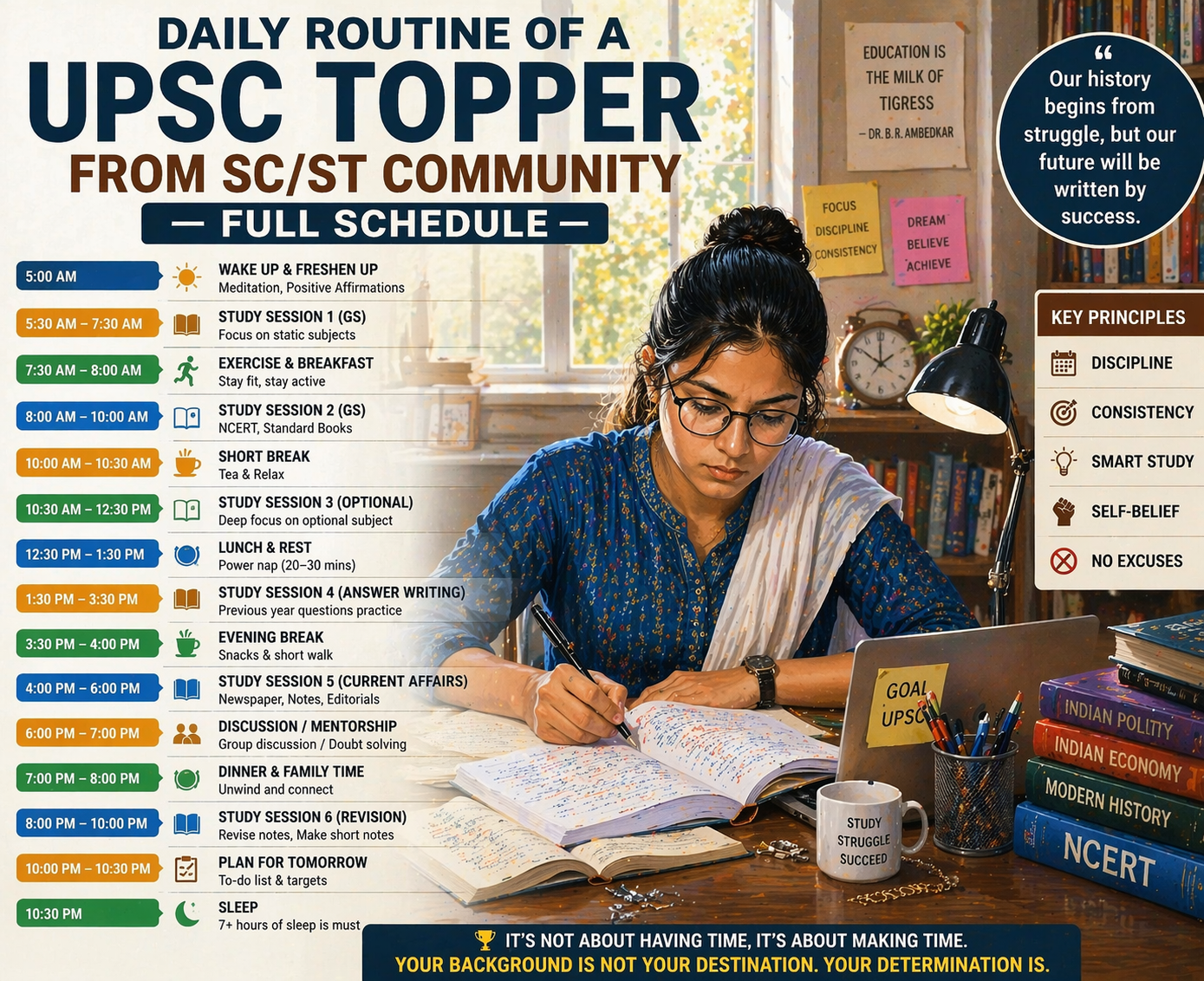
Full Daily Schedule of a UPSC Topper from the SC ST Community
Here is a practical, hour-by-hour routine used by successful SC, ST UPSC toppers. Adapt it to your life, but stay as close to the structure as possible.
🕔 5:00 AM — Wake Up and Morning Routine (30 minutes)
Start your day early. Most UPSC toppers wake up between 5:00 AM and 5:30 AM. The morning is peaceful, distractions are zero, and your mind is fresh.
Freshen up, drink water
10 minutes of light stretching or yoga
No phone, no social media
This is not negotiable. Your morning sets the tone for everything that follows.
🕔 5:30 AM – 7:30 AM — First Study Block: High-Priority Subjects (2 Hours)
Your brain is sharpest in the morning. Use this time for your toughest subjects — History, Polity, Geography, or your Optional subject.
What to do:
Read from a standard book (NCERT or Lakshmikant for Polity)
Make short notes as you read
Do not spend more than 2 hours here without a break
SC ST toppers like Hitesh Meena credit early morning study sessions as the backbone of their preparation.
🕔 7:30 AM – 8:15 AM — Newspaper + Current Affairs (45 Minutes)
Read The Hindu or Indian Express — not to read every word, but to identify:
Government schemes (especially SC ST welfare schemes — these appear in GS Paper 2)
Environmental news for GS Paper 3
International affairs
Pro Tip for SC ST aspirants: Pay special attention to news related to tribal rights, Scheduled Area laws, PESA Act, Forest Rights Act. This is your lived context — it becomes your strength in the interview and Mains.
🕔 8:15 AM – 9:00 AM — Breakfast and Physical Activity (45 Minutes)
Eat a proper meal. Take a 20-minute walk. Do not skip this.
Mental endurance in UPSC is physical, too. Toppers consistently report that light exercise improves their concentration and keeps burnout away. You are preparing for a marathon, not a sprint.
🕔 9:00 AM – 12:00 PM — Second Study Block: GS Deep Dive (3 Hours)
This is your longest and most productive block of the day.
Use the Pomodoro Technique — study for 50 minutes, rest for 10 minutes.
Rotate subjects across days:
Monday/Thursday: GS Paper 1 (History, Geography, Culture)
Tuesday/Friday: GS Paper 2 (Polity, Governance, IR)
Wednesday/Saturday: GS Paper 3 (Economy, Environment, Science)
Sunday: Revision + Mock Test
Focus on understanding concepts, not rote memorisation. Link what you study to real issues in your community. This is what makes SC ST toppers stand out in their answers.
🕔 12:00 PM – 1:00 PM — Lunch and Rest (1 Hour)
Have a full meal and rest. A 20–30 minute nap is completely fine. It actually improves afternoon performance.
Do not feel guilty for resting. Rest is part of the routine, not a break from it.
🕔 1:00 PM – 3:00 PM — Third Study Block: Optional Subject (2 Hours)
Your optional subject is where you can score maximum marks. Give it a dedicated afternoon time every day.
Complete one chapter or topic
Make structured notes
Relate optional topics to GS wherever possible (e.g., Sociology optional connects beautifully with GS Paper 1 society topics)
Many SC and ST toppers choose Sociology, Political Science, or History as the optional subjects they are already familiar with from their background.
🕔 3:00 PM – 3:30 PM — Short Break
Step away from the desk. Walk outside. Drink water. Call a family member.
Mental health is not a bonus — it is a requirement. The UPSC journey is 12–18 months long. You have to protect your mind.
This is the single habit that separates toppers from non-toppers.
Write at least 2 answers every day. Start with the previous year’s questions. Use the following structure:
Introduction (2–3 lines)
Body with subheadings
Conclusion with a way forward
SC ST aspirants often have real, on-ground knowledge of governance failures, tribal land rights, Dalit welfare programs, and rural economy. Use that knowledge in your answers. It shows authenticity and depth that no coaching material can teach.
🕔 5:30 PM – 6:30 PM — Evening Revision (1 Hour)
Revise whatever you studied in the morning. Memory science shows that reviewing within 12 hours of first reading increases retention by over 60%.
Use your short notes. Read them aloud if needed.
🕔 6:30 PM – 7:30 PM — Free Time and Dinner
Spend time with family. Eat dinner. Relax completely. This is not wasted time — this is when your brain consolidates what you learned.
🕔 7:30 PM – 9:00 PM — Night Study Block: Current Affairs + Test Series (1.5 Hours)
Review your current affairs notes from the morning
Attempt 20–30 MCQs on any topic
Check your weak areas and mark them for revision
Do not start new topics at night. Nighttime is for reinforcement, not new learning.
🕔 9:00 PM – 9:30 PM — Plan Tomorrow
Before you sleep:
Write down 3 goals for tomorrow
Review today’s study log
Keep your books and notes ready for the next morning
This small habit removes decision fatigue and makes mornings smoother.
🕔 10:00 PM — Sleep
Sleep 7–8 hours. Non-negotiable. Sleep is when your brain stores memory. Cutting sleep to “study more” is one of the biggest mistakes aspirants make.
Weekly and Monthly Targets for SC ST UPSC Aspirants
Period
Goal
Weekly
Finish one GS paper, complete the optional unit, revise all current affairs
Monthly
Full mock test, self-assessment, and adjust weak areas
Every 3 months
Finish one GS paper, complete the optional unit, and revise all current affairs
Special Advice for SC ST Aspirants
1. Use your reservation age benefit wisely. SC ST candidates get up to 37 attempts (general: 32) with more age limit relaxation. Plan thoughtfully — do not rush, but do not delay either.
2. Your lived experience is an asset. When writing answers on tribal rights, SC welfare, land reforms, or social justice, you have real knowledge. Use it confidently.
3. Connect with SC, ST, and UPSC communities. Join online groups like SC ST IAS aspirant forums. Share resources, notes, and moral support. You are not alone in this journey.
4. Free resources are enough. NCERT books (free online), The Hindu e-paper (available at libraries), PRS Legislative Research (free online), government reports — these are exactly what toppers use.
5. Believe the examples already set. Tina Dabi. Anil Basak. Hitesh Meena. Ansar Ahmad Shaikh. Every single one of them had obstacles you can recognise. And every one of them followed a disciplined daily routine.
Final Words
The daily routine of a UPSC topper from the SC ST community is not magic. It is 5 AM wake-ups, 8–10 focused hours, consistent answer writing, and protecting your sleep and mental health — day after day, month after month.
You do not need a perfect study room. You do not need the most expensive coaching. You need a plan, a routine, and the belief that your background is your strength — not your obstacle.
The IAS exam has been cracked by people with less than what you have. It has been cracked by people who sat under streetlights to read, who borrowed books from libraries, who worked part-time and studied in between.
Your daily routine starts today.
This article is written to support UPSC aspirants from the SC and ST communities with practical, experience-backed guidance. Share it with anyone who needs this push.