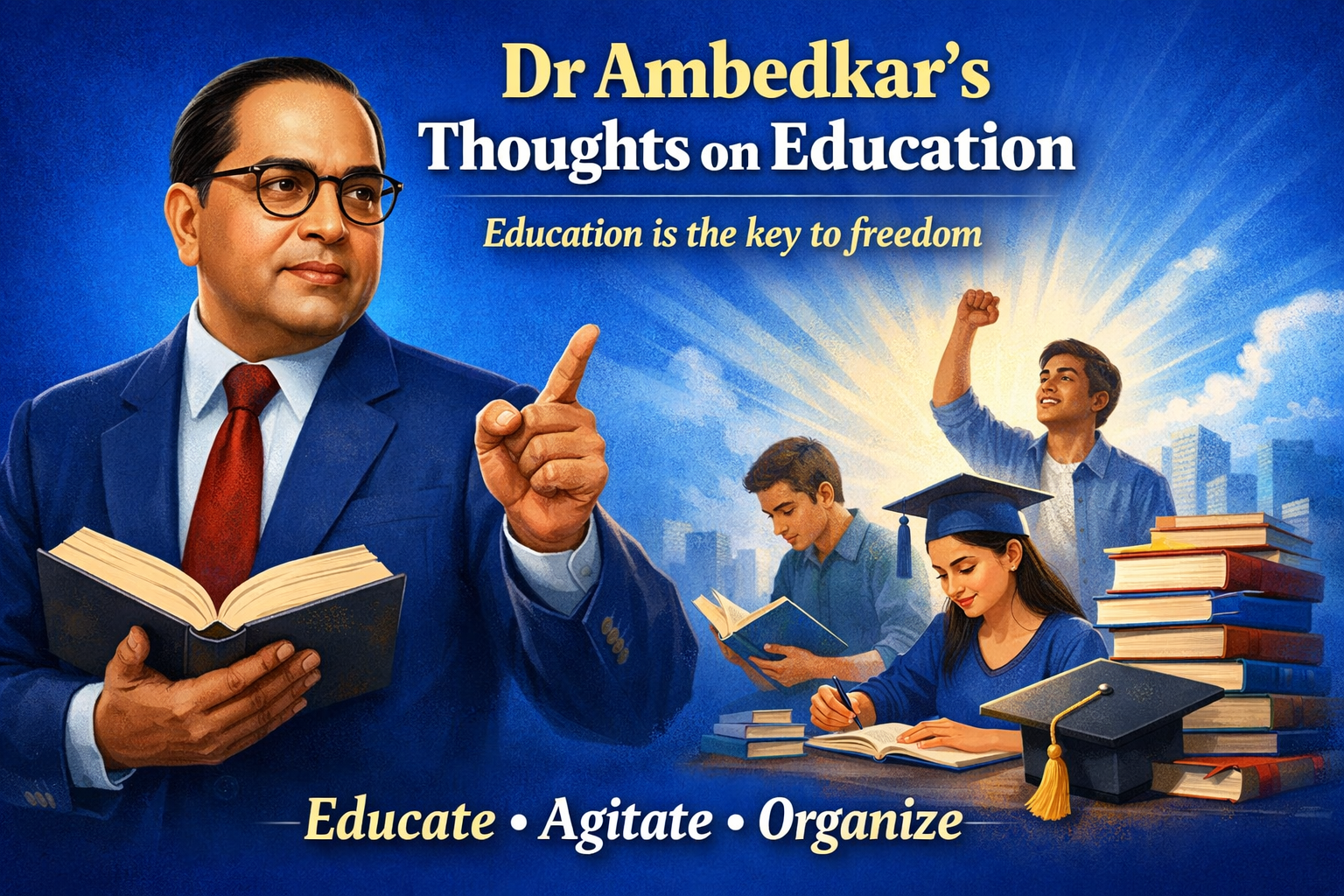
According to Dr. Ambedkar, education was the main key to open the doors of light, vision, and wisdom. He believed that education and society have a bounded relationship — the progress and development of society is possible only through education.
But Ambedkar’s view on education went much deeper than just going to school and getting a degree.
In ambedkar thoughts on Education. He saw education as having three jobs at the same time:
Job 1 — Personal liberation. Education makes a person fearless. It teaches them their rights. It pulls them out of the darkness of ignorance into the light of awareness.
Job 2 — Social change. Education is not just for the individual — it is a tool that transforms entire communities. A community that is educated can demand equality. A community that is not educated can be exploited indefinitely.
Job 3 — Political power. Ambedkar motivated Dalits to merge with the upper caste in social, economical, and political aspects through the slogan of educate, agitate, and organize. For him, education was the first step toward claiming political power — not the last.
The main key to unlocking the gates of light, vision, and wisdom, according to Dr. B.R. Ambedkar, was education. His fundamental message to the nation and society is to “take education, be united, and do the struggle.”
2. Ambedkar’s Most Powerful Quote on Education
Of all the things Ambedkar said about education, this one quote stands above everything else:
“Education is tigress’s milk — whoever drinks it will surely growl like a tiger.” — Dr. B.R. Ambedkar
Read that again slowly.
He did not say education is good. He did not say education is helpful. He said education is tigress’s milk — the most powerful nourishment in nature. And whoever drinks it will roar.
This quote comes from a man who was once denied a glass of water. The same man earned a PhD from Columbia University, a DSc from the London School of Economics, and went on to write the Constitution of the world’s largest democracy.
He drank the tigress’s milk. He roared. Loud enough for an entire nation to hear.
3. What Does “Educate, Agitate, Organize” Really Mean?
The full meaning of Ambedkar’s slogan is: educate yourself first, raise awareness about the issues that surround you, and then come together to bring about change.
Most people think this is just a protest slogan. It is not. It is a complete action plan — three steps that build on each other:
Step 1 — EDUCATE: Before you can fight for anything, you must know what you are fighting for. Read. Study. Learn your rights. Understand the Constitution. Know history. An uneducated person can be easily tricked, manipulated, and silenced.
Step 2 — AGITATE: Once you are educated, you cannot stay silent about injustice. Speak up. Write. Raise your voice. Agitation does not mean violence — it means refusing to accept a wrong quietly. He believed that education can act as a change agent to bring equality in society.
Step 3 — ORGANIZE: One voice is easy to ignore. A thousand voices together are impossible to ignore. Build communities. Join student groups. Support each other. Political power comes from organisation — not from isolated individuals.
This three-step process is as relevant in 2026 as it was in 1942 when Ambedkar first delivered these words at the All India Depressed Classes Conference in Nagpur.
4. 30+ Dr. Ambedkar Quotes on Education (With Meaning)
Here is the most complete collection of Dr. Ambedkar quotes on education — with simple explanations for each one.
On the Purpose of Education
“Cultivation of mind should be the ultimate aim of human existence.” Meaning: The most important thing a human being can do in life is grow their mind. Everything else — money, status, power — comes second.
“The purpose of education is to moralise and socialise the people.” Meaning: Education is not just about getting marks or a job. It must make you a better, kinder, and more responsible human being.
“Education is something that ought to be brought within the reach of everyone.” Meaning: Education is not a privilege for the rich. It is a right for every human being.
“Education is not only the birthright of every human being but also the weapon of social change.” Meaning: You were born with the right to study. And when you use that right, you change society.
“Education is what makes a person fearless, teaches him the lesson of unity, makes him aware of his rights, and inspires him to struggle for his rights.” Meaning: Fear comes from ignorance. Education destroys fear — and replaces it with courage.
On Knowledge and Reading
“I like the cohabitation of books more than the cohabitation of people.” Meaning: Babasaheb loved books so deeply that he preferred their company to most people. His personal library, Rajgrah, had over 50,000 books.
“Men are mortal. So are ideas. An idea needs propagation as much as a plant needs watering. Otherwise, both will wither and die.” Meaning: Good ideas die when people stop sharing them. Share what you learn. Teach others. Keep ideas alive.
“What could be more gratifying than to gradually increase your own knowledge?” Meaning: Nothing in life gives more satisfaction than learning something new. Make this your daily habit.
“Knowing that education is the way to progress in life, students should study hard and become loyal leaders of society.” Meaning: Study hard — not just to get a job, but to become someone who can lead and serve their community.
On Students and Character
“You got educated, doesn’t mean everything is done. There is no doubt in the importance of education, but along with education, morality should also improve. Without morality, the value of education is zero.” Meaning: Getting a degree is not enough. If your character is weak, your education is useless. Be a good human being first.
“Learn to be clean and free from all vices. Educate your children. Slowly instill ambition in their mind. Assure them that they are going to be great people. Destroy their inferiority complex.” Meaning: Tell your children they are capable of greatness. Do not let them believe they are less than anyone else.
“We must stand on our legs. We must depend on our strength. The best way to do so is through education.” Meaning: Do not wait for anyone to rescue you. Educate yourself — and stand up on your own.
“One cannot be a leader unless one is educated.” Meaning: True leadership requires knowledge, wisdom, and the ability to think critically. Study if you want to lead.
“Be fearless and get the kingdom of the world — that is what I want to say to young students.” Meaning: Babasaheb’s direct message to every student: fear nothing. The world belongs to those who have the courage to learn and act.
“Be educated, be agitated, be organized, be confident, never give up — these are the five principles of our life.” Meaning: Five words. Five lifelong commitments. Print this and put it on your wall.
On Education and Social Justice
“What is the use of education if it does not help to uplift those who are downtrodden?” Meaning: Education must serve the weakest members of society — not just the privileged ones. If it doesn’t, it has failed its purpose.
“They cannot make history who forget history.” Meaning: To build a better future, you must know the truth about the past. Study history — especially the history of your community.
“Without education, freedom is meaningless.” Meaning: Political freedom means nothing if you cannot think freely. Real freedom lives in an educated mind.
“No plan for the future development of the country can be deemed complete that does not provide for technical and scientific training.” Meaning: Ambedkar argued this in 1945, and it is even more relevant today. Science and technology education must be accessible to every child.
5. Ambedkar’s Thoughts on Women’s Education
Ambedkar was one of the earliest Indian leaders to fight specifically for girls’ education — at a time when most male leaders said nothing about it.
“I measure the progress of a community by the degree of progress which women have achieved.” — Dr. B.R. Ambedkar
He strongly supported women’s education, believing that imparting knowledge to women meant educating an entire family.
“Educate your sons and daughters. Do not involve them in traditional business activities.” — Dr. B.R. Ambedkar (Mumbai, 13 July 1941)
He said this in 1941 — 85 years ago. He was asking parents to break the cycle of generational poverty by sending both sons and daughters to school instead of putting them to work.
If your sister, daughter, or mother is studying today, Ambedkar fought for that right decades before it became normal.
6. Ambedkar’s Thoughts on Primary Education
Ambedkar strongly believed that it is not enough to send children to school. It is also necessary to keep them connected to the school until they get a basic education. Just like planting trees is not enough, you must also irrigate them.
He said: “Universalisation of Primary Education is the basis for all-round national progress. There must therefore be a law for compulsory Primary Education.”
He was speaking in the Bombay Legislative Council as early as 1927, arguing that the government spends far more collecting excise tax from poor people than it spends educating their children. He argued that educational expenditure should be adjusted so that the government spends on the education of the people as much as it takes from them in the form of excise revenue.
Nearly 100 years later, dropout rates among SC/ST students remain high, which is exactly what Ambedkar warned would happen without proper investment in primary education.
7. Ambedkar’s View on Morality and Education
Dr. Ambedkar believed that social emotions should be taught to pupils through the educational process. To instill the ideas of liberty, equality, fraternity, justice, and moral character in boys and girls of all religions, regions, classes, and castes was the central goal of his educational philosophy.
He was very clear: marks and degrees are not enough.
He said: “Getting educated doesn’t mean everything is done. Along with education, morality should also improve. Without morality, the value of education is zero.”
A person who graduates from university but uses their education to exploit others has betrayed everything Ambedkar stood for. Education must produce good people — not just qualified ones.
8. How Ambedkar Lived His Educational Philosophy
Ambedkar did not just talk about education. He built it.
In 1924, he founded the Bahishkrit Hitkarini Sabha, whose fundamental aim was the spread of higher education among the depressed classes.
He founded the People’s Education Society in Bombay and Aurangabad to educate Dalit pupils. The society started Siddharth College of Law and Arts in Mumbai on 20 June 1946 and later Milind College in Aurangabad — both of which still function today and have educated thousands of Dalit students.
He personally studied for 18 hours a day during his time at the London School of Economics — completing what was normally 8 years of study in just 2 years and 3 months.
His personal library, Rajgrah, had over 50,000 books — and he was known as the Symbol of Knowledge, mastering 64 different subjects.
He did not just preach education. He was its most extreme practitioner.
9. Ambedkar Quotes on Education for Instagram and WhatsApp
Looking for short, powerful quotes for your Instagram bio, WhatsApp status, or Ambedkar Jayanti posts?
Quote
Best For
“Education is tigress’s milk — whoever drinks it will growl like a tiger.”
Instagram caption, profile bio
“Educate, Agitate, Organize.”
Protest post, Jayanti caption
“Cultivation of mind should be the ultimate aim.”
Study motivation story
“Without education, freedom is meaningless.”
Republic Day, Constitution Day
“Be educated, be agitated, be organized, be confident, never give up.”
Motivational WhatsApp status
“They cannot make history who forget history.”
History quote, awareness post
“What is the use of education if it does not uplift the downtrodden?”
Social justice caption
“One cannot be a leader unless one is educated.”
Leadership motivation post
Hashtags to use: #AmbedkarQuotes #EducateAgitateOrganize #JaiBhim #Babasaheb #AmbedkarJayanti #DalitStudents #JayBhimWorld
10. Frequently Asked Questions
What was Ambedkar’s view on education?
Dr. Ambedkar believed education was the most powerful tool for social liberation and personal empowerment. He said education was the birthright of every person, regardless of caste, gender, or religion. He viewed education as having three roles: making individuals fearless and aware of their rights, bringing about social equality, and enabling political power for marginalised communities. His complete philosophy can be summarised in three words: Educate, Agitate, Organize.
What does “Educate Agitate Organize” mean?
Educate means gaining knowledge about your rights and your history. Agitate means speaking up against injustice — refusing to stay silent once you know the truth. Organize means building collective power with other people who share your goals. Ambedkar first gave this slogan at the All India Depressed Classes Conference in Nagpur in 1942. He meant it as a three-step process for the liberation of Dalit and marginalised communities through peaceful, intellectual action.
What did Ambedkar say about women’s education?
Ambedkar was one of India’s earliest champions of women’s education. He said: “I measure the progress of a community by the degree of progress which women have achieved.” He believed that educating a woman means educating an entire family. In 1941, he publicly told parents, “Educate your sons and daughters. Do not involve them in traditional business activities.” He also wrote the Hindu Code Bill (1951) to give women legal rights to property, divorce, and marriage — all of which required women to be educated to exercise those rights.
What are the most famous Ambedkar quotes on education in English?
The most famous Ambedkar quotes on education include: “Education is tigress’s milk — whoever drinks it will surely growl like a tiger,” “Cultivation of mind should be the ultimate aim of human existence,” “Educate, Agitate, Organize,” “Purpose of education is to moralise and socialise the people,” and “Without education, freedom is meaningless.” These quotes are used in schools, universities, UPSC answers, and social media posts across India every day.
Did Ambedkar build any educational institutions?
Yes. Dr. Ambedkar founded the Bahishkrit Hitkarini Sabha in 1924 to spread education among the Scheduled Caste communities. He established the People’s Education Society in 1945, which set up Siddharth College of Law and Arts in Mumbai (1946) and Milind College in Aurangabad — both of which still operate today. He personally maintained a library of over 50,000 books at his home, Rajgrah, and studied for 18 -21 hours a day throughout his academic career.
Conclusion
Dr. Ambedkar was the most educated Dalit in the world — not because he was lucky, but because he fought for every single book, every single degree, and every single right to learn.
He studied when the world told him to sit down. He learned when the world told him he had no right to know. He used that knowledge to write the document that gave every Indian citizen — including you — the right to education, equality, and dignity.
His thoughts on education are not just inspiring quotes for Instagram. They are a life map — a step-by-step guide for how a person who starts with nothing can end up changing everything.
Pick up that book. Turn on that lamp. Drink the tigress’s milk.
Jay Bhim In recent years, the phrase “Jai Bhim” has become a powerful slogan representing the struggle for social justice, equality, and the rights of marginalized communities in India. Derived from the name of Dr. B.R. Ambedkar, the chief architect of the Indian Constitution and a champion of Dalit rights, “Jai Bhim” is more than…
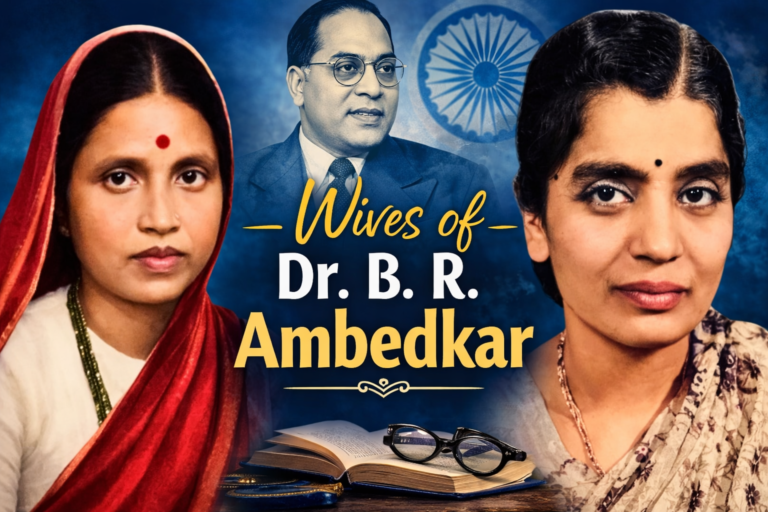
Dr. B.R. Ambedkar had two wives — Ramabai and Savita. Both women were extraordinary. Both loved him deeply. And both played a role in shaping the man who gave India its Constitution. Most people know Babasaheb’s public life — the protests, the Constituent Assembly, the Constitution. But very few know the private story. Like about…
The Wheels of Jay Bhim Picture a dusty Mumbai road, a Jay Bhim flag fluttering, and a car carrying Dr. B.R. Ambedkar—Babasaheb—speeding toward a rally for Dalit rights. Dr. Babasaheb Ambedkar car collection sparks curiosity, but it’s more than metal and wheels. It’s a symbol of his journey from a Mahar Dalit boy to the…
On 25 November 1949, Dr. B.R. Ambedkar stood before the Constituent Assembly of India and delivered what many call the greatest speech in Indian parliamentary history. He had just spent 2 years, 11 months, and 18 days writing the Constitution of the world’s most populous democracy — while fighting diabetes, near-blindness, and crippling pain. He…
More Than Just a Life Story When we think of autobiographies, we imagine personal stories of success and struggle. But Dr. B.R. Ambedkar autobiography book is different—it’s not just his life story; it’s the story of millions of oppressed Indians fighting for dignity. Unlike Gandhi’s “The Story of My Experiments with Truth”, Ambedkar’s autobiographical writings are scattered across speeches,…
Why Talk About Ambedkar and Shivaji Maharaj Together? When we think of the most powerful and inspiring leaders in Indian history, two names shine bright—Dr. Babasaheb Ambedkar and Chhatrapati Shivaji Maharaj. Though they lived in different times—Shivaji Maharaj in the 1600s and Dr. Ambedkar in the 1900s—they both stood for justice, equality, and freedom. Their…