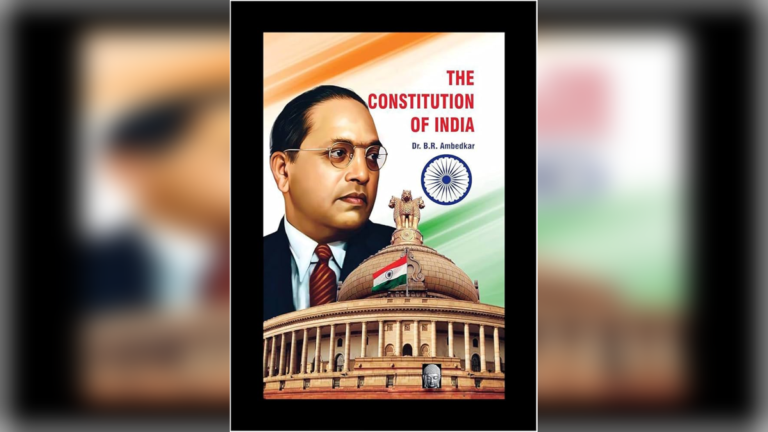
Long before “women’s empowerment” became a hashtag, one man was building the legal, social, and educational foundations for it — and paying a personal price to do it.
A note on this article: The views and facts presented here draw directly from Dr. Ambedkar’s own speeches, his writings in Bahishkrit Bharat and Mooknayak, the Indian Constitution he drafted, and verified historical records. This is not opinion — it is documented history that deserves to be better known.
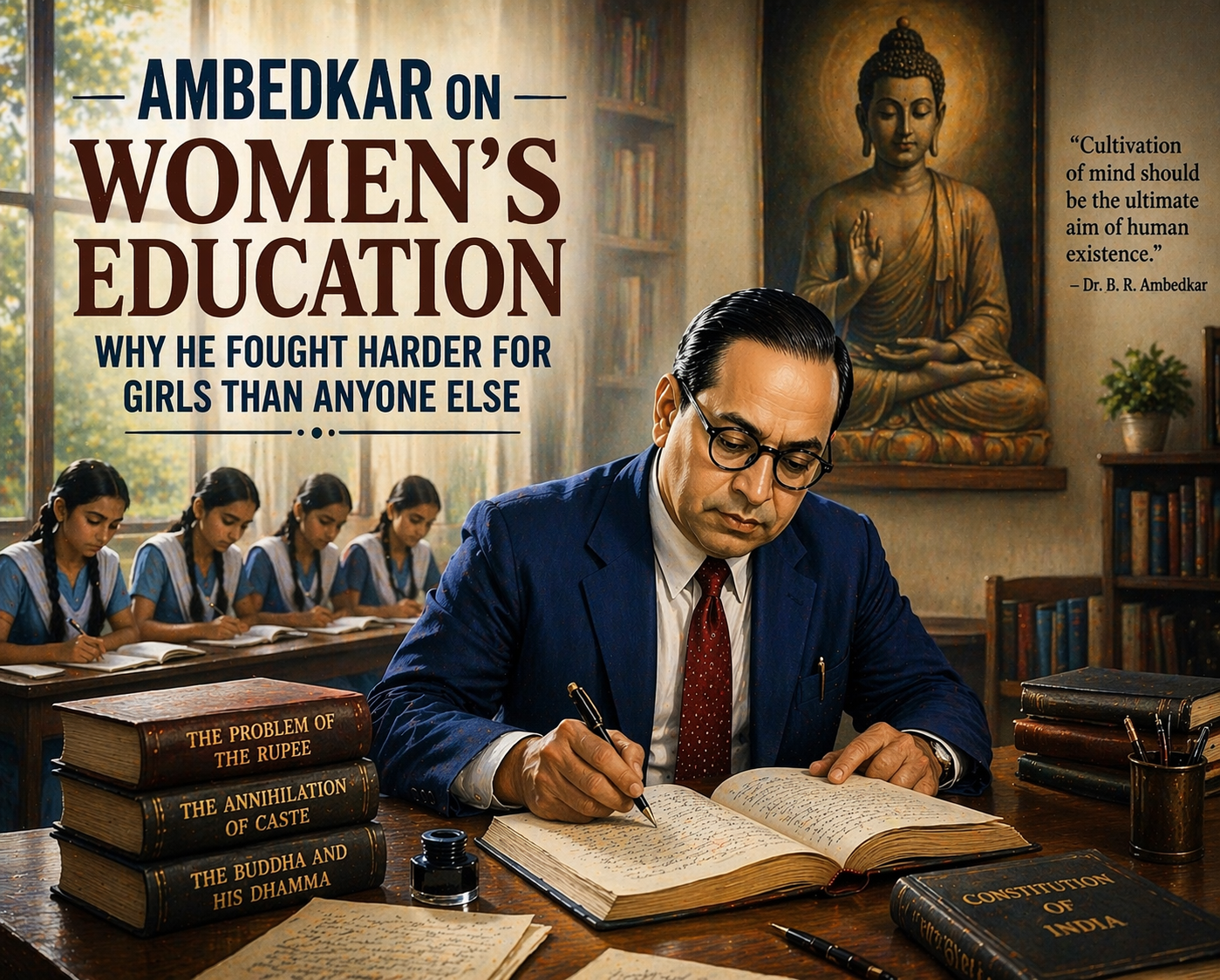
When people talk about Dr. B.R. Ambedkar, they usually talk about the Constitution, about caste, about reservations. What they don’t talk about — nearly enough — is how deeply and practically he fought for women’s education and rights at a time when almost no one else did.
Not as a talking point. Not as a footnote to his larger work. But it was a central belief that shaped everything from the newspapers he ran to the laws he wrote.
If you want to understand Ambedkar on women’s education, you need to go back to what he actually said, what he actually did, and why it still matters today.
Let’s start with his words, because Ambedkar’s words were never decorative. There were arguments.
In 1920, as a young man just returned from his studies abroad, Ambedkar wrote: “We shall see better days soon, and our progress will be greatly accelerated if male education is pursued side by side with female education.”
This wasn’t a gentle suggestion. He was saying, plainly, that educating only boys was a half-measure — and that a community could not truly progress while its women remained shut out of learning.
Later, one of his most famous declarations cut even deeper: “Unity is meaningless without the accompaniment of women. Education is fruitless without educated women. And agitation is incomplete without the strength of women.”
Read that slowly. He wasn’t saying women should be included in education as an afterthought. He was saying that without women’s education, nothing — not movements, not reform, not liberation — means anything at all.
Why He Saw Women’s Education as the Key to Everything
Ambedkar understood something that took the rest of the world decades to catch up to: the oppression of women and the oppression of caste were not separate problems.
In his work The Rise and Fall of Hindu Woman, he traced the denial of women’s education directly to the Manusmriti, which declared that women had no right to study the Vedas. He showed, using historical evidence from the Atharvaveda and Shrauta-sutras, that this had not always been the case — that women like Gargi, Maitreyi, and Vidhyadhari had been celebrated intellectuals in the pre-Manu era.
He argued that Manu’s laws didn’t just oppress lower castes — they systematically stripped women of their right to knowledge, and those two oppressions worked together to keep millions of people powerless.
This is why his push for women’s education wasn’t a side project. It was the core of his vision for India.
He Didn’t Just Talk — He Built Platforms for Women
In 1920, Ambedkar launched his newspaper Mooknayak (Voice of the Voiceless). In 1927, he launched Bahishkrit Bharat (Outcast India). Both publications, at a time when newspapers rarely covered women’s issues at all, made women’s education and empowerment regular, prominent themes.
On 3 February 1928, he wrote directly in Bahishkrit Bharat: “Knowledge and learning are not for men alone; they are essential for women too… if you want sudhaaranaa (improvement) for future generations, educating girls is very important. You cannot afford to forget my speech or to fail to put it into practice.”
He wasn’t writing to academics or politicians. He was writing to ordinary women from marginalised communities — women who had likely never been told that their minds mattered.
In 1927, he addressed a gathering of around three thousand women from the Depressed Classes. He told them: “I measure the progress of a community by the degree of progress which women have achieved.” He told them to send their children — daughters included — to school. He told them to remove inferiority complexes from their children’s minds. He told them they were destined to be great.
That speech, to three thousand women who had been told their whole lives that they didn’t matter, was not a speech. It was a revolution.
He Wrote Women’s Rights Into the Law of the Land
Words are powerful. But Ambedkar turned his words into law.
As the chairman of the Constitution Drafting Committee, he ensured that the Indian Constitution contained iron-clad protections for women’s equality in education and every other sphere:
Article 14 guarantees equality before the law for everyone, regardless of sex. Article 15 explicitly prohibits discrimination on the grounds of sex. Article 15(3) goes further: it allows the state to make special provisions in favour of women. Article 39 guarantees equal pay for equal work. Article 42 mandates humane working conditions and maternity relief.
These weren’t abstract ideals. They were Ambedkar’s vision for women, turned into enforceable rights.
Then came the Hindu Code Bill — perhaps his most courageous act. This legislation proposed to give Hindu women the right to divorce, the right to inherit property, and the right to remarry. It sought to establish monogamy as the only legal marriage system and delete caste-specific rules that kept women trapped.
The opposition was fierce. Conservative members of Parliament blocked it repeatedly. When the bill failed to pass in the form he intended, Ambedkar resigned as Law Minister in protest — a rare act of political sacrifice. In his resignation speech, he said plainly: “To leave inequality between class and class, between sex and sex, which is the soul of Hindu society, untouched… is to make a farce of our Constitution and to build a palace on a dung heap.”
He paid with his ministerial position. He didn’t blink.
The bill’s provisions were eventually passed through four separate Acts — including the Hindu Marriage Act of 1955 — and form the legal backbone of women’s property and marriage rights in India to this day.
The Maternity Benefit He Fought for in 1928
Here’s a piece of history that most people don’t know.
In 1928, as a member of the Bombay Legislative Council, Ambedkar advocated for paid maternity leave for women working in factories. This was 1928 — nearly a century ago — when the idea that a working woman deserved rest and financial support around childbirth was considered radical.
He argued that employers who profited from women’s labour had a responsibility to support them during maternity. He went further and said the government should also contribute, because protecting mothers was in the national interest.
In 1942, as Labour Minister in the Governor General’s Executive Council, he introduced the Maternity Benefit Bill, making that support a legal requirement. He also drafted the Mines Maternity Benefit Act, demanding equal wages and equal representation of women workers in welfare funds.
He believed in equal pay for equal work. He believed women had the right to control their own bodies. He believed that birth control was a woman’s right, not a moral failing.
For India in 1942, this was extraordinary.
25,000 Women Showed Up for Him
On 20 July 1942, the All India Dalit Mahila Conference was held in Nagpur. Twenty-five thousand women attended.
That number tells you everything about how deeply Ambedkar’s work had reached ordinary women. These were not urban elites. These were women from villages and working-class neighbourhoods who had been ignored by every political movement before Ambedkar came along.
He told them, “Learn to be clean. Keep free from all vices. Give education to your children. Instill ambition in them. Inculcate in their minds that they are destined to be great. Remove from them all inferiority complexes.”
He also inspired women to write plays, autobiographies, and essays. Tulsabai Bansode, inspired by Ambedkar’s movement, started her own newspaper, Chokhamela. Women who had never spoken in public began addressing press conferences.
Radhabai Vadale, encouraged by Ambedkar, addressed a press conference in 1931 — a watershed moment for Dalit women’s public voice.
Why This Still Matters Today
India in 2025 still has a gender gap in education. Girls in rural areas still drop out of school at higher rates than boys. Women from SC and ST communities still face the double burden of caste and gender discrimination.
Every government scheme that supports girls’ education — from the Beti Bachao Beti Padhao initiative to SC/ST scholarships for girls — traces its moral and legal foundation back to what Ambedkar built into the Constitution and fought for in Parliament.
When you see a Dalit girl from a village become a doctor or an IAS officer, that path was cleared — legally, constitutionally, philosophically — by a man who believed in her before she was even born.
Final Thought
Ambedkar’s position on women’s education was not a policy position. It was a moral conviction, acted upon at great personal cost, written into the fabric of the Indian state, and spoken directly to millions of women who needed to hear it.
He measured the progress of a community by how far its women had come. By that measure, we still have far to go. But the measuring stick itself — the very idea that women’s progress is how we judge society — that’s his gift to us.
Use it.
If this article helped you understand Ambedkar’s vision more deeply, share it with a student, a teacher, or anyone who cares about women’s education in India