By a Heritage & Social History Researcher | Updated: April 2026
If you are a follower of Babasaheb Dr. B.R. Ambedkar, a student of Indian history, or simply someone who wants to understand the soul of India’s social justice movement, then this guide is for you. These are not just tourist spots — they are living testimonies of one man’s extraordinary struggle against oppression, his academic brilliance, his spiritual awakening, and his enduring legacy as the chief architect of the Indian Constitution.
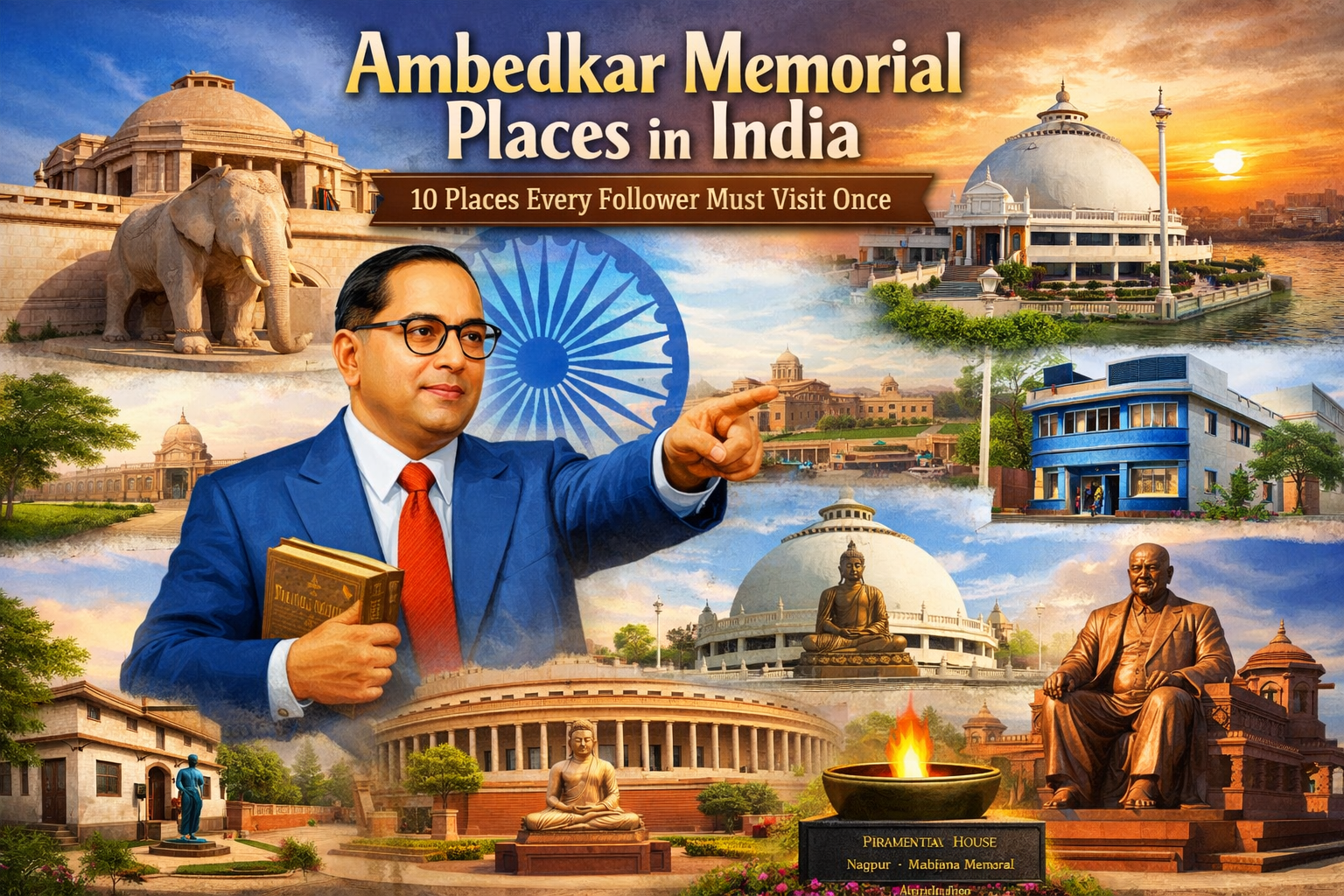
Prime Minister Narendra Modi coined the term “Panchteerth” to describe the five holiest sites associated with Dr. Ambedkar’s life. But across India, there are many more places that carry the weight of his memory. Here are the 10 essential Ambedkar memorial places India that every true follower must visit at least once in their lifetime.
Why you must visit: This is where Babasaheb rests.
Located beside Dadar Chowpatty beach in Mumbai, Chaitya Bhoomi is the most emotionally significant of all Ambedkar memorial places in India. It is built on the exact site where Dr. Ambedkar was cremated on December 6, 1956, and his ashes are enshrined here to this day. The two-storey stupa-shaped structure features a marble-floored circular sanctuary housing a bust of Ambedkar and a statue of Gautam Buddha. The main entrance gate is a replica of the famous Sanchi Stupa gateway.
Every year on Mahaparinirvan Diwas (December 6), millions of pilgrims descend on Dadar in what is arguably the largest peaceful gathering in the world. The Mumbai police deploy city-wide special arrangements to accommodate the sheer devotion on display.
Location: Dadar, Mumbai
Best Time to Visit: December 6 (Mahaparinirvan Diwas) or April 14 (Ambedkar Jayanti)
Entry: Free
2. Deekshabhoomi — Nagpur, Maharashtra
Why you must visit: This is where history was made.
On October 14, 1956, Dr. Ambedkar stood before approximately 400,000 followers and embraced Buddhism — one of the largest mass conversions in human history. This sacred ground in Nagpur is known as Deekshabhoomi (literally “ground of initiation”), and it is considered the birthplace of the Neo-Buddhist movement in India.
The iconic stupa here, inaugurated in 2001 by President K.R. Narayanan, is the largest hollow stupa in the world. Built across four acres, it is inspired by the architecture of Sanchi but entirely hollow inside, with each storey capable of housing 5,000 monks. A Bodhi Tree grown from branches brought from the original tree in Sri Lanka stands nearby, adding spiritual weight to the entire complex. The Maharashtra government has graded it an A-class tourism and pilgrimage site.
Location: Nagpur, Maharashtra
Best Time to Visit: October 14 (Dhamma Chakra Pravartan Din) and April 14
Why you must visit: This is where the legend was born.
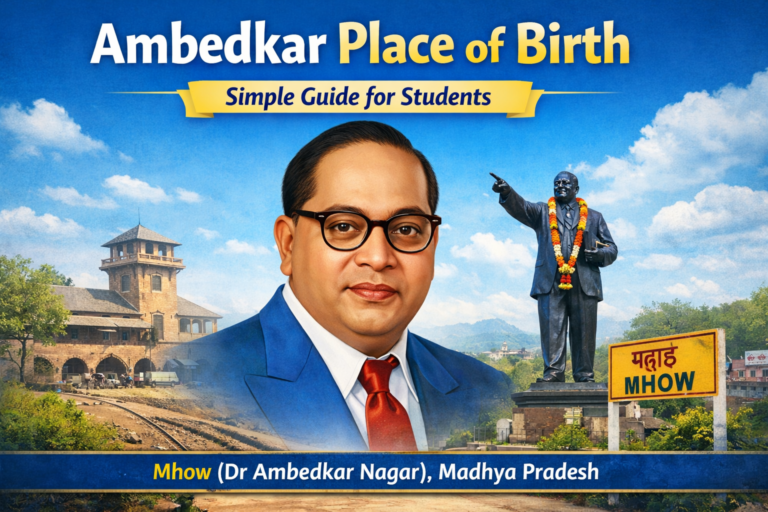
On April 14, 1891, Bhimrao Ramji Ambedkar was born in Mhow (now officially renamed Dr. Ambedkar Nagar). The memorial built at his birthplace — Bhim Janmabhoomi — was inaugurated on April 14, 2008, the 117th birth anniversary of Babasaheb. The stupa-style structure displays a large Ashoka Chakra and a statue of Ambedkar at the entrance.
Presidents and Prime Ministers have made Mhow a pilgrimage stop. PM Narendra Modi visited on the 125th Ambedkar Jayanti in 2016. The Madhya Pradesh government organizes the ‘Samajik Samrasta Sammelan’ here every year. Millions visit Ambedkar Jayanti, making it one of the most vibrant Ambedkar memorial places in India.
Location: Mhow, Madhya Pradesh (near Indore)
Best Time to Visit: April 14 (Ambedkar Jayanti)
Entry: Free
4. Dr. Ambedkar National Memorial (Mahaparinirvan Bhoomi) — New Delhi
Why you must visit: This is where Babasaheb spent his final days.
The address 26, Alipur Road, New Delhi, is where Dr. Ambedkar breathed his last on December 6, 1956. Known as Mahaparinirvan Bhoomi, the memorial completed in 2018 is an architectural marvel designed to resemble an open book — symbolising the Constitution of India. Spread across nearly 2 acres, it blends modern and Buddhist architecture seamlessly.
The complex includes a bronze Ashoka pillar replica, a Bodhi tree with fountains choreographed to Buddhist chants in a sound-and-light show, 27 interactive exhibits tracing Ambedkar’s life, an exhibition gallery documenting his final days, and a meditation hall with a marble Buddha statue. The first floor houses the museum curated by the Ministry of Social Justice and Empowerment.
Location: 26, Alipur Road, Delhi
Timings: Check with Delhi Tourism before visiting
Best Time to Visit: December 6 or April 14
5. Dr. Ambedkar International Centre — New Delhi
Why you must visit: This is India’s premier hub of Ambedkarite thought.
Inaugurated by PM Narendra Modi on December 7, 2017, the Dr. Ambedkar International Centre at 15, Janpath, New Delhi is a Centre of Excellence for research, policy-making, and study of socio-economic transformation. The state-of-the-art centre spans 3.25 acres in the heart of Delhi and features an 18-foot bronze statue of Dr. Ambedkar, a Buddha statue, and the Ashoka Stambh. It hosts seminars, exhibitions, and academic events year-round and is an important stop for scholars and students of social justice.
Why you must visit: This is India’s grandest Ambedkar memorial park.
Built across 107 acres in the posh Gomti Nagar locality of Lucknow, this colossal memorial is India’s largest Ambedkar monument by area. Constructed entirely in red sandstone from Rajasthan, the park features 124 monumental elephants at the entrance, a 34-metre sandstone stupa at its centre, statues of social reformers including Jyotiba Phule, Birsa Munda, Kanshi Ram, and Narayana Guru, and the Drashya Sthal — an 80-foot pyramid-top viewpoint overlooking the entire complex.
The adjacent Sangrahalay (museum), built over 11,000 sq. metres, houses large marble statues with inscribed quotes from reformers. The entry fee is a nominal ₹10–20, and it is open from 11 AM to 9 PM daily. The complex is best visited at dusk when it is dramatically lit.
Location: Gomti Nagar, Lucknow, UP
Timings: 11 AM – 9 PM (all days)
Entry: ₹10–₹20
7. Ambedkar Museum — Delhi
Managed by Delhi Tourism, the Ambedkar Museum near Kashmere Gate is open Tuesday to Sunday, 10 AM to 7 PM. It offers a curated journey through Babasaheb’s life, struggles, and intellectual contributions. Well-connected by metro and accessible to all, it is ideal for students and first-time visitors to Delhi wanting to understand his legacy before visiting the larger national memorial.
Location: Near Kashmere Gate, Delhi
Timings: 10 AM – 7 PM (closed Mondays)
8. Siddharth College — Mumbai, Maharashtra
Founded by Dr. Ambedkar himself in 1946 under the People’s Education Society, Siddharth College of Arts, Science, and Commerce in Fort, Mumbai, remains one of his most enduring institutional legacies. Walking through its corridors is an act of remembrance — this is where Babasaheb’s vision of education as liberation was brought to life. The college continues to serve lakhs of students from marginalised communities.
Location: Fort, Mumbai
9. Dr. Babasaheb Ambedkar Marathwada University — Aurangabad, Maharashtra
Renamed in 1994 after a long and painful agitation, Dr. Babasaheb Ambedkar Marathwada University is a symbol of the ongoing struggle for dignity and recognition. The renaming agitation of 1978 saw widespread unrest across Maharashtra. Today, the university is a centre of higher education and a pilgrimage of sorts for those who understand that Ambedkar’s deepest belief was that education is the only true weapon against injustice. The campus houses an Ambedkar memorial and museum.
Tucked inside the lanes of Hindu Colony in Dadar East, Rajgruha is perhaps the most intimate and underappreciated of all Ambedkar memorial places in India. Dr. Ambedkar personally supervised the design and construction of this three-storey building in 1934, naming it after the ancient Buddhist capital of Rajgriha (modern Rajgir, Bihar) — a deliberate homage to Buddhist heritage. The building was conceived first and foremost as a home for his massive personal library of over 50,000 books, one of the largest private collections in India at the time.
For a full 22 years, from 1934 until his death in 1956, Rajgriha served as Babasaheb’s primary residence, intellectual headquarters, and meeting ground for India’s most important social reformers and political leaders. His historic 1935 Yeola declaration — “I was born a Hindu but will not die as one” — was shaped by research conducted within these walls. The upper floors also served as a hostel for Dalit students attending Siddharth College, embodying his belief that education is liberation.
Today, the ground floor has been converted into a small heritage museum displaying photographs, personal artefacts, and a portion of his ashes. In 2022, the Maharashtra government announced its recognition as a heritage site, though followers continue to campaign for it to be declared a National Monument.
Location: 129, Khareghat Road, Hindu Colony, Dadar East, Mumbai
Nearest Station: Dadar (Central Line) — walkable
Best Time to Visit: April 14 or December 6
Entry: Free
Quick Reference: Ambedkar Memorial Places in India
#
Memorial
Location
Significance
1
Chaitya Bhoomi
Mumbai, Maharashtra
Cremation site, ashes enshrined
2
Deekshabhoomi
Nagpur, Maharashtra
Mass conversion to Buddhism (1956)
3
Bhim Janmabhoomi
Mhow, MP
Birthplace
4
Mahaparinirvan Bhoomi
Delhi
Place of death
5
Dr. Ambedkar International Centre
Delhi
Research & policy hub
6
Samajik Parivartan Sthal
Lucknow, UP
Largest memorial park
7
Ambedkar Museum
Delhi
Life & legacy exhibits
8
Siddharth College
Mumbai
Founded by Ambedkar (1946)
9
Dr. BAM University
Aurangabad, MH
Named after Babasaheb
10
Rajgruha
Mumbai, Maharashtra
This is where Babasaheb lived, thought, and fought.
People Also Ask: FAQs About Ambedkar Memorial Places in India
Q1: What are the Panchteerth sites of Dr. Ambedkar? The five Panchteerth sites are: Bhim Janmabhoomi (Mhow, MP), Shiksha Bhoomi (London, UK), Deekshabhoomi (Nagpur), Mahaparinirvan Bhoomi (Delhi), and Chaitya Bhoomi (Mumbai). PM Modi coined this term to honour the five most important places in Ambedkar’s life journey.
Q2: Where is Ambedkar’s samadhi located? Dr. Ambedkar’s samadhi is at Chaitya Bhoomi, Dadar, Mumbai. His ashes are enshrined here and it is visited by millions every year, especially on December 6 (Mahaparinirvan Diwas).
Q3: Which is the biggest Ambedkar memorial in India? By area, the Dr. Bhimrao Ambedkar Samajik Parivartan Sthal in Lucknow is the largest, spread across 107 acres. It is built entirely of Rajasthani red sandstone and cost an estimated ₹700 crore.
Q4: When is the best time to visit Deekshabhoomi in Nagpur? The best time is October 14, observed as Dhamma Chakra Pravartan Din — the anniversary of Ambedkar’s mass conversion to Buddhism. April 14 (Ambedkar Jayanti) is another major pilgrimage day.
Q5: Is the Dr. Ambedkar National Memorial in Delhi open to the public? Yes. The memorial at 26, Alipur Road, New Delhi, is open to the public. It features 27 exhibits, a meditation hall, a sound-and-light show, and an interactive Constitution-themed table. It’s managed by the Ministry of Social Justice and Empowerment.
Q6: What is the Ambedkar Circuit in India? The Ambedkar Circuit is a government-designated travel route connecting the key pilgrimage sites associated with Dr. Ambedkar’s life — including the Panchteerth — to promote heritage tourism and awareness of his legacy.
Final Word: Why These Places Matter
Visiting Ambedkar memorial places in India is not just an act of pilgrimage — it is an act of remembrance, education, and recommitment. Every stone in Chaitya Bhoomi, every step inside Deekshabhoomi, every corridor of Siddharth College whispers the same truth Babasaheb lived and died for: that liberty, equality, and fraternity are not gifts — they must be won.
Whether you are planning a pilgrimage for Ambedkar Jayanti on April 14 or Mahaparinirvan Diwas on December 6, use this guide to plan a meaningful journey across India’s most important Ambedkarite sites.
Jai Bhim.
Sources: Government of India — Ministry of Social Justice & Empowerment, Delhi Tourism, Wikipedia, Maharashtra Tourism, Drishti IAS. This article has been written for informational and heritage-awareness purposes.