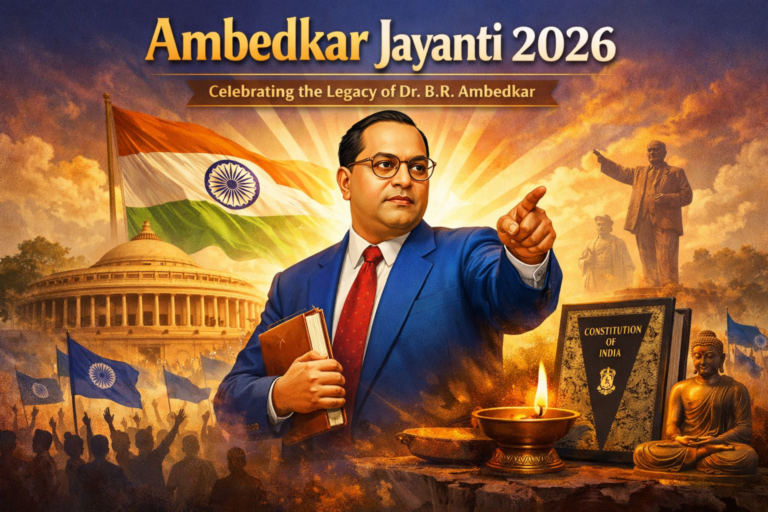
Ambedkar Jayanti is celebrated every year on 14 April, the birthday of Dr. B.R. Ambedkar, the man who gave India its Constitution. 14 April is celebrated as a yearly festival to commemorate his memory. Since 2015, this day has been observed as a public holiday across India. Schools hold assemblies. Colleges hold debates. Communities hold rallies. And students all over the country stand up and speak.
If you have been asked to give an Ambedkar Jayanti Speech in English — Short 2-Minute & Long 5-Minute Ready Speeches. you have come to the right place.
This article gives you everything you need:
A 2-minute short speech (ready to deliver)
A 5-minute-long speech (ready to deliver)
A 10-line speech for small children
Key quotes to use
Tips to deliver your speech confidently
Every speech below is written in simple English that any student from Class 6 onwards can read, understand, and deliver clearly.
Ambedkar Jayanti is a special occasion that honours the life and achievements of Dr. B.R. Ambedkar, the principal architect of the Indian Constitution.
Every year on April 14, India celebrates Ambedkar Jayanti to honour the birth anniversary of Dr. Bhimrao Ramji Ambedkar — the architect of the Indian Constitution.
It is also known as Bhim Jayanti and Equality Day. In 2026, we will celebrate his 135th birth anniversary.
2. Why Do We Celebrate Ambedkar Jayanti?
We celebrate Ambedkar Jayanti to remember a man who changed the destiny of millions of Indians.
Ambedkar is an icon for Indians, especially Dalits, for his relentless work for social reforms and empowerment of the disadvantaged sections of society.
Ambedkar Jayanti stands as a powerful reminder of the ideals of equality, liberty, and fraternity. This day is not just the celebration of Dr. Ambedkar’s birth but a commitment to building an inclusive and just society.
He fought untouchability. He wrote the Constitution that made every Indian equal. He became India’s first Law Minister. He built schools and colleges for Dalit students. He converted to Buddhism with 600,000 followers to reject the caste system.
This is why his birthday is not just a holiday. It is a declaration of equality.
3. Is Ambedkar Jayanti a National Holiday?
Yes. Ambedkar Jayanti has been celebrated as a national holiday since 2015.
On this day, the processions are carried out by his followers at Deeksha Bhoomi in Nagpur as well as Chaitya Bhoomi in Mumbai. It is customary for our esteemed public figures, like the President, Prime Minister, as well as leaders of the principal political parties, to pay reverence to the statue of Bhimrao Ambedkar at the Indian Parliament in New Delhi.
All government offices, schools, banks, and courts remain closed on 14 April across India.
4. 10-Line Speech for Kids — Class 1 to 5
(Read this slowly. Speak clearly. Stand straight. Smile.)
Good morning to my respected teachers and dear friends.
Today is Ambedkar Jayanti — the birthday of Dr. B.R. Ambedkar.
He was born on 14 April 1891 in Mhow, Madhya Pradesh.
We also call him Babasaheb, which means “respected father.”
He studied very hard and earned big degrees from America and England.
He wrote the Indian Constitution — the rule book that runs our country.
He fought so that every person in India would be treated equally.
He made a law that says untouchability is a crime in India.
He always said, “Education is the most powerful weapon.”
On this Ambedkar Jayanti, let us promise to study hard and be kind to everyone.
Jai Bhim! Thank you.
5. Short 2-Minute Speech on Ambedkar Jayanti in English
(For Class 6 to 9. Approximately 250 words. Read at a normal pace — takes exactly 2 minutes.)
Good morning to our respected Principal, teachers, and my dear friends.
Today, I feel truly proud to stand before you on this very special occasion — Ambedkar Jayanti 2026, the 135th birth anniversary of Dr. Bhimrao Ramji Ambedkar — the Father of the Indian Constitution.
Dr. Ambedkar was born on 14 April 1891 in Mhow, Madhya Pradesh. He was born into a Dalit family — into a community that was treated as untouchable by Indian society. He was not allowed to drink water from the school tap. He was made to sit outside the classroom on a gunny sack. Teachers ignored him. Other students avoided him.
But Dr. Ambedkar did not give up. He studied harder than anyone else in the room. He went to Columbia University in America and the London School of Economics in Britain. He earned a PhD, a DSc, and a law degree — all before India was even independent.
He returned to India and dedicated his entire life to fighting for the rights of the poorest and most marginalised people. He led the historic Mahad Satyagraha of 1927, marching Dalit men and women to a public water tank to assert their right to drink from it.
His greatest contribution was writing the Indian Constitution, which was adopted on 26 November 1949. He built into it Article 17, which abolished untouchability forever.
He also said these words — and I want you to remember them always:
“Educate, Agitate, Organize.”
On this Ambedkar Jayanti, let us promise to educate ourselves, speak up against injustice, and stand together as one.
Jai Bhim! Jai Bharat! Thank you.
6. Long 5-Minute Speech on Ambedkar Jayanti in English
(For Class 10, 11, 12, and College students. Approximately 600 words. Takes 5 minutes at a confident pace.)
Good morning to the respected Principal, honourable judges, beloved teachers, and my dear friends.
It fills my heart with immense pride to address you all today on the occasion of Ambedkar Jayanti 2026 — the 135th birth anniversary of Bharat Ratna Dr. Bhimrao Ramji Ambedkar — a man the world knows as the Father of the Indian Constitution, and whom millions of us call simply — Babasaheb.
Who Was Dr. Ambedkar?
Dr. Bhimrao Ramji Ambedkar was born on 14 April 1891 in the military cantonment of Mhow in Madhya Pradesh. He was born in a Dalit family and fought against untouchability and caste discrimination. From the very first day of his school life, he was forced to sit outside the classroom on a dirty gunny sack. He was denied water from the school tap. When he was thirsty, a peon would pour water into his palms from above — so that his hands never “polluted” the vessel.
When the peon was absent, young Bhimrao went the entire day without water.
The Education That Changed a Nation
Instead of breaking him, this pain sharpened him. He was the first Dalit to finish college. He earned a PhD. He was an expert in 64 areas and a fluent speaker of 11 languages. He studied at Columbia University and the London School of Economics, earning many degrees.
He returned to India not just as a scholar, but as a warrior.
The Fighter for Rights
Dr. Ambedkar dedicated his life to dismantling every structure that kept Dalit people oppressed.
In 1927, he led the Mahad Satyagraha — marching 2,500 Dalit men and women to the Chavdar Lake in Maharashtra to drink water from a public tank they had been forbidden from touching. That act of drinking water — the simplest human act — became one of the most powerful civil rights statements in Indian history.
He published newspapers — Mooknayak and Bahishkrit Bharat — to give Dalit communities a voice for the first time.
He attended the Round Table Conferences in London as the sole voice of India’s untouchable communities — demanding equal political representation.
The Constitution — His Greatest Gift
On 29 August 1947, Dr. Ambedkar was appointed Chairman of the Drafting Committee of India’s Constituent Assembly. He was also a lawyer, economist, political leader, and a true social reformer. He worked through severe diabetes and failing eyesight — sometimes through the night — to write the document that would govern the world’s largest democracy.
The Constitution of India was adopted on 26 November 1949 — a date we now celebrate as Constitution Day.
Into that document, he wrote:
Article 14 — Every citizen is equal before the law
Article 17 — Untouchability is abolished and punishable by law
Articles 330–332 — Reserved seats for SC/ST in Parliament
He played a key role in the drafting of the Indian Constitution, which guarantees equality and justice for all citizens, regardless of their caste, religion, or gender.
His Message to Every Student
Dr. Ambedkar once said: “Cultivation of mind should be the ultimate aim of human existence.” He strongly believed in the power of education. Despite facing many challenges, he became one of the most educated leaders in history.
His three-word instruction to us was:
“Educate. Agitate. Organize.”
Educate yourself — know your rights. Agitate — speak up against injustice. Organize — stand together.
The Final Act — Conversion to Buddhism
On 14 October 1956, Babasaheb converted to Buddhism at Deekshabhoomi in Nagpur — along with approximately 600,000 followers. Ambedkar was also the inspiration for the Dalit Buddhist movement. Just 47 days later, on 6 December 1956, he passed away peacefully in his sleep.
He was awarded the Bharat Ratna — the highest civilian award — in April of 1990.
Conclusion
My friends, you are sitting in a classroom today because Dr. Ambedkar fought for your right to be there. The reservation in your college application, the scholarship in your name, the Constitution that protects you — all of it flows from this one man’s extraordinary life.
Celebrating Ambedkar Jayanti is not just about remembering Babasaheb’s contributions — it is about implementing his values in our daily lives. Respect for others, standing against injustice, valuing education, and promoting unity — these are the principles he stood for.
On this Ambedkar Jayanti 2026 — let us do more than celebrate. Let us commit.
Commit to study. Commit to equality. Commit to justice.
And always, always — carry his words in your heart:
“They alone rise who strive.”
Jai Bhim! Jai Bharat! Thank you.
7. Best Ambedkar Jayanti Quotes in English for Your Speech
Use any of these quotes in your speech to make it more powerful:
Quote
Best Placed In
“Cultivation of mind should be the ultimate aim of human existence.”
Opening or closing
“Educate, Agitate, Organize.”
Middle of speech — pause before and after
“They alone rise who strive.”
Closing line
“Education is the milk of a lioness — whoever drinks it will roar.”
After talking about his education
“Life should be great rather than long.”
After talking about his death
“I measure the progress of a community by the degree of progress women have achieved.”
When talking about women’s rights
“Freedom of mind is the real freedom.”
When talking about the Constitution
8. Tips to Deliver Your Speech Confidently
Follow these 7 tips and your speech will stand out from everyone else’s:
1. Practice 3 times before the event. Read out loud — not in your head. Your voice needs rehearsal, not just your memory.
2. Speak slowly. When you are nervous, you speed up. Deliberately slow down. Let each sentence land.
3. Make eye contact. Look at your audience — not just your paper. Pick 3 faces and speak to them.
4. Pause after quotes. When you say “Educate, Agitate, Organize” — stop for 2 full seconds. Let it hit.
5. Stand straight. Posture signals confidence — to your audience and to your own brain.
6. Start strong. The first 10 seconds decide if the audience listens to you. Start with the opening line — not a long pause.
7. End with a Jai Bhim. It is the most powerful closing for an Ambedkar Jayanti speech. Say it like you mean it.
9. Frequently Asked Questions
What is Ambedkar Jayanti?
Ambedkar Jayanti is observed annually on 14th April. It commemorates the birth of Dr. Bhimrao Ramji Ambedkar, also known as Babasaheb. He is remembered as the Father of the Indian Constitution and a champion of human rights. Celebrations encourage reflection on his teachings, inspire unity, and promote education and equality.
Why do we celebrate Ambedkar Jayanti?
Ambedkar Jayanti is celebrated on the 14th of April to commemorate his sacrifices for the country. To recognise Dr. Ambedkar’s tremendous contributions to the development of modern India, the Ambedkar Jayanti holiday is observed. Ambedkar Jayanti is also celebrated in honour of the jurist’s commitment to combating social ills like caste prejudice and oppression.
Is Ambedkar Jayanti a national holiday?
Ambedkar Jayanti is a national holiday in India, celebrated every year on April 14th to commemorate the birth anniversary of Bhimrao Ramji Ambedkar, the father of the Indian Constitution and a prominent leader. It has been a gazetted national holiday since 2015.
How to write a short speech on Ambedkar Jayanti?
To write a short Ambedkar Jayanti speech: start with a respectful greeting, introduce the occasion (14 April, birth anniversary of Dr. B.R. Ambedkar), mention 2–3 key facts about his life (born 1891 in Mhow, PhD from Columbia, wrote the Constitution, abolished untouchability through Article 17), include one powerful quote like “Educate, Agitate, Organize,” and close with a commitment to his values and a “Jai Bhim.” Keep it under 250 words for a 2-minute speech.
What are good Ambedkar Jayanti quotes in English?
The best Ambedkar Jayanti quotes in English include: “Cultivation of mind should be the ultimate aim of human existence,” “Educate, Agitate, Organize,” “They alone rise who strive,” “Life should be great rather than long,” and “Education is the milk of a tigress; whoever drinks it will roar.”These quotes work perfectly as opening lines, closing statements, or mid-speech pauses.
Conclusion
Dr. B.R. Ambedkar gave his entire life so that every Indian child — regardless of caste, family, or background — could stand in a classroom and speak with confidence.
When you stand up to give your Ambedkar Jayanti speech today, you are living the future he fought for.
Speak clearly. Speak proudly. And remember who made it possible for you to speak at all.
Dr. B.R. Ambedkar was not just a leader but a symbol of equality, justice, and empowerment. Millions across India honor his legacy by wearing and using items from the Jay Bhim Collection, a range of products inspired by his life and teachings. If you’re looking for meaningful ways to keep Babasaheb’s ideals alive, this guide will…
Are you looking for a meaningful way to honor the great Dr. B.R. Ambedkar? Wearing a Dr. Babasaheb Ambedkar T-shirt is a powerful way to show your respect for his contributions to social justice, equality, and the Indian Constitution. Whether for Ambedkar Jayanti, rallies, or daily wear, an Ambedkar T-shirt lets you carry his legacy with pride. Picture this: it’s…
Ambedkar Jayanti 2026 falls on 14 April 2026, a Tuesday. This day is celebrated every year to honor the birthday of Dr. Bhimrao Ramji Ambedkar — the man who gave India its Constitution and fought all his life for the rights of SC, ST, and OBC communities. On this day, millions of people across India…
What I am Saying My brothers and sisters, Today, you came here for Ambedkar Jayanti 2025. We are not merely celebrating a date on the calendar. We are honoring the legacy of a man who dared to dream of a world free from the chains of oppression, inequality, and ignorance. But let us ask ourselves…
Every year on 14 April, India celebrates Ambedkar Jayanti — the birthday of the man who gave India its Constitution, abolished untouchability by law, and spent every single day of his life fighting for the dignity of crores of poor and marginalised people. Writing an Ambedkar Jayanti Essay for Students is one of the most…