On that morning, in a small military town in central India, a baby boy was born. Nobody around him knew it yet — but that boy would grow up to write the Constitution of the largest democracy on earth. He would fight for the rights of millions of people who were treated as less than human. And he would prove, with his own life, that education is the most powerful weapon in the world.
That boy was Bhimrao Ramji Ambedkar — the man the world knows as Babasaheb.
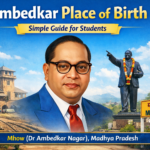
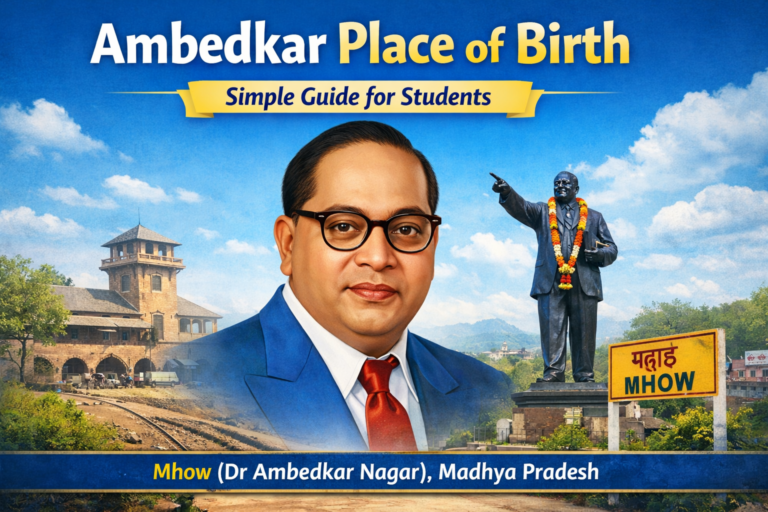
Dr. Bhimrao Ramji Ambedkar was born on 14 April 1891 in the town of Mhow, a military cantonment in the Central Provinces of British India. Today, Mhow is in Madhya Pradesh and has been officially renamed Dr. Ambedkar Nagar in his honour.
Here are his complete birth details at a glance:
Detail
Information
Date of Birth
14 April 1891
Day
Sunday
Birthplace
Mhow (now Dr. Ambedkar Nagar), Madhya Pradesh
Full Name at Birth
Bhimrao Ramji Sakpal
Later Name
Bhimrao Ramji Ambedkar
Father’s Name
Ramji Maloji Sakpal
Mother’s Name
Bhimabai Sakpal
Birth Order
14th and last child
Caste
Mahar (Scheduled Caste)
Father’s Profession
Subedar, British Indian Army
His original surname was Sakpal — not Ambedkar. The name “Ambedkar” came from a kind Brahmin schoolteacher named Krishnaji Keshav Ambedkar, who changed his surname in the school register because he was fond of young Bhimrao. That small act of kindness gave the world a name it will never forget.
2. The Story Behind the Date
Think about this for a moment.
When Babasaheb was born in 1891, India was under British rule. The caste system controlled every part of daily life. People born in lower castes could not enter temples. They could not use public water taps. Children from the Mahar caste sat outside classrooms on gunny sacks. Their shadow was considered “polluting” by others.
Babasaheb was born into exactly this world — into the Mahar caste, one of the communities labelled “untouchable” in Indian society.
His father, Ramji Maloji Sakpal, served as a Subedar in the British Indian Army. Because of this, the family had more stability than most Dalit families of that time. His father was educated and believed strongly in the value of learning. He raised his children to study hard — even when the world outside their home treated them with cruelty.
His mother, Bhimabai, passed away when young Bhimrao was just six years old. His aunt stepped in and raised him. Despite all this loss and hardship, Bhimrao kept studying.
That date — 14 April 1891 — marks the beginning of a journey that took one boy from a dusty cantonment town in central India to the drafting committee of India’s Constitution. Nobody handed him that journey. He fought for every step of it.
3. What Is Ambedkar Jayanti? Why Do We Celebrate 14 April?
Every year on 14 April, India celebrates Ambedkar Jayanti — also called Bhim Jayanti or Equality Day.
Schools hold special programs. Colleges organise speech and essay competitions. People carry out processions and place garlands on Ambedkar statues. Social media fills up with his photos and quotes. And students across the country take a moment to remember why their rights exist today.
In 2015, the Government of India officially declared 14 April a national gazetted holiday. Government offices, banks, courts, and most schools stay closed on this day. This decision recognised that Dr. Ambedkar’s contribution to the nation was so significant that it deserved a permanent national day of remembrance.
In 2026, we celebrate his 135th birth anniversary.
The celebrations in 2026 are expected to be bigger than ever, because more young people — especially students from SC, ST, and OBC communities — are reading about Ambedkar and understanding what he actually did for them.
4. What Makes This Date Special for SC/ST/OBC Students?
This is not just a calendar date. This date is deeply personal for every SC, ST, and OBC student in India.
Because of the man born on 14 April 1891:
You have reserved seats in colleges and universities
You receive government scholarships to fund your education
You have legal protection from caste discrimination under Article 17 of the Constitution
You have equal rights under Articles 14, 15, and 16
You have a Constitution that declares every citizen equal before the law
Dr. Ambedkar did not get any of these things. He was denied water at school. He was thrown out of rented accommodation because of his caste. He was insulted even after earning degrees from Columbia University and the London School of Economics.
He built those protections so you would never have to suffer what he suffered.
When you use a scholarship, sit in a reserved seat, or exercise your legal rights, you are using something he built with his pain, his intelligence, and his entire life.
5. Quick Facts for Competitive Exams
Students preparing for UPSC, SSC, MPSC, or any state exam — note these down. They appear regularly in papers:
Fact
Answer
Date of birth
14 April 1891
Ambedkar Jayanti 2026
14 April 2026 — Tuesday
Birth anniversary in 2026
135th birth anniversary
Official names of the day
Ambedkar Jayanti / Bhim Jayanti / Equality Day
National holiday declared in
2015
Birthplace
Mhow, Madhya Pradesh (now Dr. Ambedkar Nagar)
Father’s name
Ramji Maloji Sakpal
Mother’s name
Bhimabai Sakpal
Birth order
14th and last child
Bhim Janmabhoomi inaugurated
14 April 1991 (100th birth anniversary)
Bharat Ratna awarded
1990 (posthumously)
Frequently Asked Questions
What is Dr. Ambedkar’s date of birth?
Dr. B.R. Ambedkar was born on 14 April 1891 in Mhow, Madhya Pradesh. This date is celebrated every year as Ambedkar Jayanti, a national public holiday across India. In 2026, it marks his 135th birth anniversary.
Where was Dr. Ambedkar born?
Dr. Ambedkar was born in Mhow, a military cantonment town in Madhya Pradesh, India. The town was officially renamed Dr. Ambedkar Nagar in his memory. His exact birthplace is now a grand memorial called Bhim Janmabhoomi, which was inaugurated on his 100th birth anniversary on 14 April 1991.
Why is 14 April celebrated as Ambedkar Jayanti?
14 April is Dr. Ambedkar’s birthday. He was born on this date in 1891. Because of his enormous contribution to India — drafting the Constitution, abolishing untouchability through Article 17, and fighting for Dalit rights throughout his life — the government declared his birthday a national gazetted holiday in 2015. People celebrate it every year to honour his legacy.
What is the 135th birth anniversary of Dr. Ambedkar?
In 2026, it is exactly 135 years since Dr. Ambedkar was born in 1891. So Ambedkar Jayanti 2026 — falling on Tuesday, 14 April — marks his 135th birth anniversary. This is a significant milestone year for his followers, students, and communities across India.
What is Bhim Jayanti?
Bhim Jayanti is another name for Ambedkar Jayanti. “Bhim” is short for Bhimrao — Dr. Ambedkar’s first name. His followers lovingly called him Babasaheb Bhim. So his birthday celebration is also called Bhim Jayanti, especially in Maharashtra and among Ambedkarite communities across India. The meaning is the same — it is a day to honour the father of the Indian Constitution.
The Date That Belongs to All of Us
On 14 April 1891, nobody celebrated in Mhow. There were no speeches, no processions, no holiday.
But today — 135 years later — millions of people stop everything on that date to say thank you. They thank a man who was born with nothing and gave a nation everything.
He was born untouchable. He made untouchability illegal. He was born without rights. He wrote the rights of a billion people. He was born in Mhow. His name is now known across the world.
14 April 1891. Remember this date. Share it because this date belongs to every Indian.
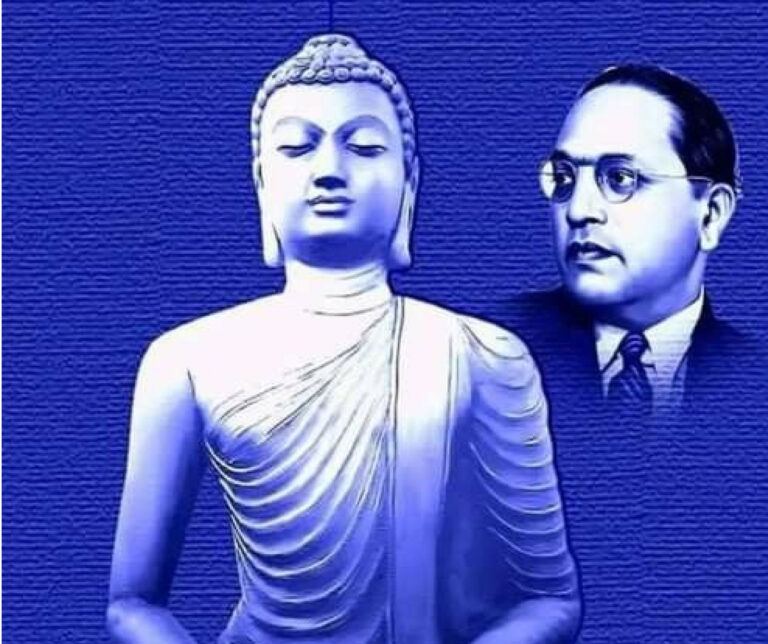
Ambedkar and Buddha Two Giants, One Mission Imagine a man sitting under a tree, seeking peace over 2,500 years ago. Now picture another man, 2,000 years later, reading about him late into the night, finding answers to free millions. The first is Gautama Buddha, born in India. The second is Dr. B.R. Ambedkar, India’s champion…
Carrying the Jay Bhim Torch Who is Prakash Ambedkar? A present Voice for Justice and Equality Prakash Ambedkar is an Indian politician, lawyer, and social activist. He is the grandson of Dr. B.R. Ambedkar, the architect of the Indian Constitution and a great leader who fought for the rights of Dalits and other marginalized communities….
Dr. B.R. Ambedkar, the architect of India’s Constitution and a champion of social justice, is often remembered for his towering intellect and relentless fight against caste oppression. But behind his revolutionary ideas and transformative leadership was a lifelong habit that fueled his brilliance, his voracious reading. Ambedkar wasn’t just a reader, he was a scholar…
Dr. B. R. Ambedkar was born in Mhow, a town in present-day Madhya Pradesh, India.His date of birth is 14 April 1891. Today, Mhow is officially called Dr. Ambedkar Nagar in his honor. Let’s see why this Ambedkar place of birth is very important in Indian history. Where Was Dr. Ambedkar Born? Dr. Ambedkar was…
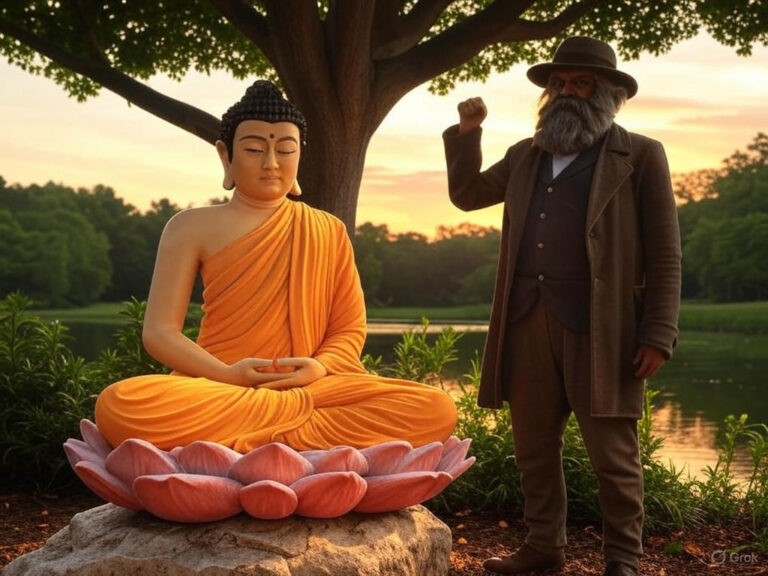
What happens when a monk meets a revolutionary? At first glance, Buddha and Karl Marx seem like polar opposites—one a serene spiritual teacher, the other a firebrand revolutionary. Buddha sought liberation from suffering through inner peace; Marx fought for liberation from oppression through systemic change. Yet both were radical thinkers who challenged the status quo,…
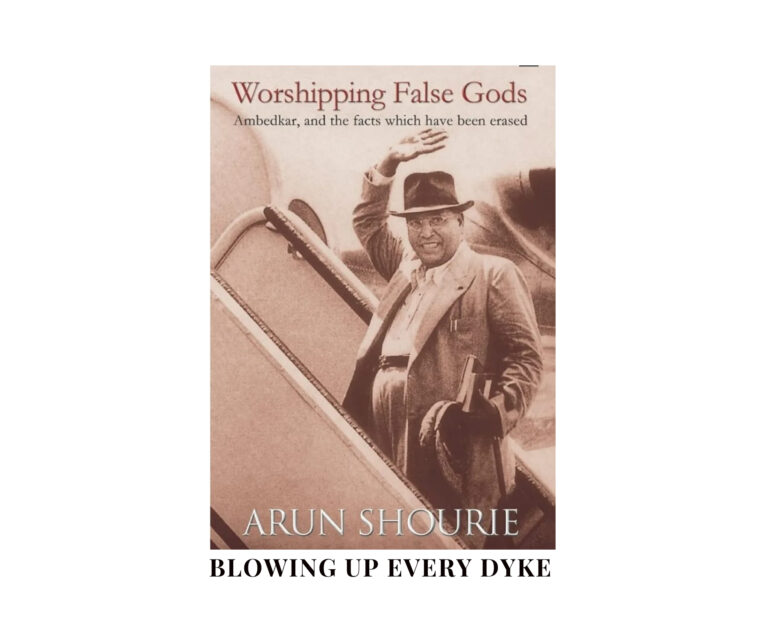
The book Worshipping False Gods (1997), by Arun Shourie, calls Ambedkar a “British stooge.” Sparks fly! Arun Shourie on Ambedkar is no small topic; it’s a clash of ideas, emotions, and history. Shourie’s controversial critique portrays Ambedkar as a divisive figure who undermined India’s freedom struggle, while supporters argue he was a visionary who fought caste oppression first….