
Every year, thousands of SC, ST, OBC, minority, and EWS students miss out on thousands of rupees in government scholarships — not because they are ineligible, but because they do not know where to apply.
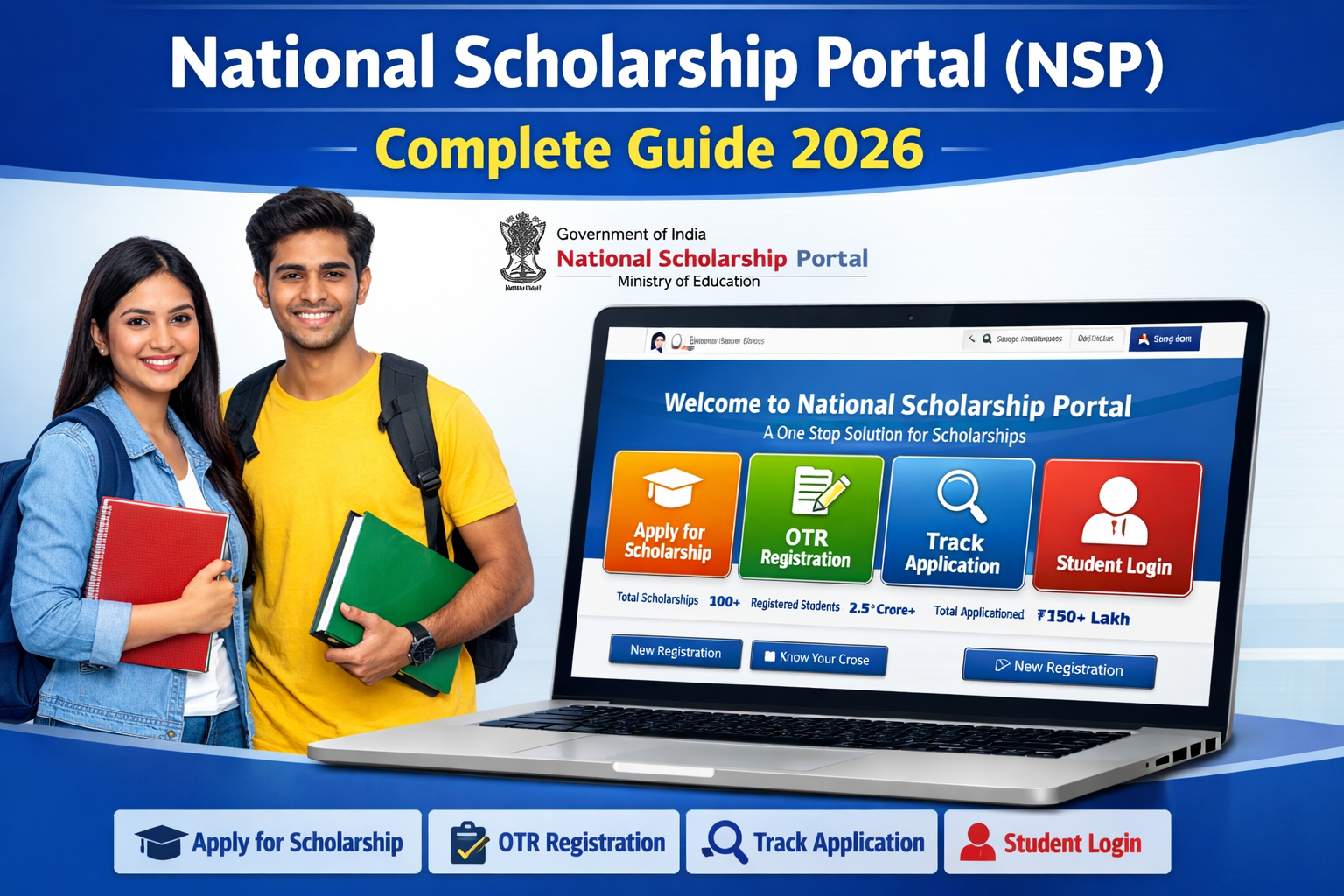
The answer is one website: scholarships.gov.in — the National Scholarship Portal (NSP).
This one portal houses over 140 scholarship schemes from the Government of India, from Class 1 all the way to PhD. Pre-matric, post-matric, top-class education, merit-cum-means, disability scholarships — all in one place. You apply once. The money comes directly to your bank account.
This is your complete guide to the National Scholarship Portal — what it is, how to register, how to apply, and how to make sure your application succeeds.
1. What Is the National Scholarship Portal?
The National Scholarship Portal (NSP) is an online platform created by the Government of India. It acts as a single online window for students across the country to apply for and receive government scholarships. It is a key part of the National e-Governance Plan (NeGP), aimed at making government services simple, clear, and fast.
In plain language: NSP is the one website where you apply for almost every central government scholarship in India. Before NSP existed, students had to visit different offices, fill out different paper forms, and follow up manually. NSP replaced all of that with a single digital system.
The National Scholarship Portal (NSP) 2025 is an integrated online portal operated by the Government of India that brings together more than 140 scholarship schemes under one roof. Designed for students from Class 1 to Ph.D., NSP 2025 aims to provide a one-stop, transparent, and efficient way to apply for government scholarships.
Official website: scholarships.gov.in Developed by: National Informatics Centre (NIC), Government of India
2. Why Was NSP Created? — The SMART Mission
The portal’s main job is to manage the entire scholarship process — from the student’s application to the final fund transfer — in a way that is Simplified, Mission-oriented, Accountable, Responsive, and Transparent (SMART).
Before NSP, the scholarship system was broken:
- Students applied on paper forms at district offices
- Files got lost, delayed, or manipulated
- Money took months — sometimes years — to arrive
- Corrupt middlemen charged fees to “process” applications
NSP fixed all of this by moving everything online and sending money directly to students’ bank accounts.
With two-level verification — Institute Nodal Officer (INO) followed by District or State-level verification (DNO/SNO) — NSP reinforces accountability in scholarship awarding.
3. NSP Benefits for Students
The benefits of NSP include: 100% Online Process — Registration, form submission, verification, and payment are all digital. Aadhaar-based Verification makes the process faster and ensures genuine applications. Direct Benefit Transfer (DBT) sends approved scholarship amounts directly to your bank account. Real-Time Status lets you check your application progress anytime. Easy Renewal allows students to renew their scholarship every year with just a few steps.
Additional benefits:
- The Central Sector Scheme of Scholarship (CSS) alone gives a maximum of 82,000 fresh scholarships every year to college students across the country.
- In the academic year 2020-21, close to ₹2,731 crore of scholarships were disbursed through NSP.
- NSP services are available at Common Service Centres (CSCs) — if you do not have internet at home, visit your nearest CSC to apply.
4. Who Can Apply — NSP Eligibility
Eligibility varies by scheme. Most require Indian citizenship, enrollment in a recognised institution, a valid category (SC/ST/OBC/EWS/Minority/Disability where applicable), and family income within the scheme’s limit.
General eligibility criteria across most NSP schemes:
| Condition | Requirement |
|---|---|
| Nationality | Indian citizen |
| Enrollment | Must be studying in a recognised school, college, or university in India |
| Income | Usually below ₹2.5 lakh/year (varies by scheme — some allow up to ₹6 lakh) |
| Category | SC / ST / OBC / EWS / Minority / PwD — each scheme specifies |
| Level | Class 1 to PhD — different schemes for different levels |
| Bank Account | Aadhaar-seeded bank account in your name — mandatory |
Use the Scheme Eligibility filter on NSP to check exactly which schemes you qualify for. Go to scholarships.gov.in, click “Scheme Eligibility,” and fill in your state, course level, category, income, and gender — the portal shows all matching scholarships instantly.
5. Complete List of Scholarship Categories on NSP
The NSP serves as a centralized platform for students to apply for multiple scholarship schemes, including: Pre-Matric Scholarships for students from Class 1 to 10, Post-Matric Scholarships for students from Class 11 to PhD, Merit-cum-Means Scholarships for professional and technical courses, Top Class Education Scholarships for SC/ST students pursuing higher education, and Scholarships for Persons with Disabilities supporting students at various education levels.
Other major categories on NSP:
- PM YASASVI — for OBC, EBC, and DNT students
- Central Sector Scheme (CSS) — merit-based, for Class 12 passed students
- National Means-cum-Merit Scholarship (NMMS) — for Class 8 students
- Swanath Scholarship Scheme — for orphans, semi-orphans, and differently abled students
- Minority Scholarships — Pre-Matric, Post-Matric, Merit-cum-Means
- UGC / AICTE Scholarships — for higher education students
6. What Is OTR? — The Most Important First Step
Before you can apply for anything on NSP, you must complete your OTR — One Time Registration.
One Time Registration (OTR) is a unique 14-digit number issued based on the Aadhaar/Aadhaar Enrolment ID (EID) and is applicable for the entire academic career of the student. OTR is required to apply for a scholarship on the National Scholarship Portal.
OTR simplifies the scholarship application process, thereby eliminating the need of registration in each academic year.
Think of OTR like your school ID card — you get it once, and you use it for every scholarship application from Class 9 to PhD. You never need to register again.
When an application is submitted, the system will generate an Application ID linked to the OTR ID, ensuring that only one Application ID is active against an OTR ID at any given time.
IMPORTANT about Aadhaar biometrics: It has been observed in some cases that face authentication for the generation of OTR is failing because the Aadhaar holder has locked their biometrics. Before proceeding for face authentication through the NSP OTR app, ensure that the Biometric Lock/Unlock status is “Unlocked” in your Aadhaar. To unlock, use the mAadhaar app or the My Aadhaar web portal at resident.uidai.gov.in.
7. NSP OTR App — How to Download and Use
The NSP OTR App is for students to complete One Time Registration (OTR) on the National Scholarship Portal. This application uses Aadhaar Face RD Services to authenticate users from UIDAI. External biometric devices are not required to perform face authentication. Download the AadhaarFaceRD app from the Google Play Store first, then download the NSP OTR App.
How to get the app:
- Go to the Google Play Store on your Android phone
- Search “NSP OTR” — download the app by the National Informatics Centre
- Also search “AadhaarFaceRD” — download and install this too
- Open the NSP OTR app. Enter your Aadhaar. Complete face scan. Get your OTR number.
The latest update introduces functionality to link APAAR ID with OTR in the NSP OTR application. APAAR ID is your Academic Bank of Credits ID — link it if you have one.
You can also complete OTR on the website (scholarships.gov.in) if you cannot use the app.
8. How to Register on NSP 2025-26 — Step by Step
The NSP portal is now using the NSP 2.0 system, with an updated registration and application process for 2025-26. Applications opened from June 2, 2025. The portal now requires a mandatory One Time Registration (OTR). All students must complete OTR (using Aadhaar or Aadhaar-EID plus face authentication) before applying.
Step 1: Go to scholarships.gov.in
Step 2: Click the “Students” tab at the top of the page
Step 3: Click on the “Login” button under the OTR section. Click the “Register” tab. Read the guidelines carefully and tick the checkboxes, then click “Next.” Enter your Mobile Number and click “Get OTP.” Enter the received OTP, Captcha Code, and click “Verify.” Fill in your Aadhaar number and click “Get OTP.” Click “Verify” to proceed. Students will be redirected to a page with personal details. Fill in required details — mother’s name, father’s name, and email ID — and click “Finish.”
Step 4: Complete face authentication using the NSP OTR App (Aadhaar Face RD)
Step 5: Your 14-digit OTR number is generated. Save it. Screenshot it. Write it in your notebook. This number is your key to all scholarships.
9. How to Apply for a Scholarship on NSP — Step by Step
Once you have your OTR number, applying for a scholarship takes just a few more steps:
Log in using your OTR ID and password. Select the scholarship scheme you are eligible for. Fill in the application form with accurate details. Upload the necessary documents. Submit the application and take a printout for future reference.
Detailed steps:
Step 1 — Login: Go to scholarships.gov.in → Click “Login” → Enter OTR ID and password
Step 2 — Select Scheme: The system automatically filters eligible schemes based on your data. Choose your scholarship.
Step 3 — Fill the Form: Candidates are asked to enter their name, date of birth, mobile number, email ID, state of domicile, category, and bank details.
Step 4 — Upload Documents: Upload a copy of the Bank Passbook in PDF or JPEG Format with a size of 200KB. Upload all other required documents in the same format.
Step 5 — Submit: Check all details and submit. Note your Application ID.
Step 6 — Institute Verification: Your school or college must verify your application. Visit your scholarship coordinator immediately after submitting.
10. NSP Institute Login — What Your College Must Do
Your college plays a critical role in your scholarship. After you submit your application, it goes to your college for verification. If your college does not verify — your application dies, regardless of how perfectly you filled it.
College login portal: Same website — scholarships.gov.in. Institutes log in under the “Institute” tab using their Institute Nodal Officer (INO) credentials.
What you should do: The day you submit your application, visit your college’s scholarship section (usually in the administration office) and say: “I have submitted my NSP scholarship application — Application ID [your number]. Please verify it before the deadline.”
Follow up every week until you see “Institute Verified” in your application status.
11. NSP Last Date 2025-26
The National Scholarship Portal has extended the last date to submit the application form for the remaining scholarships to December 15, 2025. Earlier, the application window for PM YASASVI closed on November 15, 2025. Pre-Matric Scholarship for students with disabilities, NMMS, and Financial Assistance schemes closed on October 31, 2025.
Candidates can apply for the Ministry of New and Renewable Energy’s scholarship by March 23, 2026. The last date to apply for the Department of Agriculture Research and Education’s scholarships has been revised to March 24, 2026.
| Scheme Category | Last Date |
|---|---|
| Pre-Matric (SC/ST/Minority) | October–November 2026 |
| Post-Matric (SC/ST/OBC) | November 30, 2026 |
| PM YASASVI | November 15, 2026 |
| NMMS | September–October 2026 |
| Central Sector Scholarship | November–December 2026 |
| Renewable Energy / Agriculture schemes | March 2026 |
Always check the live deadline: NSP frequently extends and modifies deadlines. The dates above are based on historical patterns. Before applying, always verify the current last date directly on scholarships.gov.in → “Schemes Dates at a Glance.” The portal shows real-time open/closed status for every scheme.
12. How to Check NSP Scholarship Status
Use the Application Status page to track whether your form is submitted, verified, approved, or sent for payment.
Method 1 — NSP Portal: scholarships.gov.in → Login → “Track Application Status”
Method 2 — PFMS Payment: Track your scholarship disbursement status on the PFMS portal. Go to pfms.nic.in → “Know Your Payment” → Enter bank account number or Aadhaar.
Method 3 — Check Aadhaar Bank Seeding: Check your bank account seeding status with Aadhaar on the NSP portal. If your Aadhaar is not seeded with your bank account, your payment will fail even if the scholarship is approved. NPCI has launched the Bharat Aadhaar Seeding Enabler (BASE) platform to facilitate Aadhaar Seeding and De-seeding activities in self-service mode for Direct Benefit Transfer (DBT).
13. NSP Renewal Application — For Existing Beneficiaries
If you received an NSP scholarship last year, you do not start from scratch. You submit a Renewal Application.
All renewal students who have received a Reference number in their registered mobile numbers should generate OTR only through this reference number. They need not register as a new student in the portal again.
For renewal:
- Login with your existing OTR ID
- Select “Renewal Application”
- Update current year academic details
- Upload fresh documents (income certificate must be for the current year)
- Submit before the renewal deadline
Missing the renewal deadline means your scholarship stops for that year.
14. NSP Odisha — State-Specific Information
Odisha students apply for central scholarships through NSP (scholarships.gov.in), like all other states. For state-specific scholarships, Odisha uses its own portal at scholarship.odisha.gov.in — known as the PRERANA portal.
Odisha students should apply on BOTH portals to maximise their scholarship benefits. The central Post Matric Scholarship from NSP and the state Odisha scholarship from PRERANA can both be availed if the eligibility criteria for each are independently met.
15. NSP Helpdesk — Who to Call When You Are Stuck
If you face problems during registration, application, or payment:
Contact the NSP helpdesk at 0120-6619540 or email at helpdesk@nsp.gov.in.
Other support options:
- NSP services are also available at Common Service Centres (CSCs). Students can avail scholarship-related services by visiting the nearby CSC.
- The Government of India launched its “National Scholarship Portal Mobile App” in 2018. It is also available in the UMANG app — if you have UMANG installed, you can apply through it too.
- State Nodal Officers (SNOs) — listed on NSP under “Scheme-wise State Nodal Officers.”
16. Frequently Asked Questions
What is the National Scholarship Portal?
The National Scholarship Portal (NSP) is an online platform created by the Government of India. It acts as a single online window for students across the country to apply for and receive government scholarships. It is a key part of the National e-Governance Plan (NeGP), aimed at making government services simple, clear, and fast. It hosts over 140 scholarship schemes and is accessible at scholarships.gov.in.
How to apply for National Scholarship Portal AY 2025-26?
Visit the official website of NSP 2.0 at scholarships.gov.in. Look for the “New Registration” tab and complete your OTR. Select the scholarship scheme you are eligible for. Enter your name, date of birth, mobile number, email ID, state of domicile, category, and bank details. Upload required documents including bank passbook, caste certificate, income certificate, and marksheet. Submit the application before the NSP last date 2025-26.
How do I check if a student has applied for a scholarship?
Students can check their own application status by logging into scholarships.gov.in with their OTR ID and password. For payment status, visit pfms.nic.in and enter the bank account number or Aadhaar. Institutes can track student applications through the Institute login on the same portal. If an application shows “Forwarded to Institute,” the college scholarship coordinator must verify it before the deadline.
How can a student apply for a fresh scholarship scheme?
Submit a fresh application (new students) or renew your NSP scholarship (previous beneficiaries). Select the scheme, fill the form carefully, and upload the required documents. Double-check all details. Your application will undergo institute-level and department-level verification. After verifying your entries, click “Submit Application” to complete the process. Fresh applicants must first complete OTR registration before filling any application.
What is the OTR number on NSP?
One Time Registration (OTR) is a unique 14-digit number issued based on the Aadhaar/Aadhaar Enrolment ID (EID) and is applicable for the entire academic career of the student. OTR is required to apply for a scholarship on the National Scholarship Portal. You generate it once using the NSP OTR App on your Android phone, and use it for every scholarship application throughout your student life.
Conclusion
The National Scholarship Portal is the most important website for every SC, ST, OBC, minority, and EWS student in India.
Over 140 scholarships. One portal. Direct money in your bank.
Your three-step action plan today:
Step 1: Go to scholarships.gov.in and complete your OTR using the NSP OTR App. Takes 15 minutes.
Step 2: Use the “Scheme Eligibility” filter to see every scholarship you qualify for. Apply for all of them.
Step 3: Tell your college scholarship coordinator. Make sure they verify your application before the deadline.
That is it. No middlemen. No corruption. No paper forms. Just you, your Aadhaar, and the portal that Dr. B.R. Ambedkar’s Constitution made possible.
Jai Bhim. 🙏