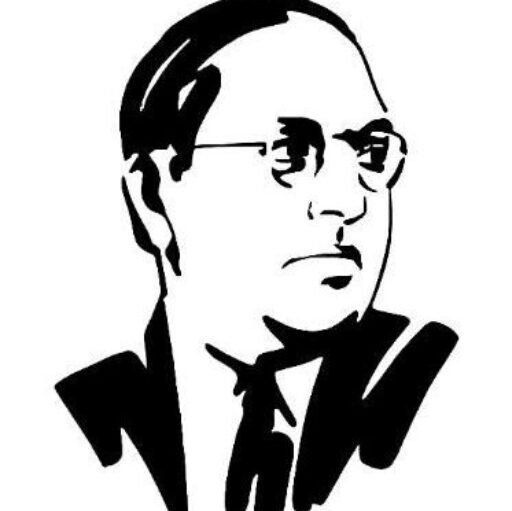
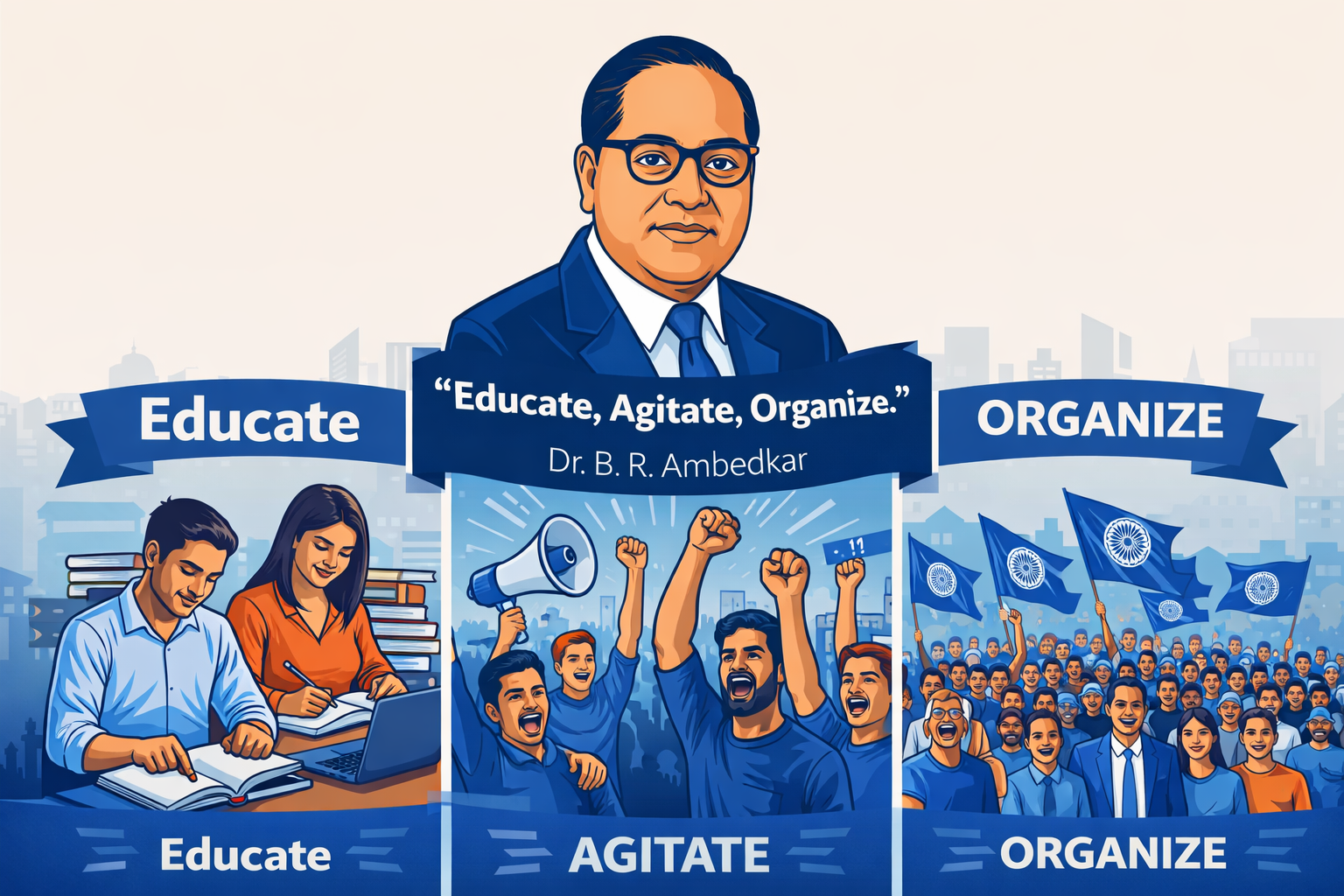
Dr. B.R. Ambedkar gave these words to his followers on 20 July 1942 in Nagpur, at the All India Depressed Classes Conference. He was ending one of the most important speeches of his life. He had spoken for hours about rights, about freedom, about the battle ahead. And then he brought it all down to three words that every person in that crowd — educated or not, young or old — could carry home and live by.
Those three words became the most powerful slogan in India’s social justice movement. They are painted on walls in Dalit neighbourhoods across Maharashtra. They are written in the preambles of Ambedkarite organisations in America, Canada, and the UK. They are tattooed on people’s arms. They are the first words millions of Dalit children learn about their history.
But what do they actually mean?
This article gives you the complete answer — word by word, step by step, in the simplest possible language.
1. The Exact Words — What Did Ambedkar Actually Say?
Dr. Ambedkar addressed the All India Depressed Classes Conference on 20th July 1942 as follows: “My final words of advice to you is Educate, Agitate and Organise; have faith in yourselves and never lose hope. I shall always be with you, as I know you will be with me. For ours is a battle, not for Wealth or for Power. It is a battle for Freedom. It is a battle for the Reclamation of Human Personality, which has been suppressed and mutilated by the Hindu social system.”
Read that again. He did not say “fight for money.” He did not say “fight for power.” He said this is a battle for something much more fundamental — the reclamation of human personality.
Dalit people had been told for centuries that they were less than human. The caste system said their birth made them impure. Ambedkar’s slogan was a direct counter to that lie: educate yourself to know the truth, agitate to resist the lie, and organise to dismantle the system that produces it.
2. Where Did This Slogan Come From?
Educate, Agitate, Organize was not only first used in 1942. It was actually the motto of the Bahishkrit Hitkarini Sabha, which Dr. Ambedkar founded in 1924, 18 years before the famous 1942 speech.
The Sabha was established on 20th July 1924 and was registered under Society Act XXI of 1860. The Vow and Slogan of the Institute was “Educate, Agitate and Organise.”
So Ambedkar had been living by these three words for nearly two decades before he made them famous at Nagpur. The 1942 speech did not create the slogan — it amplified it to a national stage.
The slogan’s first known wider use was by the Social Democratic Federation (SDF), a UK socialist organisation whose members included Eleanor Marx and William Morris. The SDF first used the slogan in an 1883 pamphlet entitled “Socialism Made Plain.”
Ambedkar studied in Britain at the London School of Economics. He was deeply aware of the international tradition of this slogan — and he adopted it because it perfectly fit the needs of the Dalit liberation movement.
3. The Correct Order — Why Sequence Matters
Here is something very important that most people get wrong.
The correct order is: EDUCATE → AGITATE → ORGANIZE
Not “Educate, Organize, Agitate.” Not “Educate, Agitate, Self-reliance.” Ambedkar gave a trinity of principles for social transformation: “educate, agitate, and organise.” This was the motto of the Bahishkrit Hitakarini Sabha, founded by Babasaheb in 1924. It is important to use the slogan in the same way as advised by Dr. Ambedkar.
Why does order matter? Because each step is only possible if the previous one has been done.
You cannot agitate effectively without education — you will not know what to demand.
You cannot organise effectively without agitation — you will not know why people need to come together.
One has to be educated on social issues — not a mere academic education — and such education agitates their minds (internal revolution), and these agitated minds organise themselves or would help the people to unite and strive for a common cause. A mob without proper education gets organised or involved in agitation, then it will lead to utter chaos or violent protests, and face many end up in confusion.
The three words are a sequence, not a menu. Do them in order.
4. EDUCATE — What It Means and Why It Comes First
Education comes first because everything else depends on it.
But Ambedkar was not just talking about school certificates and university degrees. Getting educated does not mean only acquiring academic designations. One must get educated about Babasaheb’s mission and his thoughts. We must read and learn about Dr. Ambedkar’s ideology and strategy to strengthen our people.
There are two kinds of education Ambedkar had in mind:
Academic Education — Go to school. Get your degree. Study science, law, medicine, and economics. “Nobody can dare to raise an eyebrow towards a society which has ten doctors, twenty engineers, and thirty lawyers.” When a community produces professionals, it cannot be dismissed.
Political and Social Education — Know your history. Understand the caste system. Read the Constitution. Know your rights under Articles 14, 15, 16, 17. Know what the SC/ST Atrocities Act says. Know what reservations you are entitled to and how to use them. Know who fought for you and what they sacrificed.
Through his call, Dr. Ambedkar asked the oppressed community to reach out for the education of the next generation, which they had been denied by the dominant castes on the basis of spurious religious, social, and cultural reasons.
If you do not know your rights, someone else will decide them for you.
5. AGITATE — The Most Misunderstood Word in the Slogan
This is the word that scares people. And it is the word that is most important.
“Agitate” does NOT mean riot. It does NOT mean violence. It does NOT mean break windows or burn buses.
The key aspect of this struggle is a peaceful mode of agitation. “Making sure to raise our voice against the silencing of caste atrocities; the lie that caste does not matter anymore — all of this is a part of the movement.”
The slogan has deep-rooted meaning: “One has to be educated on social issues, NOT a mere academic education, and such education agitates their minds (internal revolution), and these agitated minds organise themselves for a common cause.”
Agitation is first an internal revolution. When you read about the caste system, about untouchability, about the rights that were denied to your community for centuries, something shifts inside you. You feel a fire. That fire is agitation. It is necessary. It turns passive acceptance into active resistance.
Then agitation becomes external — peaceful but loud. Writing articles. Giving speeches. Asking questions in classrooms. Demanding answers from authorities. Voting. Protesting peacefully. Refusing to stay silent about discrimination.
This “stirring” or “shaking” of the marginalised communities is meant for them to realise their own bondage in the caste system and struggle to overcome it.
Ambedkar himself demonstrated this perfectly. The Mahad Satyagraha of 1927 — walking peacefully to a public water tank and drinking from it — was pure agitation. No violence. Enormous impact.
6. ORGANIZE — The Final and Most Powerful Step
Education gives you knowledge. Agitation gives you fire. Organisation gives you power.
One voice is easy to ignore. A thousand voices organised together are impossible to ignore.
There was a call to organize, which Dr. Ambedkar emphasised in order to bring all sections of the depressed classes together.
Ambedkar theorised a way in which lower castes could mobilise, organise, and demand an equal seat at the table of citizenship. The title of this paper is borrowed from his call to the oppressed to “educate, agitate, and organize,” and thereby wage a battle for freedom and reclamation of human personality.
Organising means:
Building student groups in your college
Joining or forming community organisations
Voting together as a community
Supporting each other in legal battles
Pooling resources to send children to school
Creating networks of professionals who help their own community rise
Ambedkar himself organised throughout his life. He founded the Bahishkrit Hitkarini Sabha (1924). He founded the Independent Labour Party (1936). He founded the Scheduled Castes Federation (1942) at the very conference where he gave this speech. He founded the People’s Education Society (1945) to organise education for Dalit students. He built institutions, not just ideas.
7. The Buddhist Connection — Buddham, Dhammam, Sangham
The slogan of EAO is linked as Buddham (Educate), Dhammam (Agitate), Sangham (Organize).
In Buddhism, the Three Jewels are:
Buddham — I take refuge in the Buddha (the Enlightened One — representing knowledge and education)
Dhammam — I take refuge in the Dhamma (the Teaching — representing the principles to live by, which agitate the mind toward justice)
Sangham — I take refuge in the Sangha (the Community — representing the organised collective)
Being a Buddhist, Babasaheb gave these slogans based on Buddhist philosophy. These commandments must be kept in this order.
This is not a coincidence. Ambedkar’s three-word slogan maps perfectly onto the three pillars of Buddhist practice. He was not just making a political strategy — he was building a complete philosophy of liberation that was both social and spiritual.
8. How Ambedkar Lived Each of These Three Words
The greatest thing about Ambedkar is that he never asked his followers to do something he had not already done himself. Here is his personal life as evidence:
Word
How Ambedkar Lived It
EDUCATE
Led the Mahad Satyagraha in 1927. Burned the Manusmriti publicly. Attended Round Table Conferences in London to demand Dalit rights. Resigned as Law Minister on principle. Converted to Buddhism as a public declaration.
AGITATE
Led the Mahad Satyagraha in 1927. Burned the Manusmriti publicly. Attended the Round Table Conferences in London to demand Dalit rights. Resigned as Law Minister on principle. Converted to Buddhism as a public declaration.
ORGANIZE
Founded the Bahishkrit Hitkarini Sabha (1924). Founded the Independent Labour Party (1936). Founded the Scheduled Castes Federation (1942). Founded the People’s Education Society (1945). Drafted the Indian Constitution — the supreme organizing document of a nation.
He was not a theorist who preached from a distance. He was a practitioner who built institutions, led movements, wrote laws, and converted with 600,000 people by his side.
9. Why This Slogan Is Still Relevant in 2026
With 20% rural dropouts, caste fights still happening across India, and persistent economic inequality, his words are not old — they are alive.
In 2026, the situation Ambedkar fought against has not completely changed:
Dalit students still face discrimination in classrooms
SC/ST/OBC communities still face barriers in education and employment
Caste-based atrocities are still reported every week
Many Dalits still do not know their constitutional rights
The answer to all of this is the same as it was in 1942: Educate. Agitate. Organize.
Educate yourself about your rights. Agitate — speak up when you see discrimination. Organize — build a community so that your voice cannot be ignored.
The slogan is a trinity — three steps that feed each other in a continuous cycle. The more you educate, the more you agitate. The more you agitate, the more effectively you organise. The more you organise, the better you can educate the next generation.
10. Frequently Asked Questions
What does Educate Agitate Organize mean?
Educate, Agitate, Organize is a three-step slogan given by Dr. B.R. Ambedkar for the liberation of oppressed communities. Educate means gaining both academic knowledge and awareness of your rights and history. Agitate means raising your voice peacefully against injustice — first as an internal mental revolution, then as a peaceful public protest. Organize means building collective power with your community so that individual voices become an unstoppable movement. The three steps must be followed in this exact order.
Who gave the slogan Educate Agitate, Organize?
Dr. B.R. Ambedkar gave this slogan as the concluding words of his historic speech at the All India Depressed Classes Conference on 20 July 1942 at Nagpur. However, the slogan was already the motto of his Bahishkrit Hitkarini Sabha, which he founded in 1924. The slogan’s first known use globally was by the Social Democratic Federation (SDF), a UK socialist organisation, in an 1883 pamphlet.
What is the correct order of Educate, Agitate, Organize?
The correct order is Educate first, then Agitate, then Organize. This is the order Dr. Ambedkar used in his 1942 speech and in the motto of the Bahishkrit Hitkarini Sabha (1924). Some people mistakenly say “Educate, Organize, Agitate” — but this is incorrect. The order matters because education must come first to make agitation and organization effective rather than chaotic.
Why did Ambedkar give the slogan Educate Agitate, Organize?
Ambedkar gave this slogan because he needed a simple, actionable three-step plan for a community that had been denied education, silenced into passivity, and kept deliberately divided. Education breaks the chains of ignorance. Agitation breaks the chains of silence. Organization breaks the chains of division. Together, the three steps form a complete strategy for liberation — not through violence, but through knowledge, peaceful resistance, and collective power.
Is Educate Agitate Organize connected to Buddhism?
Yes. The three words map onto the Three Jewels of Buddhism: Buddham (Buddha = Education/Enlightenment), Dhammam (Dhamma = Teaching/Agitation of the mind toward justice), and Sangham (Sangha = Community/Organization). Dr. Ambedkar was deeply influenced by Buddhist philosophy when he formulated this slogan. He later converted to Buddhism in 1956, and the three-word slogan reflects his belief that social liberation and spiritual liberation are deeply connected.
Conclusion
Three words. One complete philosophy.
Educate — so you know what you are worth. Agitate — so you demand what you deserve. Organize — so your demand cannot be ignored.
Ambedkar did not give us a slogan. He gave us a life map — a step-by-step guide for how every person who starts with nothing can end up changing everything.
He earned degrees when the world told him he was untouchable. He led peaceful marches when the world told him to sit down. He built organisations and wrote constitutions when the world told him he had no right to speak.
He educated. He agitated. He organised.
The question he is asking you, from 1942 and across all these decades, is simply: Are you doing the same?