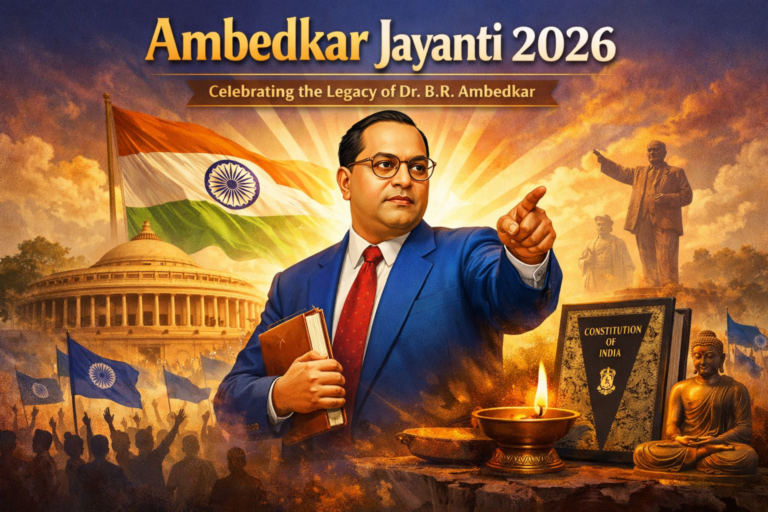
Every year on 14 April, India celebrates Ambedkar Jayanti — the birthday of the man who gave India its Constitution, abolished untouchability by law, and spent every single day of his life fighting for the dignity of crores of poor and marginalised people.
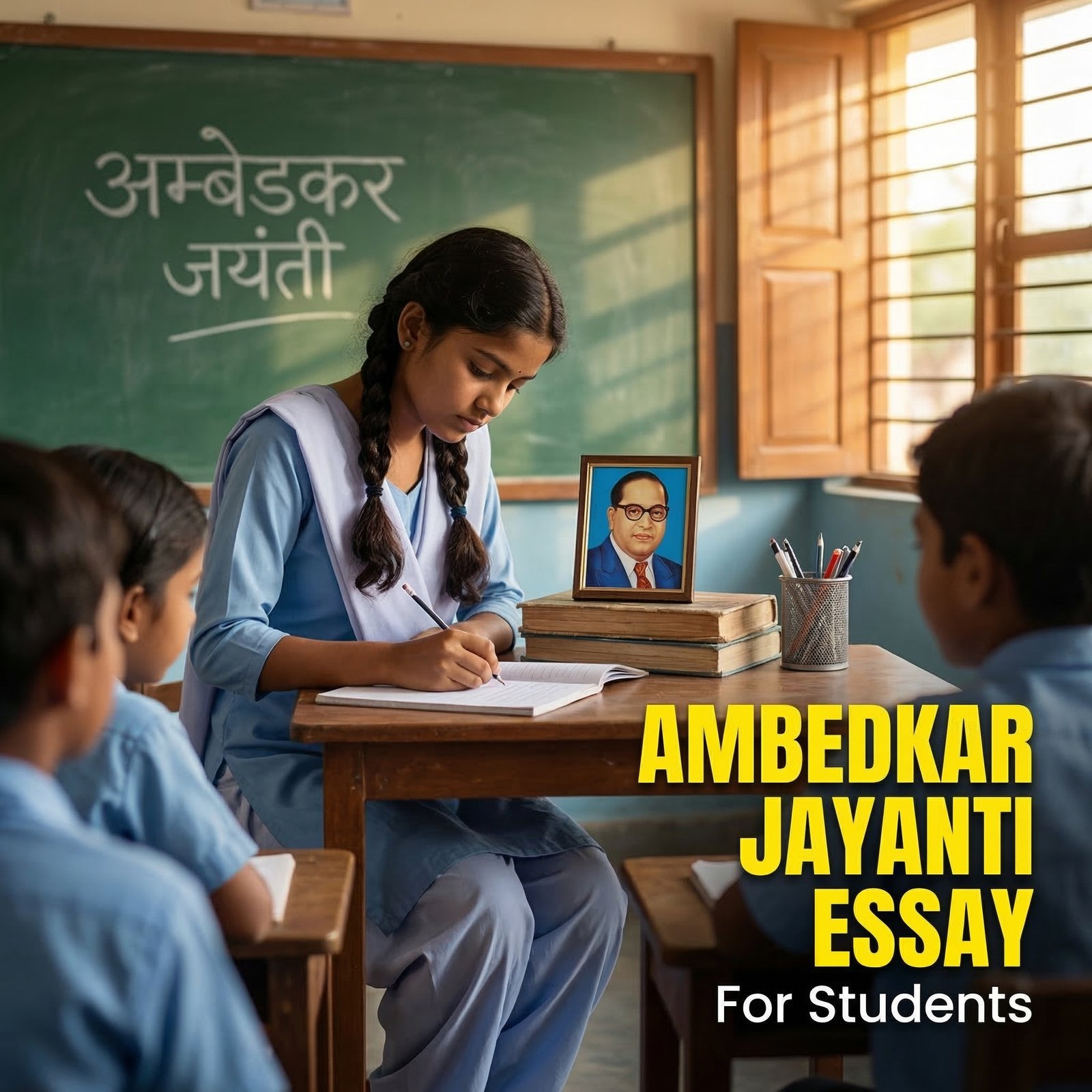
Writing an Ambedkar Jayanti Essay for Students is one of the most common school assignments across India, from Class 5 all the way to Class 12. Teachers ask for it before Jayanti. It appears in board exams. It comes up in competitive tests.
This article gives you four complete, ready-to-submit essays — one for each stage of school — written in simple, clear English that every student can read, understand, and use.
1. What Is Ambedkar Jayanti? — Key Facts to Know Before Writing
Before you write your essay, know these facts. They will make your essay stronger than everyone else’s.
Key Fact
Answer
What is Ambedkar Jayanti?
Birth anniversary of Dr. B.R. Ambedkar — celebrated on 14 April every year
Also called
Bhim Jayanti, Equality Day, Knowledge Day
First celebrated
14 April 1928 — organized by Janardhan Sadashiv Ranapisay in Pune
National holiday since
2015 (declared by Government of India)
2026 anniversary
135th birth anniversary
Why is it important?
Honours the man who wrote the Indian Constitution and abolished untouchability
United Nations connection
UN celebrated Ambedkar Jayanti for three consecutive years — 2016, 2017, and 2018
Celebrated internationally?
Yes — in Pakistan, Nepal, Sri Lanka, the USA, the UK, and South Africa
2. Short Essay on Ambedkar Jayanti — 100 Words
(For Class 3, 4, and 5 students. Simple sentences. Easy words.)
Ambedkar Jayanti — 14 April
Ambedkar Jayanti is celebrated on 14 April every year. It is the birthday of Dr. B.R. Ambedkar, also called Babasaheb.
Dr. Ambedkar was born on 14 April 1891 in Mhow, Madhya Pradesh. He was born in a Dalit family and faced a lot of discrimination as a child. But he studied very hard and became one of the most educated people in the world.
He wrote the Indian Constitution — the book of rules that runs our country. He also made a law that says untouchability is a crime.
Since 2015, 14 April has been a national holiday in India. On this day, schools hold programs, students give speeches, and people across India remember Babasaheb with respect.
His message to all of us was: “Educate, Agitate, Organize.”
Jai Bhim.
3. Medium Essay on Ambedkar Jayanti — 250 Words
(For Class 6, 7, and 8 students. More details. Exam-ready format.)
Essay on Ambedkar Jayanti
Introduction
Ambedkar Jayanti is celebrated on 14 April every year as the birth anniversary of Dr. Bhimrao Ramji Ambedkar — the Father of the Indian Constitution. This day marks a tribute to his countless efforts and contributions to our country. Since 2015, the Government of India has declared 14 April a national public holiday in his honour.
Who Was Dr. Ambedkar?
Dr. B.R. Ambedkar was born on 14 April 1891 in Mhow, Madhya Pradesh. He was not allowed to sit with other students in class because he was a Dalit, and the situation was so bad that he was not even allowed to touch the tap to drink water.
Despite all this cruelty, he never stopped studying. He earned a PhD from Columbia University in America and a DSc from the London School of Economics in Britain. He was an expert in 64 areas and a fluent 9-languages
His Greatest Contribution
Dr. Ambedkar became the Chairman of the Drafting Committee of India’s Constituent Assembly. He wrote the Indian Constitution, which was adopted on 26 November 1949. He placed Article 17 inside it, which abolished untouchability and made it a punishable offence. He also built Fundamental Rights that protect every citizen equally.
How We Celebrate
The day has been declared a public holiday in India as an honour to the man who fought tirelessly to eradicate the caste system and gain equal rights for all citizens of India. Schools hold essay competitions, debate contests, and morning assemblies. People gather at Deekshabhoomi in Nagpur and Chaityabhoomi in Mumbai to pay tribute.
Conclusion
Dr. Ambedkar’s life teaches us that education is the most powerful weapon against injustice. On Ambedkar Jayanti, we do not just celebrate a birthday — we celebrate the rights, freedom, and dignity that one man built for millions of people.
Jai Bhim.
4. Long Essay on Ambedkar Jayanti — 500 Words
(For Class 9, 10, 11, and 12 students. Board exam standard. Complete structure.)
Ambedkar Jayanti — Celebrating the Father of the Indian Constitution
Introduction
Writing an essay on Ambedkar Jayanti provides an opportunity to reflect on his remarkable contributions, including his role as the chief architect of the Indian Constitution and his relentless fight against caste-based discrimination. Celebrated on 14 April every year, Ambedkar Jayanti is not merely a public holiday — it is a declaration of the values of liberty, equality, and fraternity that Dr. Ambedkar spent his entire life building into the foundation of modern India.
Early Life and the Struggle Against Discrimination
Dr. Bhimrao Ramji Ambedkar was born on 14 April 1891 in Mhow, a military cantonment in Madhya Pradesh. He was born into the Mahar caste — one of the communities classified as untouchable under India’s deeply unjust caste system.
From the very first day of school, young Bhimrao faced discrimination that most of us cannot imagine. He sat outside the classroom on a dirty gunny sack. He was denied water from the school tap. He used to ask the peon to open the tap to drink — and when the peon was absent, he went without water the whole day. He later wrote about this experience in an article called “No Peon No Water.”
But he responded to every humiliation with harder study. Of all his brothers and sisters, Ambedkar was the only one who passed his primary school examination and went to high school. He was the first Dalit to complete higher education.
Education Abroad — Becoming the World’s Most Educated Dalit
In 1913, Ambedkar received the Baroda State Scholarship from Sayajirao Gaekwad III — the progressive Maharaja of Baroda — and sailed to the United States to study at Columbia University, New York. He earned an MA and then a PhD in Economics, becoming one of the first South Asians to earn a doctorate in Economics.
He then moved to Britain and studied at the London School of Economics, earning an MSc and then a DSc in Economics. He also qualified as a Barrister-at-Law from Gray’s Inn, London.
He is recognised as one of the greatest scholars globally and was the first South Asian to earn a PhD in Economics. He mastered 64 different subjects and spoke 11 languages fluently — earning the title “Symbol of Knowledge.”
The Fighter for Dalit Rights
Dr. Ambedkar returned to India not just as a scholar, but as a warrior for justice. He founded newspapers — Mooknayak, Bahishkrit Bharat, and Equality Janta — to give the Dalit community a public voice for the first time.
In 1927, he led the historic Mahad Satyagraha — marching 2,500 Dalit men and women to the Chavdar Lake in Maharashtra to drink water from a public tank that had been denied to them. It was the first major organised civil rights movement in India.
In 1932, he signed the Poona Pact with Madan Mohan Malviya to ensure reservation for Dalits in provincial elections. He attended the Round Table Conferences in London as the sole representative of untouchable communities, demanding equal political rights on the world stage.
The Indian Constitution — His Greatest Achievement
On 29 August 1947, Dr. Ambedkar was appointed Chairman of the Drafting Committee of India’s Constituent Assembly. As the Chairman of the Drafting Committee, he was the principal architect of the Constitution, which guarantees fundamental rights and justice for all citizens.
He worked through severe diabetes and failing eyesight — sometimes through the night — for 2 years, 11 months, and 18 days. The Constitution was adopted on 26 November 1949. Into it, he wrote:
Article 14 — Every citizen is equal before the law
Article 17 — Untouchability is abolished and a punishable offence
Article 21 — Right to life and personal dignity
Article 32 — The right to approach the Supreme Court if your rights are violated (Ambedkar called this “the heart and soul of the Constitution”)
Articles 330–332 — Reserved seats for SC/ST in Parliament
His guidelines, presented in his book “The Problem of the Rupee — Its Origin and Its Solution,” were also instrumental in the conceptualisation of the Reserve Bank of India.
Conversion to Buddhism and Final Years
On 14 October 1956, at Deekshabhoomi in Nagpur, Dr. Ambedkar converted to Buddhism — along with approximately 600,000 followers. He was the inspiration for the Dalit Buddhist movement. He completed his final book, “The Buddha and His Dhamma,” just weeks before his death.
He passed away on 6 December 1956 at his home in New Delhi. He was 65 years old.
He was awarded the Bharat Ratna — the highest civilian honour — in April of 1990, posthumously.
How Ambedkar Jayanti Is Celebrated
Ambedkar Jayanti is celebrated for around a week at Chaityabhoomi in Mumbai, and numerous people from all over the country travel to pay tribute. Deekshabhoomi in Nagpur sees massive gatherings. The President and Prime Minister of India lay flowers at Ambedkar’s statue in the Central Hall of Parliament.
In schools, common activities include essay writing and speech competitions, morning assemblies dedicated to discussing his role in drafting the Constitution, cultural programs like plays and skits, poster-making on themes of equality and justice, and quiz contests.
Ambedkar Jayanti is also being celebrated in Pakistan for around a decade — the Dalits of Pakistan are highly inspired by the ideologies of Dr. Ambedkar.
Conclusion
Celebrating Ambedkar Jayanti is not just about remembering Babasaheb’s contributions — it is about implementing his values in our daily lives. Respect for others, standing against injustice, valuing education, promoting unity — these are the principles Dr. Ambedkar stood for.
He said: “Education is the milk of a lioness — whoever drinks it will roar.”
On this Ambedkar Jayanti, let us roar.
Jai Bhim.
5. 10-Line Paragraph on Ambedkar Jayanti
(Use for quick homework, Class 3–5 paragraph questions)
Ambedkar Jayanti is celebrated on 14 April every year.
It is the birthday of Dr. B.R. Ambedkar — also known as Babasaheb.
Dr. Ambedkar was born on 14 April 1891 in Mhow, Madhya Pradesh.
He was born in a Dalit family and faced severe caste discrimination as a child.
Despite all difficulties, he earned a PhD from Columbia University and a DSc from the London School of Economics.
He is known as the Father of the Indian Constitution — he wrote it as Chairman of the Drafting Committee.
He wrote Article 17, which abolished untouchability and made it a punishable offence.
He converted to Buddhism with 600,000 followers at Deekshabhoomi, Nagpur on 14 October 1956.
He was awarded the Bharat Ratna — India’s highest civilian award — in 1990.
His famous message to all students is: “Educate, Agitate, Organize.”
6. How Is Ambedkar Jayanti Celebrated in Schools?
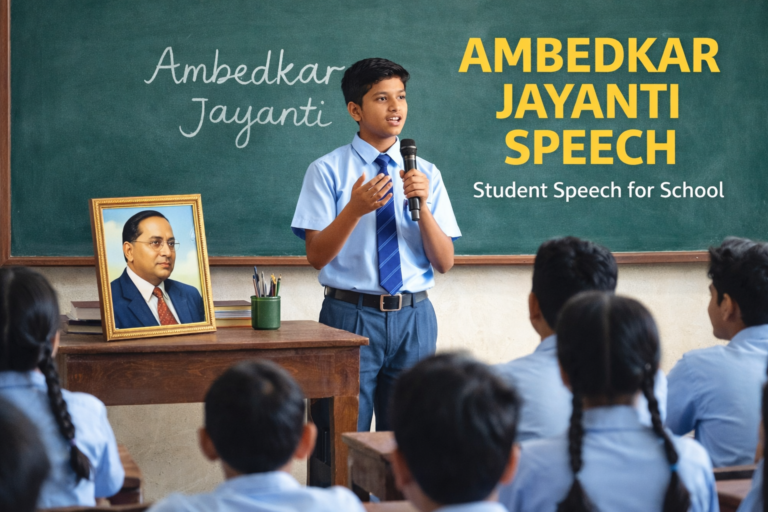
Schools across India observe Ambedkar Jayanti with enthusiasm and respect. Common activities include essay writing and speech competitions based on his life and teachings, morning assemblies dedicated to discussing his role in drafting the Constitution, cultural programs like plays, songs, and skits depicting his contributions, poster-making and slogan-writing on themes like equality and justice, and quiz contests that help students learn about his academic achievements and reforms.
As Ambedkar Jayanti is a national holiday, schools often celebrate it one day in advance. The teachers organise events for the students to know about Dr. Ambedkar and his practices that helped the Dalit society get their rights.
The first Ambedkar Jayanti was celebrated on 14 April 1928 by his fervent follower Janardhan Sadashiv Ranapisay, while Dr. Ambedkar was still alive and just 37 years old.
7. Frequently Asked Questions
What is Ambedkar Jayanti?
Ambedkar Jayanti is observed annually on 14th April. It commemorates the birth of Dr. Bhimrao Ramji Ambedkar, also known as Babasaheb. He is remembered as the Father of the Indian Constitution and a champion of human rights. Celebrations encourage reflection on his teachings, inspire unity, and promote education and equality.
Why do we celebrate Ambedkar Jayanti?
The primary significance of Ambedkar Jayanti is to honour Dr. Ambedkar’s immense contributions to building a modern, equitable India. The day serves as a reminder of his relentless fight for social justice, equality, and human rights for marginalised communities and his vision for a society free from discrimination.
What key points should be included in an essay on Ambedkar Jayanti?
A comprehensive essay on Ambedkar Jayanti should cover: an introduction to Dr. Ambedkar’s life and caste background, his remarkable education journey, his fight against untouchability and caste discrimination, his role as Chairman of the Drafting Committee of the Indian Constitution, the key articles he wrote (especially Article 17), his conversion to Buddhism, and a conclusion reflecting on his lasting legacy for India.
What was Dr. Ambedkar’s main role in framing the Indian Constitution?
Dr. Ambedkar’s main role was serving as the Chairman of the Drafting Committee of the Constituent Assembly. He was instrumental in structuring the constitution, ensuring it included fundamental rights, directive principles, and crucial safeguards for all citizens, particularly the legal abolition of untouchability.
Is Ambedkar Jayanti celebrated outside India?
Yes. Ambedkar Jayanti is celebrated in various parts of the world. The United Nations celebrated Ambedkar Jayanti for three years straight — from 2016 to 2018. People in Pakistan also began celebrating this day around a decade back, with events organised in Lahore and Karachi. The Dalits of Pakistan are highly inspired by the ideologies of Dr. Ambedkar
Conclusion
Dr. B.R. Ambedkar’s story is the most powerful essay topic you will ever write — because it is a true story.
It is the story of a child who was denied water. Who became the man who gave a nation its Constitution? Who turned personal pain into public justice? Who left behind a document that protects every single student reading these words right now.
When you submit your essay on Ambedkar Jayanti, write it like you mean it. Because you are not just completing an assignment. You are honouring a man who made it possible for you to sit in that classroom and hold that pen.