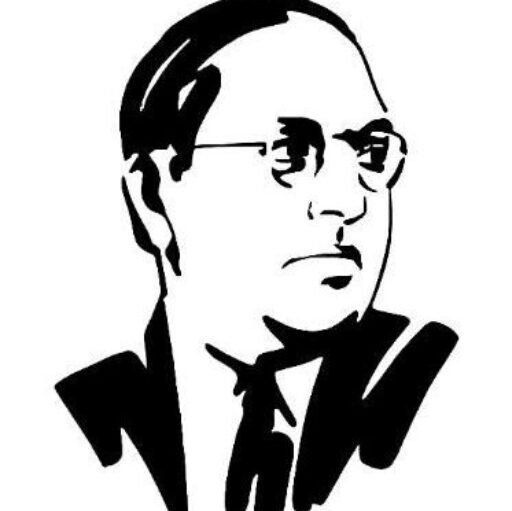
On 20 March 1927, Dr. B.R. Ambedkar walked to a public water tank in the small Maharashtra town of Mahad and drank from it.
That sentence sounds simple. Almost unremarkable.
But in 1927, India It was revolutionary.
The Chavdar Lake in Mahad was a public tank — built and maintained by public money. Yet Dalit people were strictly forbidden from touching its water. If a Dalit person’s shadow fell near the tank, upper castes would “purify” the water with rituals. If a Dalit dared to draw water from it, they risked being beaten or killed.
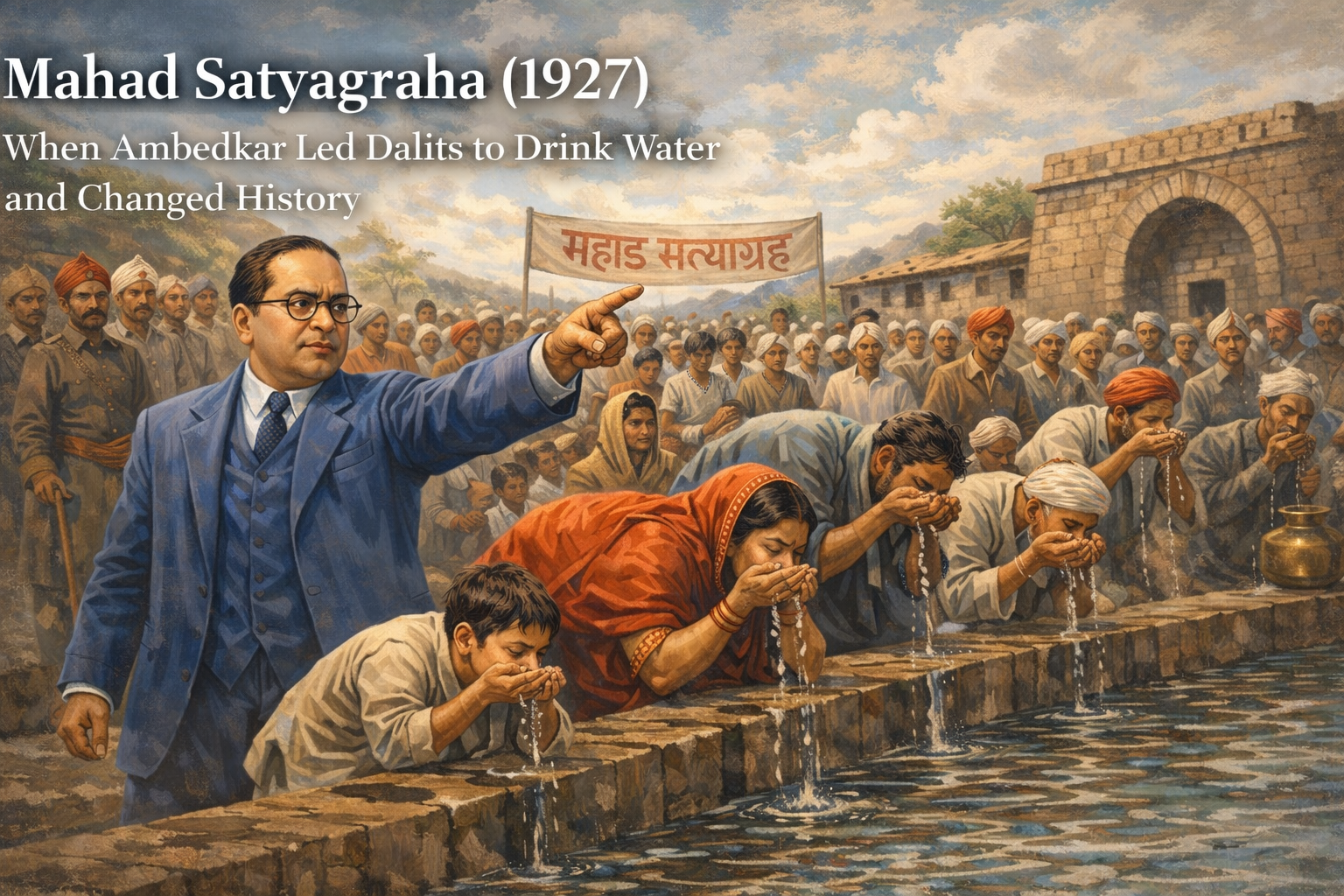
On 20 March 1927, Ambedkar walked up to that tank with 2,500 Dalit men and women behind him, dipped his hand in the water, and drank.
It was one of the most powerful acts of civil disobedience in Indian history — and it set off a chain of events that changed the Indian freedom movement forever.
This is the complete story of the Mahad Satyagraha.
The Mahad Satyagraha — also called the Chavdar Tale Satyagraha — was a satyagraha led by B.R. Ambedkar on 20 March 1927 to allow untouchables to use water in a public tank in Mahad, currently in Raigad district, Maharashtra, India.
The Mahad Satyagraha is hailed as the foundational event of the Dalit movement, marking the community’s collective rejection of the caste system and assertion of human rights.
In plain language: a group of human beings marched to a public water tank — which they had every legal right to use — and demanded to drink from it. The “crime” they were accused of was being born Dalit.
The primary aim of the Mahad Satyagraha was to challenge the social restrictions placed on Dalits, asserting their right to access public water bodies.
But Ambedkar himself explained the deeper meaning in his speech at the conference:
“It is not as if drinking the water of the Chavdar Lake will make us immortal. We have survived well enough all these days without drinking it. We are not going to the Chavdar Lake merely to drink its water. We are going to the Lake to assert that we, too, are human beings like others. It must be clear that this meeting has been called to set up the norm of equality.”
It was never about the water. It was about human dignity.
2. Where Did the Satyagraha Take Place?
The Satyagraha took place in the town of Mahad in 1927. In 1927, Dr. Ambedkar led a procession of Dalits to the Chawdar Tank, where they were prohibited from drawing water due to their caste. The Chawdar Tank is located in the Raigad district of Maharashtra, India.
Mahad, a small yet historically significant town in Maharashtra’s Konkan region, was formerly known as ‘Kolaba.’ This town was an integral part of Chhatrapati Shivaji Maharaj’s Maratha Empire, serving as its capital. The iconic Raigad Fort, where Shivaji Maharaj’s samadhi is located, stands as a testament to its legacy. Situated on the banks of the Savitri River, Mahad also holds ancient roots.
3. The Background — Why Was This Fight Necessary?
To understand the Mahad Satyagraha, you need to understand what life looked like for a Dalit person in 1927.
By the Indian caste system, untouchables (Dalits) were segregated from the other Hindu castes. They were banned from using water bodies and roads that were used by other Hindu castes.
A Dalit woman could not draw water from the village well. A Dalit man could not walk on the main street of a village. Dalit children could not sit on benches in school. And the Chavdar Lake in Mahad — a public tank built with public money — was completely off-limits for Dalit people.
One example shows how serious this was: Bapurao Tajne had to dig his own well in order to fulfill the need of water for his family. Tajne had no option but to spend 40 days digging a well after his wife attempted to draw water from the well of someone of a higher caste and was denied and humiliated.
People were forced to dig their own wells — or go thirsty — simply because of their caste. This was life for millions of Dalit families across Maharashtra.
In August 1923, SK Bole, a social reformer, moved a resolution in the Bombay Legislative Council, which provided that the untouchable classes be allowed to use all public watering places and dharamshalas which are built and maintained out of public funds.
Mahad Municipality, which was part of Bombay Province territory, had reaffirmed this resolution in 1924. However, the resolution remained on paper until Dr Ambedkar and his companions went to drink water from the Chavdar tank of Mahad on 20 March 1927.
The law already said Dalits could use public water. But no one was implementing it. Ambedkar decided to enforce it himself — by simply walking up and drinking.
4. Why Did Ambedkar Launch This Satyagraha?
In 1927, Ambedkar launched a satyagraha to assert the untouchables’ rights to use water in public places. The oppressed castes had faced severe discrimination, segregation, and social ostracism in Indian society for centuries. Access to public resources such as water bodies, temples, and schools was often denied to them, perpetuating their social, political, and economic marginalization.
Ambedkar chose Mahad for three reasons:
First — the Bole Resolution of 1923 had already legally opened the Chavdar tank to Dalits. Upper castes were defying a law. Ambedkar was not breaking any rule — he was enforcing one.
Second — Mahad had a supportive municipal president. Surendranath Tipnis, the president of the Mahad municipality, declared its public spaces open to untouchables and invited Ambedkar to hold a meeting at Mahad in 1927.
Third — Ambedkar wanted to build mass consciousness. Dr Ambedkar had gone to Mahad for a two-day conference organised by the Kolaba District Depressed Classes on 19–20 March 1927 on the invitation of Ramachandra Babaji More. The main agenda of the gathering was to raise awareness about the civil rights of Dalits.
5. What Happened on 20 March 1927?
On 20th March 1927, Dr. Ambedkar led a procession of 2,500 “untouchables” through the main streets of Mahad towards the Chavdar tank. Dr. Ambedkar took water from the tank and drank it. Others followed suit. It was a peaceful protest but quite revolutionary in its implications.
Picture that scene. Two thousand five hundred people — who had been told their entire lives that they were too impure to touch public water — walking together through the streets of Mahad in the open sun, heads high, following one man who was about to commit the “crime” of drinking water.
Ambedkar reached the tank. He bent down. He drank.
The crowd followed. One by one, person by person — they drank too. Some wept. Some cheered. All of them understood: something had just changed.
Ambedkar also made a powerful statement to the Dalit women at the Satyagraha. He asked them to abandon all old customs that provided recognizable markers of untouchability and asked them to wear saris like high-caste women. Before that time, the Dalit women were not allowed to drape saris completely. Immediately after Ambedkar’s speech at Mahad, the Dalit women readily decided to drape their saris like the higher caste women. Upper caste women named Lakshmibai Tipnis and Indirabai Chitre helped the Dalit women dress like upper caste women by covering the legs of the Dalit women down to their ankles.
The Mahad Satyagraha was not just about water. It was about every form of humiliation the caste system imposed — and the declaration that Dalit people would no longer accept any of them.
6. The Violent Backlash — Upper Castes React
The peaceful demonstration lasted only a few hours before violence began.
Two hours after the event, upper-caste Hindus raised a false rumour that the “untouchables” were also planning to enter the temple of Veereshwar, which prompted many to gather with bamboo sticks at street corners. They dashed into the pandal. Many of the delegates were at that time scattered in small groups in the city. Some were busy packing, and a few were taking their meals before dispersing for their villages. The rowdy mob pounced upon the delegates in the pandal, knocked down their food in the dust, pounded their utensils, and beat them.
The oppressor castes even performed a purification ritual of the tank, which, according to them, had been defiled by the touch of the Untouchables. Under pressure from the oppressor castes, the Mahad Municipality, on 4 August 1927, revoked its resolution of 1924 under which it had declared the Chavdar Tank open to the Depressed Classes.
The upper castes literally “cleaned” the tank after Dalits drank from it — as if the act of being touched by a Dalit person had polluted the water.
And then they went to court.
7. The Second Mahad Satyagraha — December 1927
Ambedkar did not back down. He planned a second conference and march at Mahad for 25–27 December 1927.
As the proposed date for the Mahad Satyagraha drew closer, the activity in Mahad intensified. Upper-caste individuals filed a claim in court on December 12, 1927, stating that the Chavdar Tank was private property and that SK Bole’s resolution could not be implemented there. On December 14, 1927, the court issued a temporary injunction that prohibited Dr. Ambedkar and the Dalit community from accessing the Chavdar Tank and using its water.
A large number of people gathered in Mahad to participate in the conference. On December 24, 1927, Dr. Ambedkar also arrived at the venue. That evening, the District Magistrate handed Dr. Ambedkar a copy of the court’s order and requested him to postpone the Mahad Satyagraha. However, Dr. Ambedkar was allowed to address the conference.
Even with the injunction in place, Ambedkar gathered the crowd. He addressed them with some of his most powerful words. And then he did something even more dramatic.
8. The Burning of Manusmriti
On 25 December 1927 — at 4:00 PM — at the second Mahad conference, Ambedkar and his followers did something that sent shockwaves through Hindu society.
Later in December 1927, Ambedkar and his supporters symbolically burned the ‘Manusmriti’ at the same location, signaling their rejection of caste-based inequalities and advocating for social justice.
The Manusmriti is an ancient Sanskrit text that codified the Hindu caste system — decreeing that Dalits were at the bottom of society and must stay there. Upper-caste Hindus treated it as sacred law.
Ambedkar treated it as the enemy.
By burning the Manusmriti publicly, he sent one message: we reject the religious justification for our oppression. We do not accept any scripture that says we are less than human.
The day of this burning — 25 December — is now observed annually as Manusmriti Dahan Din (Manusmriti Burning Day) by Ambedkarite Buddhists and Dalit communities across India.
9. The Legal Battle — Bombay High Court
The court case filed by the upper castes dragged on for a full decade.
In December 1937, the Bombay High Court ruled that untouchables have the right to use water from the tank.
It took ten years in court for Dalits to win the legal right to drink from a public tank in Mahad — a right the Bole Resolution had already given them in 1923.
Ambedkar won in court, too. But the real victory had already happened on 20 March 1927 — the moment he stood at the water’s edge and refused to be told he was less than human.
10. Legacy of the Mahad Satyagraha
The day of 20 March is observed as Social Empowerment Day in India, in honour of the Mahad Satyagraha.
The legacy of the Mahad Satyagraha is profound, as it marked a significant step in the fight against caste discrimination in India. It inspired future movements and became a reference point for Dalit activism. The event also strengthened the resolve of the Dalit community to demand their rights and paved the way for further social reforms.
The Mahad Satyagraha did several things that changed India permanently:
It proved Dalits could organise. Two thousand five hundred people marched together in 1927. That was unheard of. It showed that the Dalit community could mobilise at scale — and that Ambedkar was the leader who could unite them.
It shifted the strategy. Before Mahad, the approach to untouchability was moral persuasion — asking upper castes to be kinder. After Mahad, Ambedkar insisted on rights, not charity. Dalits do not need to be “given” access to public places. They have a legal right to them — and they will assert that right themselves.
It directly inspired the Constitution. The Mahad Satyagraha planted the seed that would become Article 17 of the Indian Constitution — the clause that abolished untouchability and made it a punishable offence. Ambedkar carried the memory of Mahad with him into every session of the Constituent Assembly.
On 19 March 1940, Dr. Ambedkar arranged a rally and public conference in Mahad to recollect the 14th Mahad Satyagraha Day as “Empowerment Day.” He never forgot what happened there. And neither should we.
11. Frequently Asked Questions
What is Mahad Satyagraha?
The Mahad Satyagraha — also called the Chavdar Tale Satyagraha — was a peaceful civil rights movement led by Dr. B.R. Ambedkar on 20 March 1927 in Mahad, Maharashtra. Ambedkar led 2,500 Dalit men and women to drink water from the public Chavdar Lake, which had been denied to Dalits due to caste discrimination. It is remembered as the foundational event of the Dalit rights movement in India and a landmark in the history of Indian civil rights.
What was the Mahad Satyagraha of 1927?
The Mahad Satyagraha of 1927 was a two-phase nonviolent protest. The first phase took place on 20 March 1927, when Ambedkar led 2,500 Dalits to the Chavdar Lake and drank water from it. The second phase took place on 25–27 December 1927, when Ambedkar organised a second conference at Mahad, burned the Manusmriti publicly, and addressed thousands about the principles of equality. The movement asserted that Dalit people had the same legal and moral right to public water as any other citizen.
Why did Ambedkar launch the satyagraha at Mahad?
Ambedkar launched the Mahad Satyagraha because the Bole Resolution of 1923 had already legally opened public water sources to Dalit communities in the Bombay Province — but the resolution was never implemented due to opposition from upper-caste Hindus. He wanted to enforce a law that already existed, prove that Dalits could organise and act collectively, and assert their fundamental dignity as human beings. He also used the movement to challenge the religious justification for untouchability — eventually burning the Manusmriti at the second conference in December 1927.
Where did the Mahad Satyagraha take place?
The Mahad Satyagraha took place in the town of Mahad in the Raigad district of Maharashtra, India. The specific site was the Chavdar Lake — a public water tank in the town. Mahad is a historically significant town in Maharashtra’s Konkan region, situated on the banks of the Savitri River. Today, Mahad is considered a pilgrimage site for Ambedkarites across India due to its role in the 1927 movement.
What happened after the Mahad Satyagraha?
After the March 1927 event, upper-caste Hindus violently attacked the Dalit delegates and performed a “purification” ritual of the tank. The Mahad Municipality then revoked the Bole Resolution under pressure. Upper castes filed a court case claiming the tank was private property. After a 10-year legal battle, the Bombay High Court ruled in 1937 that untouchables had the right to use water from the tank. The December 1927 Manusmriti burning at the second conference became an annual observance called Manusmriti Dahan Din. March 20 is now observed as Social Empowerment Day in India.
12. Conclusion
The Mahad Satyagraha was not a war. No weapons were raised. No violence was started by Ambedkar’s side.
It was simply two thousand five hundred people walking to a public water tank and drinking from it — and through that single act, declaring to all of India: we are human beings. We have rights. And we will not wait for your permission to exercise them.
That declaration echoes through every article of the Constitution that Ambedkar would later write. It echoes through Article 17, which made untouchability illegal. It echoes through the reservations in your college application and the scholarship in your name.
Every right you exercise today as an SC, ST, or OBC student has a beginning somewhere. One of those beginnings is on the banks of the Chavdar Lake in Mahad, on 20 March 1927.