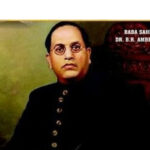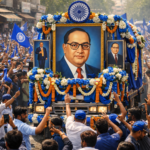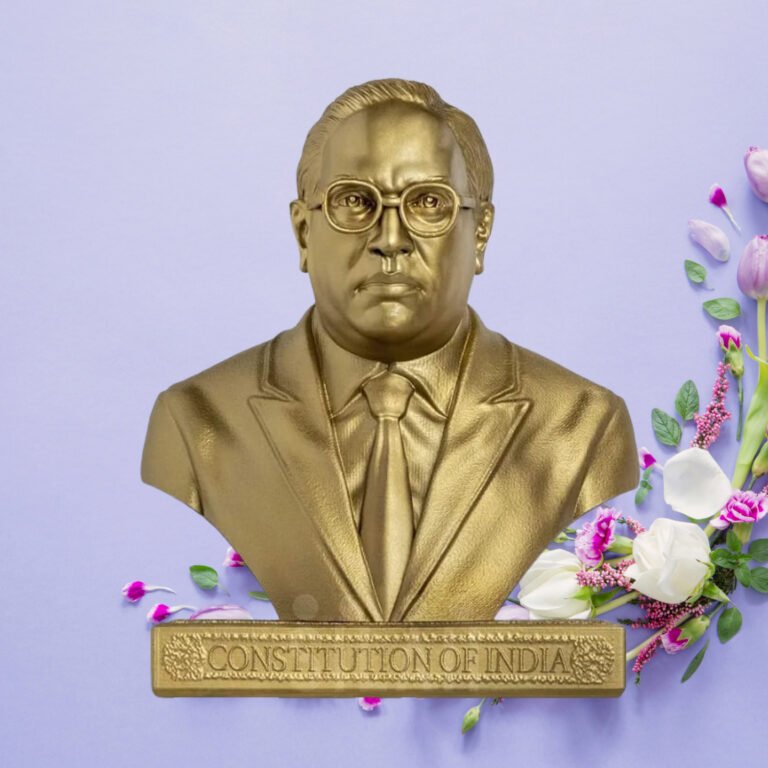

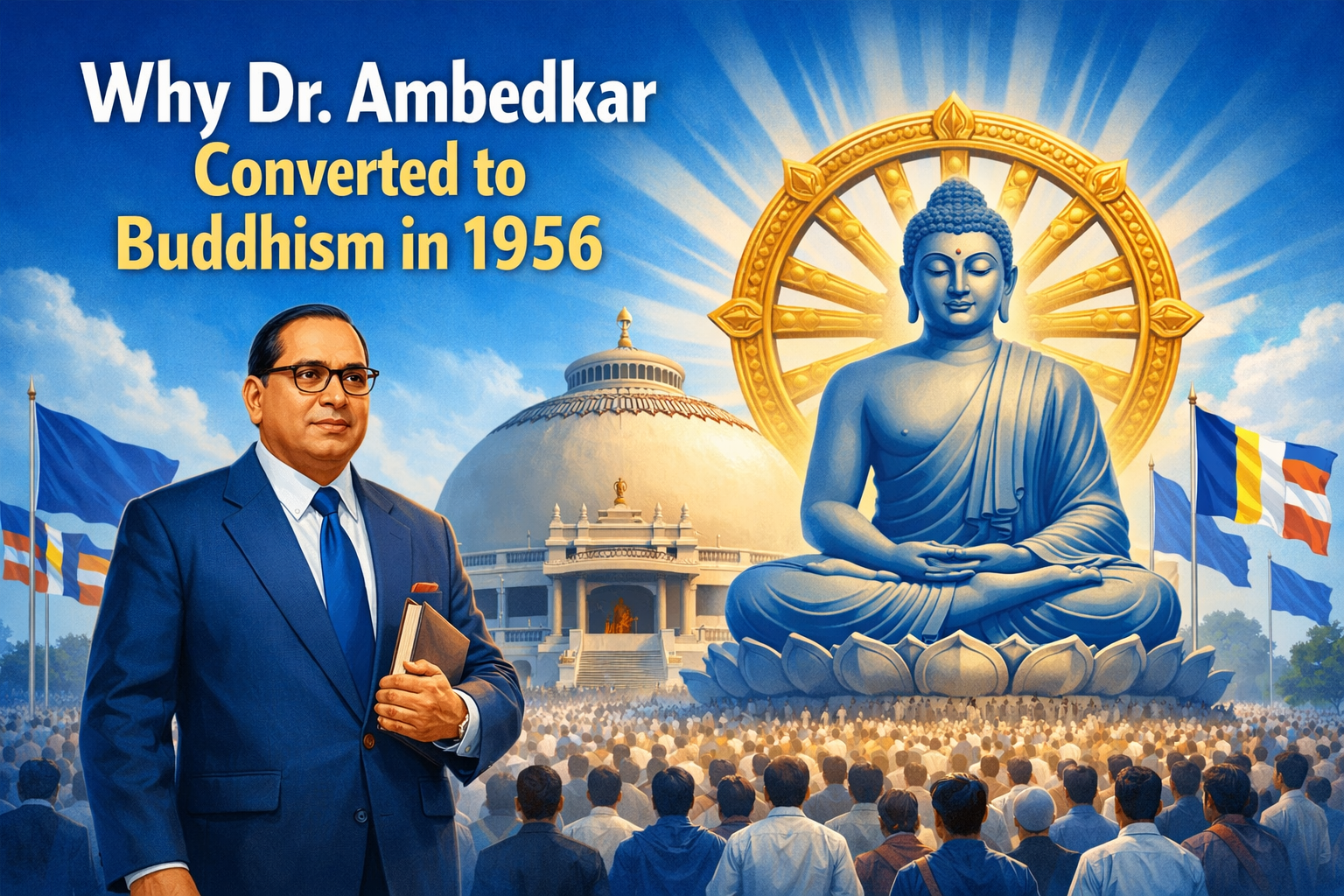
On the morning of 14 October 1956, in the city of Nagpur, Maharashtra, Dr. B.R. Ambedkar stood before hundreds of thousands of people and did something that shook all of India.
He converted to Buddhism.
He was 65 years old. He had spent 21 years studying every major religion in the world before this moment. And on this one morning — at a place now known as Deekshabhoomi — he walked away from the religion he was born into and stepped into one built on reason, equality, and compassion.
He did not do it alone. Approximately 400,000 people converted alongside him that day.
This is the full story of Ambedkar conversion to Buddhism — why he did it, when he did it, how it happened, and what it means for India today.
1. When Did Ambedkar Convert to Buddhism?
Dr. B.R. Ambedkar converted to Buddhism on 14 October 1956.
The day he chose was not random. 14 October 1956 was Ashoka Vijayadashami — the day traditionally associated with Emperor Ashoka’s own conversion to Buddhism in ancient India. Ambedkar chose this date deliberately, connecting his act to one of the greatest moments of Buddhist history.
| Key Fact | Detail |
| Date of Conversion | 14 October 1956 |
| Location | Deekshabhoomi, Nagpur, Maharashtra |
| Number of Converts | ~400,000 on 14 Oct; another 300,000+ on 16 Oct at Chandrapur |
| Monk Who Administered Vows | Mahasthavir Chandramani (Burmese Buddhist monk from Kushinagar) |
| Vows Taken | Three Jewels + Five Precepts + 22 Special Vows |
| Religion Left | Hinduism |
| Religion Adopted | Buddhism (Navayana / Neo-Buddhism) |
| Days Before His Death | 47 days |
2. Where Did His Conversion Take Place?
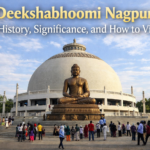
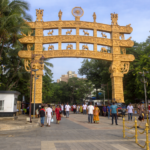
Ambedkar’s conversion took place at Deekshabhoomi — a large open ground in Nagpur, Maharashtra.
The word Deekshabhoomi means “Land of Initiation.” It is now one of the most sacred pilgrimage sites in India for Ambedkarite Buddhists and Dalits.
After the conversion, a magnificent stupa was built at Deekshabhoomi. Today, millions of pilgrims visit every year — especially on 14 October (Dhamma Chakra Pravartan Din) and 6 December (Mahaparinirvan Diwas). A part of Ambedkar’s ashes is also enshrined here.
Ambedkar chose Nagpur specifically because, as he explained in his speech, Nagpur was historically the homeland of the Nag people — a community that had played a key role in spreading Buddhism across India in ancient times.
3. Why Did Ambedkar Convert to Buddhism?
This is the most important question. And the answer has layers.
The simple answer: Ambedkar converted to Buddhism to escape the Hindu caste system, which, he believed, was built into the core of Hindu scripture and could not be reformed from within.
The deeper answer: He converted because Buddhism offered what Hinduism denied — equality, reason, and human dignity.
His entire life, Ambedkar had lived inside the caste system’s cruelty. As a child, he was denied water in school. As an adult with two foreign degrees, he was denied housing because of his caste. Even after writing India’s Constitution, caste discrimination followed Dalit people everywhere.
He had spent decades trying to reform Hinduism from within — asking upper castes to treat Dalits equally. It did not work. So he concluded: the problem was not bad people practising Hinduism badly. The problem was that caste hierarchy was built into the foundations of Hinduism itself — encoded in texts like the Manusmriti.
And if the foundation is rotten, you do not repaint the walls. You build a new house.
Buddhism was that new house.
4. The 21-Year Journey — From 1935 to 1956
Ambedkar’s conversion did not happen overnight. It took 21 years of searching, studying, and waiting.
1935 — The Declaration at Yeola: On 13 October 1935, at a conference of the Mahar community in Yeola, Nasik district, Maharashtra, Ambedkar made a public declaration that changed history:
“I was born a Hindu. I had no choice in the matter. But I will not die a Hindu.”
The crowd was stunned. He was 44 years old. He had not yet decided which religion to convert to — just that he was leaving Hinduism.
1935–1950 — The Research Years: Over the next 15 years, Ambedkar studied every major world religion in depth:
- Islam — He rejected it for keeping women unequal and for its strict social hierarchy
- Christianity — He rejected it for its colonial associations and hierarchical church structure
- Sikhism — He seriously considered it, but did not feel it offered a complete break from the Varna system
- Buddhism — He found it matched all his requirements for a truly equal religion
By 1950, his inclination toward Buddhism was clear. He wrote “Buddha and the Future of His Religion” in the Mahabodhi Journal that year, outlining exactly why Buddhism met his criteria for a rational, moral, and egalitarian religion.
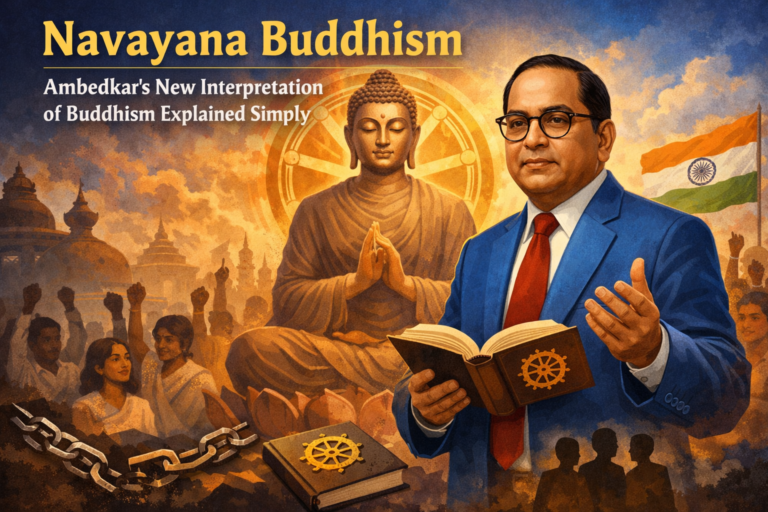
1956 — The Final Book: He completed his masterwork, “The Buddha and His Dhamma,” in 1956. It was published after his death. In it, he reinterpreted the Buddha’s teachings through the lens of social justice — creating what he called Navayana Buddhism (literally: “New Vehicle”).
5. Why Did He Choose Buddhism Over Other Religions?
Ambedkar gave specific, clear reasons for choosing Buddhism. He said a religion must have:
- The sanction of reason — it must make logical sense
- The principle of equality — it must treat all human beings the same
- A commitment to social justice — it must challenge oppression, not justify it
- A foundation in morality — conduct matters more than birth
Buddhism, he said, met every single one of these standards. The Buddha himself was born into the Kshatriya caste — and rejected caste entirely. The Buddha said, “A person is not born noble or ignoble. A person becomes noble or ignoble by their actions.”
For a man who had been told his entire life that his birth made him inferior, this message was everything.
6. What Happened at Deekshabhoomi on 14 October 1956?
The scene at Deekshabhoomi on 14 October 1956 was one of the most extraordinary in Indian history.
Early that morning, Ambedkar and his wife Savita received the Three Jewels (I take refuge in the Buddha, the Dhamma, and the Sangha) and the Five Precepts from the Burmese Buddhist monk Mahasthavir Chandramani, who had come specially from Kushinagar for this ceremony.
Then Ambedkar turned to the massive crowd — estimated at 400,000 people — and administered the Three Jewels, Five Precepts, and his own specially written 22 Vows to all of them.
The 22 Vows were Ambedkar’s unique addition — not part of traditional Buddhism. They were a direct rejection of the caste system and Hindu religious practices. They included vows like:
- “I shall not regard Brahma, Vishnu, and Mahesh as gods, nor shall I worship them.”
- “I shall not believe that God created this world.”
- “I believe that all human beings are equal.”
- “I shall follow the Noble Eightfold Path of Buddha.”
- “I solemnly declare that I shall hereafter lead my life according to the principles and teachings of the Buddha and his Dhamma.”
The entire ceremony was peaceful, emotional, and historic.
The very next day — 15 October — another 100,000 people converted at the same spot. Two days later, on 16 October 1956, Ambedkar led another mass conversion at Chandrapur, where over 300,000 more people embraced Buddhism.
In one weekend, the Buddhist population of India changed forever.
7. The 22 Vows — What Ambedkar Asked His Followers to Promise
The 22 Vows of Ambedkar are the soul of the Navayana Buddhist conversion ceremony. They are carved on a marble pillar at Deekshabhoomi. Here are the most important ones in simple language:
| Vow | What It Means |
| I shall not worship Hindu gods | Complete break from caste-linked Hindu rituals |
| I shall not believe in caste | Caste is rejected as a religious or social fact |
| All human beings are equal | Equality is the first principle |
| I shall follow the Noble Eightfold Path | The Buddhist way of right thought, speech, and action |
| I shall follow the Ten Paramitas of Buddha | Generosity, morality, patience, effort, meditation, wisdom |
| I shall not perform Shraddha | Rejection of Brahmin-controlled death rituals |
| I will spread Buddhist teachings | Every convert becomes a messenger of Dhamma |
These 22 vows are taken by every person who converts to Buddhism through the Ambedkarite tradition in India today.
8. What Happened After the Conversion?
The conversion ceremony’s impact was massive and immediate.
By March 1959 — just three years later — an estimated 15 to 20 million Dalits had converted to Buddhism across India. The 1961 census recorded that the Buddhist population of India had increased by 1,697% compared to 1951.
Today, India has over 8.44 million Buddhists — and approximately 6.5 million of them are Neo-Buddhists in Maharashtra — direct descendants of Ambedkar’s conversion movement.
Unfortunately, Ambedkar himself did not live long to see the movement grow. He passed away just 47 days after his conversion, on 6 December 1956, at his home in New Delhi.
His conversion is observed every year as Dhamma Chakra Pravartan Din on 14 October — a day of mass gatherings at Deekshabhoomi in Nagpur, where millions reaffirm their Buddhist vows.
9. How to Convert to Buddhism Legally in India
Many people who read about Ambedkar’s conversion ask: Can I convert to Buddhism? How does it work?
Yes — anyone in India can convert to Buddhism. Here is how it works:
Step 1 — The Ceremony (Dhamma Diksha): Contact your local Buddhist organisation or vihara. They will arrange a formal Dhamma Diksha ceremony where a Buddhist monk administers the Three Jewels, Five Precepts, and 22 Vows to you.
Step 2 — The Affidavit: After the ceremony, make an affidavit on a non-judicial stamp paper declaring that you have converted to Buddhism by your own free will. Get it notarised by a notary or magistrate.
Step 3 — Update Your Records: Submit the notarised affidavit to update your religion in official documents — including ration card, Aadhaar, school/college records.
Important for SC Students: As per a 1990 government order, people of Scheduled Caste origin who convert to Buddhism retain their SC status and remain eligible for all SC reservations and scholarships. This was a direct result of the Ambedkarite movement’s advocacy.
How long does it take? The ceremony itself takes about 1–2 hours. The paperwork takes 1–2 weeks. There is no waiting period or approval required.
10. Which Indian King Also Converted to Buddhism?
Many students ask this question — especially in competitive exams.
The most famous Indian king to convert to Buddhism was Emperor Ashoka — also called Samrat Ashoka — of the Maurya Empire in the 3rd century BCE.
After the devastating Kalinga War (around 261 BCE), in which over 100,000 people died, Ashoka was overcome with grief and remorse. He converted to Buddhism and spent the rest of his life spreading the Buddha’s teachings of peace, non-violence, and compassion across Asia.
This is exactly why Ambedkar chose 14 October — Ashoka Vijayadashami — for his own conversion. He was consciously connecting his act to Ashoka’s historic conversion — linking the two greatest moments of Buddhist revival in Indian history.
11. Frequently Asked Questions
When did Ambedkar convert to Buddhism?
Dr. B.R. Ambedkar converted to Buddhism on 14 October 1956 — a date that falls on Ashoka Vijayadashami. The ceremony took place at Deekshabhoomi in Nagpur, Maharashtra. Approximately 400,000 followers converted alongside him on that single day.
Why did Ambedkar convert to Buddhism?
Ambedkar converted to Buddhism because he believed the Hindu caste system was built into the foundation of Hindu scripture and could not be reformed from within. He found that Buddhism aligned with his values of equality, reason, and social justice. The Buddha had explicitly rejected the caste system — and his teachings offered Dalit people a path to live with dignity. Ambedkar declared his intention to leave Hinduism in 1935 and spent 21 years studying all major world religions before choosing Buddhism in 1956.
Where did Ambedkar’s conversion to Buddhism take place?
His conversion took place at Deekshabhoomi in Nagpur, Maharashtra. The word means “Land of Initiation.” It is now a sacred Buddhist pilgrimage site visited by millions of people every year. A large stupa was built there after his death, and part of Ambedkar’s ashes are enshrined inside it.
In which year did Ambedkar convert to Buddhism?
Dr. Ambedkar converted to Buddhism in 1956, specifically on 14 October 1956. He died just 47 days later, on 6 December 1956. Despite his short life as a Buddhist, his conversion inspired 15–20 million people to embrace Buddhism within three years.
What are Ambedkar’s 22 vows?
The 22 vows are a set of pledges that Ambedkar wrote himself and administered to his followers at Deekshabhoomi on 14 October 1956. They include rejecting Hindu gods and caste hierarchy, affirming the equality of all human beings, following the Buddha’s Noble Eightfold Path, and committing to spread Buddhist teachings. These vows go beyond traditional Buddhism — they are specifically designed as a tool for social liberation from caste oppression. They are taken by every person who converts through the Ambedkarite Buddhist tradition today.
Can you convert to Buddhism in India?
Yes. Any person in India can convert to Buddhism freely. You attend a formal Dhamma Diksha ceremony at a Buddhist organisation or vihara, take the Three Jewels, Five Precepts, and 22 Vows, and then make a notarised affidavit declaring your conversion. People of SC origin who convert to Buddhism retain their SC status and reservation benefits under a 1990 government order. The entire process takes one ceremony and a few weeks of paperwork.
Conclusion
On the morning of 14 October 1956, Dr. B.R. Ambedkar stood at Deekshabhoomi and made the most powerful personal statement of his 65-year life.
He was not just choosing a new religion. He was choosing freedom.
He was saying — in front of 400,000 witnesses, with the whole nation watching — that no human being is born untouchable. No ancient text has the right to declare one human being less worthy than another. No religion that justifies caste deserves your loyalty.
He said it with a ceremony. He said it with 22 vows. He said it with the lives of millions of people who followed him into a new path.
Jai Bhim. Jai Buddha.