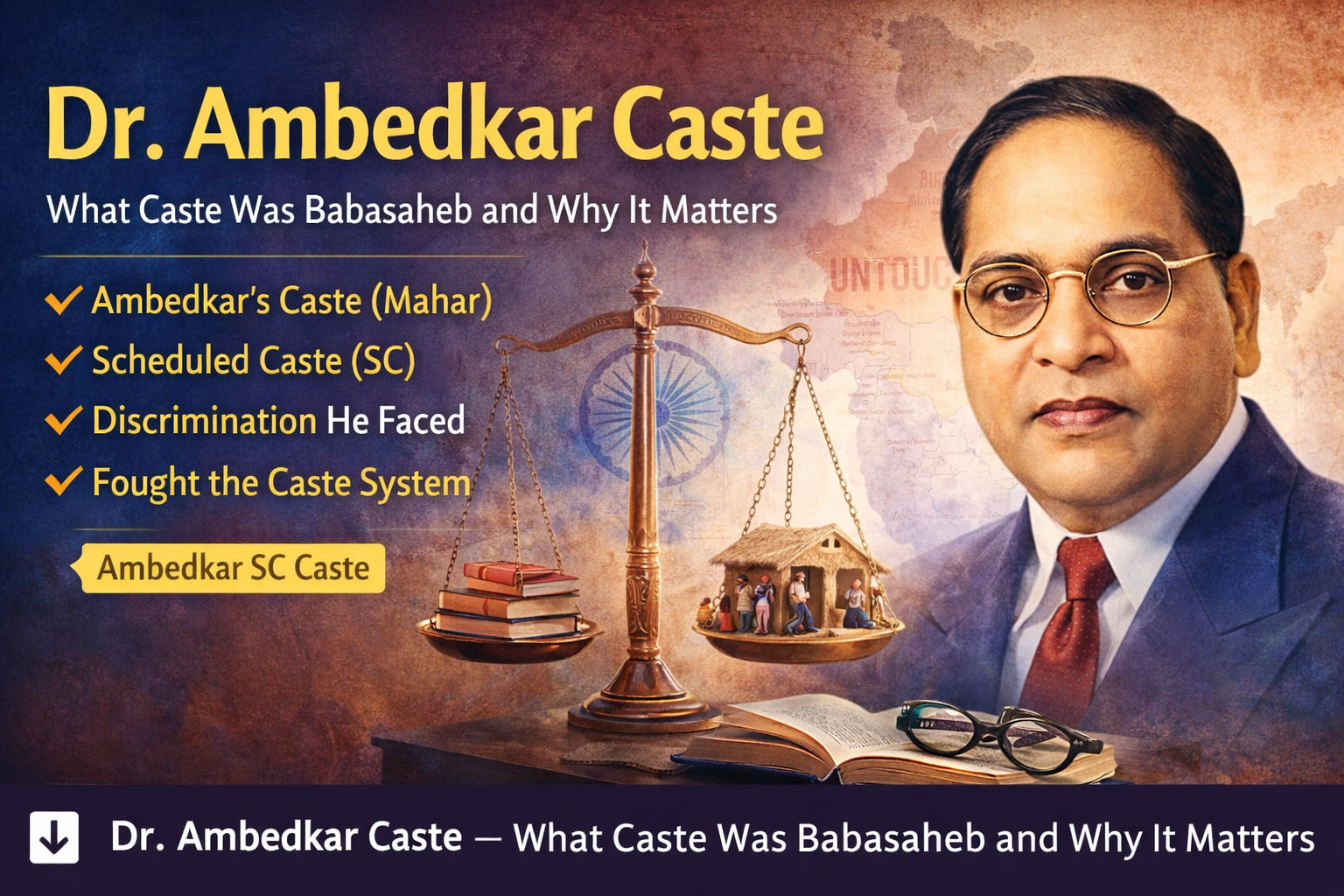
Dr. B.R. Ambedkar was born into the Mahar caste — one of the communities classified as Scheduled Caste (SC) under the Indian Constitution.
The Mahar community was treated as untouchable in Indian society for centuries. They were forced to live outside village boundaries. They were not allowed to draw water from public wells. They were not permitted to enter temples. And in Ambedkar’s school days, young Bhimrao could not even sit inside a classroom.
He was born into this caste. He spent his entire life fighting to destroy the system that created it.
This is the full story of Ambedkar caste — what it was, what it meant, what it did to him as a child, and how he turned that pain into one of the greatest fights for human equality the world has ever seen.
The Mahar community belongs to the Scheduled Caste (SC) category — the category that the Indian Constitution uses for communities that were historically treated as untouchable under the Hindu caste hierarchy.
Here is the complete caste information for Dr. Ambedkar:
Detail
Answer
Caste Name
Mahar
Caste Category
Scheduled Caste (SC)
Sub-category
Dalit
State of Origin
Maharashtra
Religion at Birth
Hindu
Religion at Death
Buddhist (converted 14 October 1956)
Father’s Caste
Mahar (Ramji Maloji Sakpal)
Is Mahar SC or ST?
Scheduled Caste (SC) — NOT ST
2. Ambedkar Caste — SC or ST? The Clear Answer
This is one of the most searched questions about Ambedkar’s caste. Let us answer it clearly.
Dr. Ambedkar’s caste — Mahar — is a Scheduled Caste (SC). It is NOT a Scheduled Tribe (ST).
In India, Scheduled Castes (SC) and Scheduled Tribes (ST) are two separate categories listed in the Indian Constitution. SCs are mostly communities that faced untouchability within the Hindu caste system. STs are mostly tribal or indigenous communities that live in forests and hills.
The Mahar community falls under the Scheduled Caste (SC), not the Scheduled Tribe (ST). This is true across Maharashtra and in all other states where Mahars are listed.
If you search “ambedkar caste sc or st” — the answer is SC.
3. What Is the Mahar Caste? History and Origins
The Mahar community is one of the oldest and largest communities in Maharashtra. In fact, the name “Mahar” itself is said to mean “original inhabitants of Maharashtra” — Maha (great) + Raashtrakuta (kingdom). Some historians call the Mahars the Bumiputera — Sons of the Soil.
The Mahars have a long and proud history. For centuries, they served as village administrators, watchmen, boundary guards, and messengers. They defended the village boundaries from outside attackers. Their traditional name Kathiwale — meaning “Men with Sticks” — reflects this history of protection and authority.
But over centuries, as the caste system became more rigid, the Mahar community was pushed to the bottom of the social hierarchy. By the time Ambedkar was born in 1891, the Mahar community faced brutal conditions:
They lived on the outskirts of villages, separated from the main settlement
They could not use public water sources
They were forced to perform menial duties like removing dead cattle and sweeping streets
Upper castes believed their very shadow was polluting
They could not enter Hindu temples
The Mahar community is listed as a Scheduled Caste in 16 Indian states as of 2017, including Maharashtra, Madhya Pradesh, Gujarat, Karnataka, Andhra Pradesh, and others.
4. Ambedkar Caste in Different States
Students often search for “Ambedkar caste in Maharashtra,” “Ambedkar caste in Tamil,” “Ambedkar caste telugu,” and “Ambedkar caste kannada.” Here is the clear picture:
State
Is Mahar Listed as SC?
Local Name / Notes
Maharashtra
Yes — largest SC community (9% of state population)
Mahar
Madhya Pradesh
Yes
Mahar / Mehra
Karnataka
Yes
Mahar
Andhra Pradesh / Telangana
Yes
Mahar
Gujarat
Yes
Mahar
Tamil Nadu
The Mahar community is not prominent here; the Adi Dravida and Paraiyar are the main SC communities
—
In every state where the Mahar community exists, they are listed under the Scheduled Caste (SC) category — not OBC, not ST.
5. Ambedkar’s Caste-Based Discrimination — His Own Story
Ambedkar did not just study the caste system from books. He lived its cruelty from the day he was born.
Here are the real experiences of caste-based discrimination that Dr. Ambedkar personally went through — in his own words and in documented historical records.
At School in Satara: When young Bhimrao started school, the teacher made him sit outside the classroom on a gunny sack. He had to bring the sack from home and take it back every day — because his body was considered unclean. Other students would not sit near him. Teachers paid him no attention.
The Water Episode: Bhimrao could not touch the water tap or the pot in school. When he needed water, a school peon poured it from a height so that Bhimrao’s hands would not “pollute” the vessel. He later described this with three devastating words: “No peon, no water.” On days the peon was absent, he went thirsty all day.
In Baroda — After His PhD: When Ambedkar returned to India after earning his PhD from Columbia University, he went to Baroda (now Vadodara) to work as Defence Secretary to the King, the same king who had funded his scholarship. No one would rent him a house. He was a PhD holder with one of the world’s top degrees. He was still homeless because of his caste. He had to secretly stay at a Parsi inn by hiding his identity. When his caste was discovered, he was thrown out.
At Sydenham College: When he joined Sydenham College of Commerce as a professor in Mumbai, other professors refused to share the water jug with him. He was an educator at a college. Still, untouchability followed him into the faculty room.
These experiences did not make Ambedkar bitter toward life. They made him furious about injustice. And that fury became fuel.
6. How Ambedkar Fought the Caste System
Ambedkar did not just survive caste discrimination — he built a systematic, lifelong campaign to destroy it. Here is how:
Through Writing: In 1936, he wrote Annihilation of Caste — one of the most powerful critiques of the Hindu caste system ever written. He was supposed to deliver it as a speech to a conference of liberal Hindu reformers. When they read the text, they cancelled his invitation. He published it himself. It still circulates in millions of copies today.
Through Law:He drafted Article 17 of the Indian Constitution, which abolished untouchability and made practising it a punishable offence. For the first time in India’s history, caste-based discrimination became illegal.
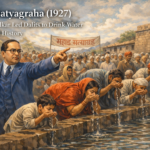
Through Protest: He led the Mahad Satyagraha in 1927, marching thousands of Dalit people to a public water tank in Mahad, Maharashtra to assert their right to drink from public water. He publicly burnt the Manusmriti — the ancient text that codified caste hierarchy.
Through Religious Conversion: In 1956, he converted to Buddhism, taking nearly 600,000 followers with him. He chose Buddhism because it was a religion of reason and equality that rejected the caste system entirely.
7. Ambedkar’s View on the Caste System
Dr. Ambedkar did not see caste as just a social problem. He saw it as a system deliberately built to keep certain people permanently down.
His most famous quote on caste: “Caste is not a division of labour. It is a division of labourers.”
He meant: caste does not just divide work — it divides human beings. It does not say “this job is less important.” It says, “This person is less human.” That was the evil he dedicated his life to fighting.
He wrote in Annihilation of Caste: “The caste system is not merely a division of labour. It is also a division of labourers into watertight compartments, a hierarchy from which there is no escape.”
He believed the only real solutions were education, political power, legal rights, and inter-caste marriage — and he spent every year of his life building all four.
8. What Happened to the Mahar Community After Ambedkar?
After Ambedkar led the mass conversion to Buddhism in 1956, most Mahars followed him. Today:
According to the 2011 census, 62% of Mahars identify as Buddhist
The community is now largely referred to as Neo-Buddhists or Ambedkarite Buddhists
The Mahar community remains the largest Scheduled Caste in Maharashtra, making up about 9% of the state’s population
Many Mahar/Neo-Buddhist families have entered education, government service, and professional fields through the reservation system Ambedkar built
However, caste-based discrimination and violence against SC communities — including former Mahars — continues to be reported across India
Ambedkar’s work changed the legal status of the Mahar community forever. But the social work he started is still unfinished.
9. Frequently Asked Questions
What caste did Dr. Ambedkar belong to?
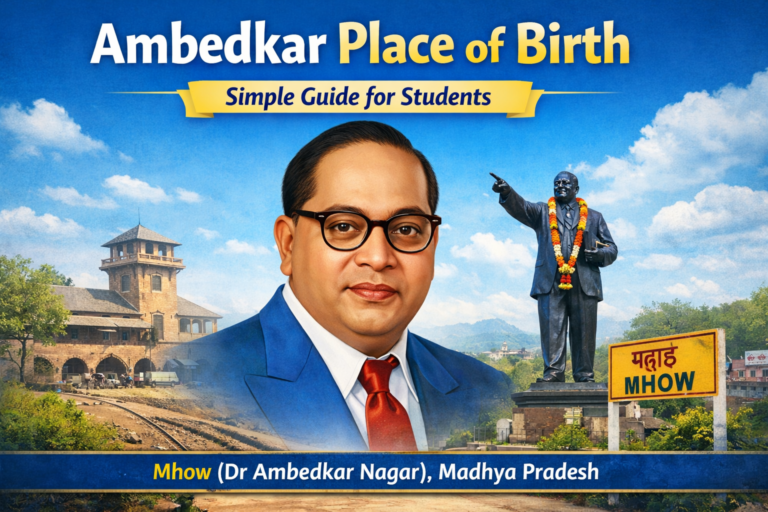
Dr. B.R. Ambedkar belonged to the Mahar caste — a Scheduled Caste (SC) community primarily found in Maharashtra and other parts of central and western India. The Mahar community was historically treated as untouchable under the Hindu caste system. Ambedkar was born into this caste on 14 April 1891 in Mhow, Madhya Pradesh.
Was Ambedkar’s caste SC or ST?
Dr. Ambedkar’s caste — Mahar — is a Scheduled Caste (SC). It is NOT a Scheduled Tribe (ST). The Mahar community is listed as a Scheduled Caste in 16 Indian states. It is one of the largest and most historically significant SC communities in Maharashtra.
What is the Ambedkar caste category?
The Ambedkar caste category is the Scheduled Caste (SC). Within the SC category, Mahar is classified as a Dalit community — one of the communities that faced untouchability under the Hindu social system. Under the Indian Constitution (which Ambedkar himself wrote), all forms of caste discrimination are prohibited.
What caste discrimination did Ambedkar face personally?
Dr. Ambedkar faced severe caste-based discrimination throughout his life. As a child, he was made to sit outside his classroom on a gunny sack and was denied drinking water unless a peon poured it from a height. As an adult — even after earning a PhD from Columbia University — he was refused housing in Baroda because of his caste. Fellow professors at Sydenham College refused to share a water jug with him. These experiences directly motivated his lifelong fight against the caste system.
Did Ambedkar change his caste?
Ambedkar could not change the caste he was born into — no one can. But he rejected the system that gave caste its power. On 14 October 1956, he formally converted to Buddhism — along with approximately 600,000 followers — as a conscious act of rejecting the Hindu caste hierarchy. He could not erase the caste he was born into, but he refused to live and die inside a system that treated him as less than human.
Conclusion
Dr. Ambedkar’s caste was Mahar — Scheduled Caste (SC), category Dalit, from Maharashtra.
He did not choose this caste. No one chooses the family they are born into. But he chose what to do with the pain that came from it.
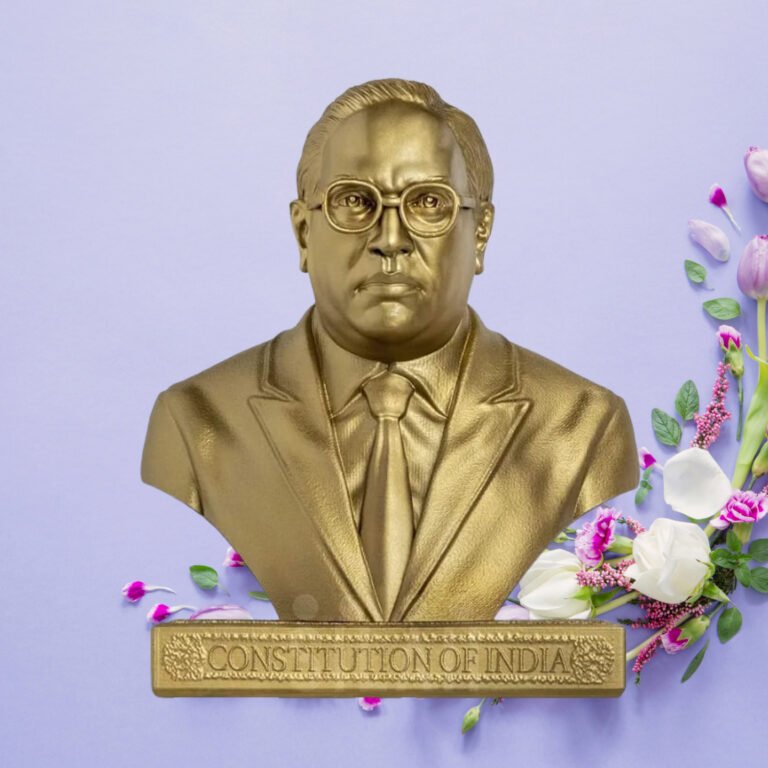
He studied. He fought. He wrote. He marched. He argued in the highest rooms of power. He wrote a Constitution that made every human being in India equal under the law.
He was born untouchable. He built the document that said: no one is untouchable. Ever again.
That is what his caste gave the world — not shame, but a revolution.