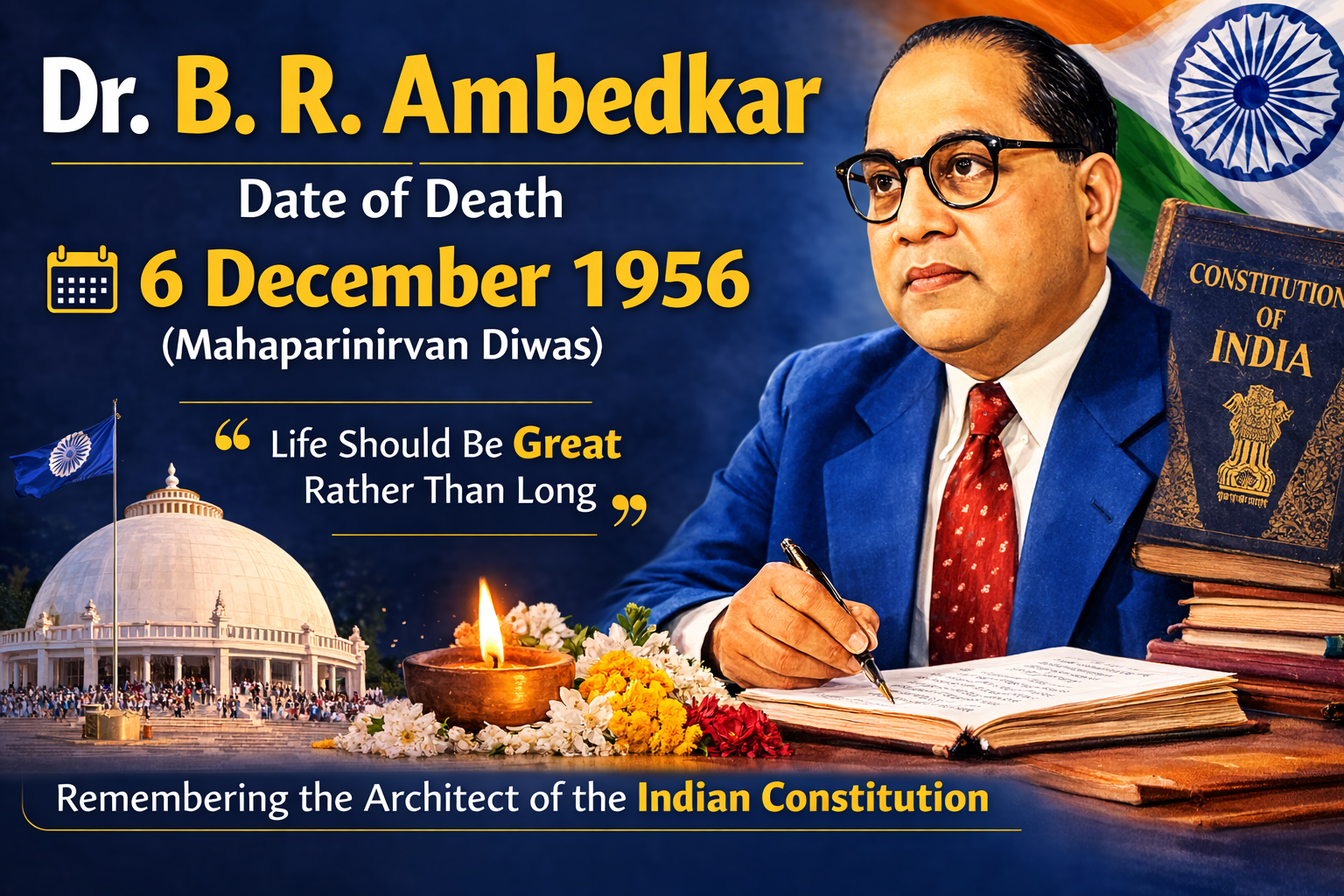
Dr. B.R. Ambedkar died on 6 December 1956. He passed away quietly in his sleep at his home in New Delhi. He was 65 years old.
That morning, India woke up to news that changed the country forever. The man who had fought untouchability, written the Indian Constitution, and spent every single day of his life fighting for the rights of crores of poor and marginalised people — was gone.
But his work was not gone. It never will be.
In this article, you will learn everything about Dr. Ambedkar date of death — when he died, how he died, what his final days looked like, and why millions of people across India still observe 6 December as Mahaparinirvan Diwas every year.
Dr. B.R. Ambedkar died on 6 December 1956 in New Delhi, India.
He passed away in his sleep at his residence on 26 Alipur Road, New Delhi — a home that has since been turned into a memorial in his honour.
His full name was Bhimrao Ramji Ambedkar. He was popularly known as Babasaheb — a name that means “respected father.” Millions of Dalit, SC, ST, and OBC people across India still call him that today.
Key Fact
Detail
Date of Death
6 December 1956
Place of Death
26 Alipur Road, New Delhi
Age at Death
65 years
Cause of Death
Natural causes — declining health due to diabetes
Date of Birth
14 April 1891
Death Anniversary
Observed as Mahaparinirvan Diwas
2. Who Was Bhimrao Ramji Ambedkar?
Before we talk about his death, you need to understand who this man really was — because the size of his death can only be understood by knowing the size of his life.
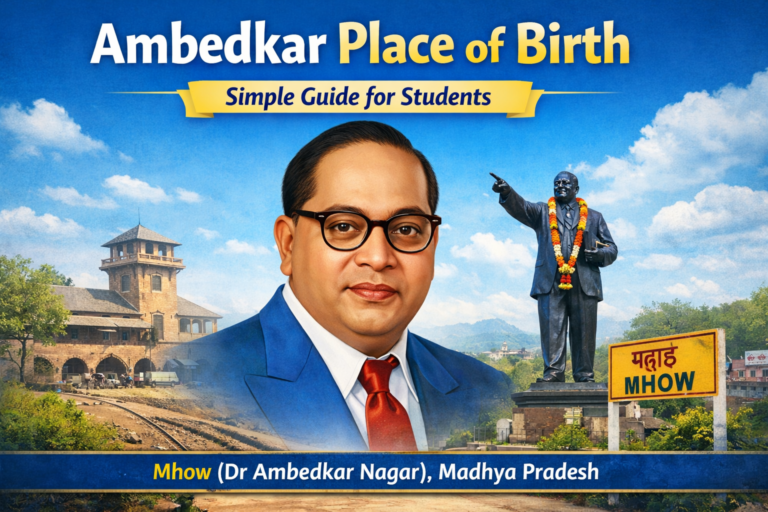
Dr. Bhimrao Ramji Ambedkar was born on 14 April 1891 in Mhow, Madhya Pradesh. He was born into the Mahar caste — one of the communities treated as untouchable under India’s brutal caste system.
As a child, he was not allowed to sit inside his classroom. He could not drink water from the school tap. Teachers ignored him. Other students refused to play with him.
But young Bhimrao did something extraordinary — he studied harder than anyone else.
He went on to earn a PhD from Columbia University in New York and a DSc from the London School of Economics in Britain. He became a lawyer, an economist, a politician, and India’s most powerful voice for equality and social justice.
His greatest achievement? He became the Chairman of the Drafting Committee of the Constituent Assembly — the man who actually wrote the Constitution of India. He built Article 17 into it, which abolished untouchability and made it a punishable offence under Indian law.
He served as India’s first Law Minister from 1947 to 1951. He fought for reservations in education and government jobs for SC/ST/OBC communities. He launched historic movements like the Mahad Satyagraha of 1927 and negotiated the Poona Pact to secure political representation for Dalits.
Everything he did, he did for one reason: so that people born in lower castes could live with dignity.
3. How Old Was Dr. Ambedkar When He Died?
Dr. Ambedkar was 65 years old when he died on 6 December 1956.
He was born on 14 April 1891. By the time of his death, he had given 65 years of his life to studying, fighting, writing, and arguing — all in the service of justice.
For someone who had worked as hard as he had — and fought as many battles as he had — 65 was not an old age. It was too young. India needed him for much longer.
4. What Happened in His Final Days?
The last few years of Dr. Ambedkar’s life were full of physical pain. He suffered from severe diabetes that gradually weakened his body. His eyesight became very poor. Walking became difficult. He struggled to complete the books and projects he had started.
But even in those painful final years, he did not stop working. He was writing his most personal book — “The Buddha and His Dhamma” — right up until his final days. He completed the manuscript just before he died. The book was published after his death.
He attended events, gave speeches, and kept fighting. His body was slowing down, but his mind and his purpose never did.
5. The Last Great Act — Conversion to Buddhism
Just 47 days before his death, Dr. Ambedkar did something that shook the entire country.
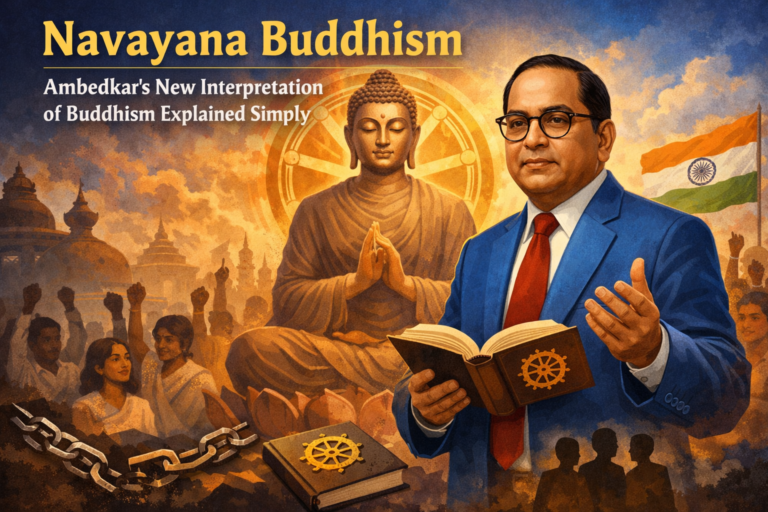
On 14 October 1956, in Nagpur — at a place now called Deekshabhoomi — he formally converted to Buddhism. He had declared his intention to leave Hinduism back in 1935, saying: “I was born in Hinduism but I will not die a Hindu.”
It took him 21 years to choose the right religion and the right moment.
At the Nagpur ceremony, approximately 600,000 people converted to Buddhism along with him in a single day. It was one of the largest mass religious conversions in world history.
He chose Buddhism because it was a religion of reason, equality, and compassion — everything the caste system was not. His conversion was not just a personal decision. It was a powerful political and social statement to all of India: Dalit people refuse to live in a system that dehumanises them.
6. How Did Dr. Ambedkar Die?
Dr. Ambedkar died of natural causes on the night of 5–6 December 1956. He passed away in his sleep.
His body was discovered in the morning at his residence on 26 Alipur Road in New Delhi.
He had been suffering from diabetes for years. In the weeks before his death, his health had declined significantly. He was weak and largely confined to his home.
There was no drama. No final battle. Just a man who had fought every single day of his life — finally resting.
7. What Happened After His Death?
The news of his death spread across India like a wave of grief.
His body was brought from Delhi to Mumbai. His funeral took place at Dadar Chowpatty Beach in Mumbai on 7 December 1956. It was a Buddhist funeral — matching his conversion just weeks before.
Over 10,00,000 people attended his funeral. It was one of the largest funeral gatherings in Indian history. People came from every corner of Maharashtra and beyond — weeping, chanting, and paying their final respects to the man they called Babasaheb.
The spot where his funeral took place is now known as Chaityabhoomi — and it has become one of the most sacred places for Ambedkarites across India.
Every year on 6 December, millions of people travel to Chaityabhoomi to observe his death anniversary. The crowd is so large that it rivals the gathering at Ambedkar Jayanti on 14 April.
8. What Is Mahaparinirvan Diwas?
Mahaparinirvan Diwas is observed every year on 6 December to mark the death anniversary of Dr. B.R. Ambedkar.
The word comes from Buddhism. In Buddhist teachings, Mahaparinirvana means the final liberation — the ultimate nirvana that comes after death, a complete release from the cycle of suffering. It is one of the most sacred concepts in the Buddhist calendar.
Dr. Ambedkar’s followers gave his death anniversary this name because they believe he was as transformative a figure as the Buddha himself — and that his passing deserves the same reverence.
On this day across India:
Millions gather at Chaityabhoomi in Mumbai
Government offices hold tribute events
Schools and colleges organise remembrance programmes
People share Ambedkar’s quotes and images on social media with the hashtag #MahaparinirvanDiwas
It is a day of mourning, yes. But more than that, it is a day of reflection and recommitment — to carry forward the work he left behind.
9. Why Is Dr. Ambedkar’s Death So Important to Remember?
Because the rights you have today came from his life.
Every SC/ST/OBC student who sits in a classroom, applies for a scholarship, or casts a vote in an election. You live inside the world Dr. Ambedkar built.
He wrote Article 17, which made untouchability illegal. He built the reservations in education and jobs that give marginalised communities a fair chance. He fought for political representation so that Dalit voices could never be completely silenced.
When you observe 6 December, you are not just remembering a man’s death. You are honouring the fact that one human being — born into the most disadvantaged position in Indian society — changed the destiny of millions of people through the sheer power of education, courage, and relentless work.
That is worth remembering. Every year. Every December.
10. Frequently Asked Questions
When did Ambedkar die?
Dr. B.R. Ambedkar died on 6 December 1956. He passed away in his sleep at his home at 26 Alipur Road in New Delhi. His death anniversary is observed every year as Mahaparinirvan Diwas.
Who was Dr. B.R. Ambedkar?
Dr. B.R. Ambedkar — full name Bhimrao Ramji Ambedkar — was an Indian jurist, economist, social reformer, and politician. Born on 14 April 1891 in Mhow, Madhya Pradesh, he is best known as the chief architect of the Indian Constitution and India’s first Law Minister. He fought all his life for the rights of Dalit, SC, ST, and OBC communities, and converted to Buddhism just 47 days before his death.
How old was Dr. Bhimrao Ramji Ambedkar when he died?
Dr. Bhimrao Ramji Ambedkar was 65 years old when he died on 6 December 1956. He was born on 14 April 1891. His health had been declining for several years due to severe diabetes before his passing.
Who was Bhimrao Ramji Ambedkar?
Bhimrao Ramji Ambedkar was one of the greatest leaders in Indian history. Born into the Mahar Dalit caste in 1891, he overcame severe caste discrimination to earn a PhD from Columbia University and a DSc from the London School of Economics. He wrote India’s Constitution, abolished untouchability through Article 17, and spent his entire life fighting for the rights of India’s most marginalised communities. Millions of his followers call him Babasaheb — meaning “respected father.”
What is Mahaparinirvan Diwas?
Mahaparinirvan Diwas is the death anniversary of Dr. B.R. Ambedkar, observed every year on 6 December. The word Mahaparinirvana comes from Buddhism and refers to the final liberation after death. Millions gather at Chaityabhoomi in Mumbai and other memorials across India to pay tribute to Babasaheb on this solemn day.
Conclusion
Dr. B.R. Ambedkar died on 6 December 1956 — but his work did not die with him.
He left behind a Constitution that protects every citizen equally. He left behind laws that made untouchability a crime. He left behind a movement — carried forward by millions of people — that still fights for the dignity of India’s marginalised communities.
He lived 65 years. In those 65 years, he changed India more than most people change in ten lifetimes.
Every time you drink water from a public tap without anyone stopping you — that is Ambedkar’s life made real. Honour it.