Featured Snippet Answer (Direct Answer Box Target)
What is the difference between a Caste Certificate and a Caste Validity Certificate?
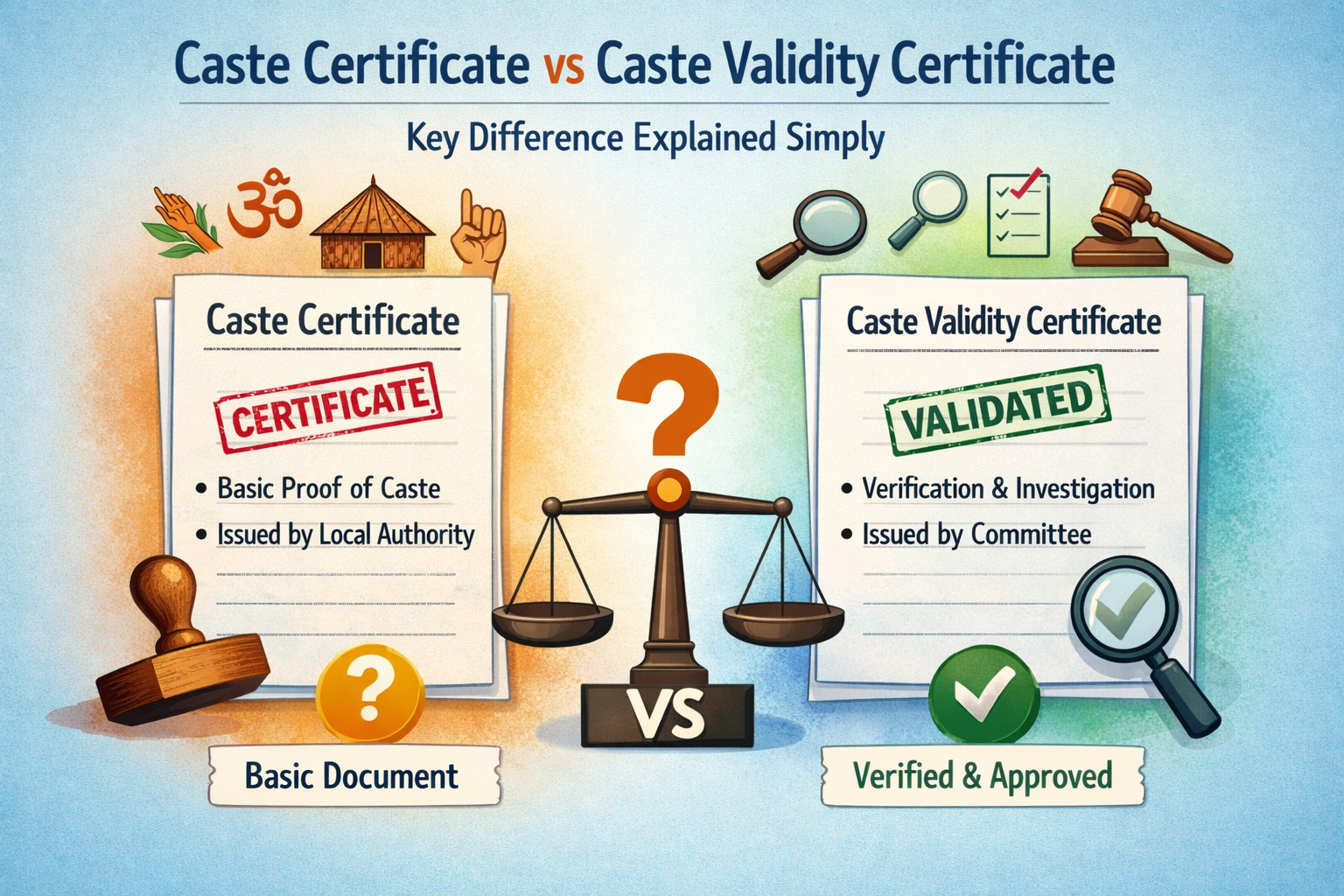
A Caste Certificate is an official document issued by local government authorities (Tehsildar/SDM) that simply states which caste an individual belongs to. A Caste Validity Certificate is a separate, higher-level document issued by the District Caste Certificate Scrutiny Committee that verifies and confirms the authenticity of the caste certificate. In simple terms, the Caste Certificate says, “I belong to this caste.” The Caste Validity Certificate says, “We have verified that claim, and it is genuine.”
You need both documents to fully claim reservation benefits in education, government jobs, and competitive exams — especially in Maharashtra.
Introduction: Why This Confusion Costs Students Their Seats
Every year, thousands of SC, ST, OBC, VJ, NT, and SBC students across Maharashtra lose their reserved seats — not because of merit, but because they submitted the wrong document at the wrong time.
They either submitted a Caste Certificate where a Caste Validity Certificate was required, or they didn’t know the two were different things at all.
This article will end that confusion permanently. If you are a student, job applicant, or parent trying to understand the Indian caste documentation system, this is the only guide you need.
What Is a Caste Certificate?
A Caste Certificate is the primary, foundational document that certifies an individual’s membership in a particular caste — specifically for those belonging to Scheduled Castes (SC), Scheduled Tribes (ST), Other Backward Classes (OBC), Vimukta Jati (VJ), Nomadic Tribes (NT), or Special Backward Class (SBC).
Who issues it? The Caste Certificate is issued by the local revenue authority — typically the Tehsildar or Sub-Divisional Magistrate (SDM) — at the district or taluka level.
What does it contain? It states the applicant’s name, caste, category (SC/ST/OBC, etc.), district, and state. It is essentially a government declaration: “This person belongs to this caste.”
What is it used for? It is the entry-level document used for school admissions, applying for scholarships, government schemes, and as the base proof of caste identity. Without a Caste Certificate, you cannot apply for a Caste Validity Certificate.
Validity period: For SC and ST categories, the caste certificate is generally valid for a lifetime, since caste is determined by birth and does not change. For OBC candidates, periodic renewal may be required depending on the state.
What Is a Caste Validity Certificate?
A Caste Validity Certificate is an advanced verification document that goes one step further than the Caste Certificate. It does not just state your caste — it legally verifies that your Caste Certificate is genuine, authentic, and that you are truly eligible for the caste-based benefits you are claiming.
Who issues it? In Maharashtra, the Caste Validity Certificate is issued by the District Caste Certificate Scrutiny Committee — a government body specifically created for this verification purpose. The BARTI (Dr. Babasaheb Ambedkar Research and Training Institute) manages the online system for this in Maharashtra through the CCVIS portal.
What does verification involve? The Scrutiny Committee examines ancestral records, genealogical history, revenue records, village panchayat records, and other documentary proof going back generations to confirm the caste claim is legitimate — not fraudulent.
How long does it take? The District Caste Certificate Scrutiny Committee is required to take a decision and issue the Validity Certificate within 3 months from the date of application submission. In exceptional circumstances, an additional 2 months may be allowed.
What is it used for? The Caste Validity Certificate is mandatory for higher-stakes situations: admission to professional colleges (engineering, medical, law), government job appointments, MPSC and other competitive exam benefits, and election candidature under reserved constituencies.
The Core Difference: A Simple Table
Feature
Caste Certificate
Caste Validity Certificate
Purpose
States your caste
Verifies your caste is genuine
Issued by
Tehsildar / SDM
District Scrutiny Committee
Level
Primary document
Secondary verification document
Required for
Schools, basic schemes
Colleges, govt jobs, MPSC
Based on
Your application + basic proof
Deep ancestral scrutiny
Time to get
15–45 days typically
Up to 3 months
Can you apply without it?
No — it is the first step
No — needs Caste Certificate first
Validity
Lifetime (SC/ST); varies for OBC
Issued once; permanent after verified
Think of It This Way — A Simple Analogy
Imagine you apply for a driving licence. You fill the form and get a Learner’s Licence — that is your Caste Certificate. It says you are in the system and have made your claim.
Then the RTO does your actual driving test, verifies everything is correct, and gives you the Permanent Driving Licence — that is your Caste Validity Certificate. It confirms everything is genuine and gives you full legal access.
One without the other is incomplete.
When Do You Need Which Document?
Situations where the Caste Certificate alone is sufficient:
Admission to Class 1 through Class 10
Applying for state government scholarships (basic level)
Ration card category benefits
Initial application for reservation in some schemes
Situations where Caste Validity Certificate is compulsory:
Admission to degree colleges, engineering colleges (CET/JEE), medical colleges (NEET), and law colleges
Final appointment to the Maharashtra government jobs after the MPSC selection
Claiming reservation benefits in MPSC, UPSC, and other competitive exams
Contesting elections from reserved constituencies
Post-graduate college admissions (M.Tech, MBA, M.Sc under CCMT/CCMN)
Important: Many students submit their Caste Certificate for college admission, but are then asked for the Caste Validity Certificate before the seat is confirmed. If you don’t have it ready, you may lose the seat. Apply for your Caste Validity Certificate as early as possible — ideally right after getting your Caste Certificate.
How to Apply for a Caste Validity Certificate in Maharashtra
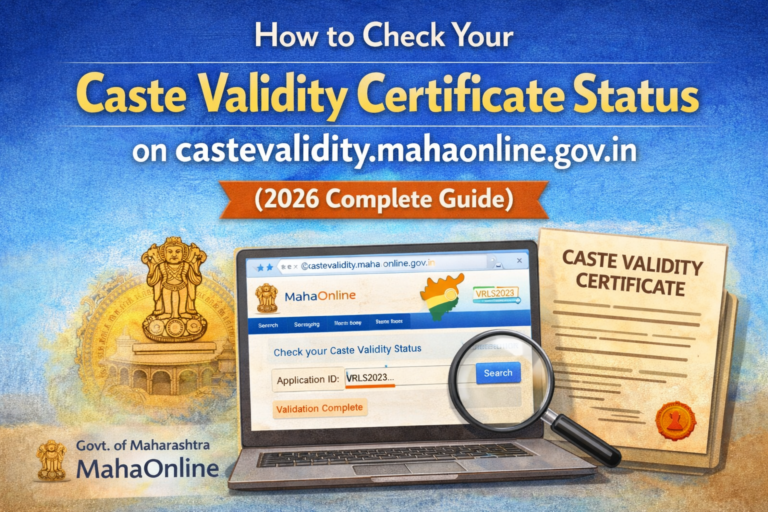
Step 1: Visit the official portal: bartievalidity.maharashtra.gov.in or castevalidity.mahaonline.gov.in
Step 2: Fill out the Caste Validity Certificate online application form correctly. Upload scan copies of all original documents.
Step 3: Take a printout of the submitted application and attach all supporting documents (originals or self-attested copies).
Step 4: Submit the physical application with documents to your Respective District Caste Certificate Scrutiny Committee office.
Step 5: Track your application status online. You will be notified by SMS and email.
Step 6: If your case is valid, you receive the Validity Certificate with an e-signature sent to your registered email. You can also download it from DigiLocker.
Documents Required (General List):
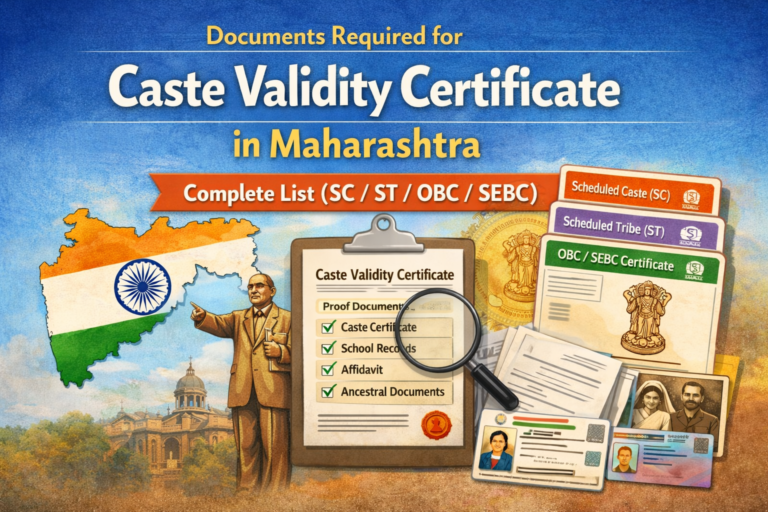
Original Caste Certificate
Proof of identity (Aadhaar, Voter ID, Passport)
Proof of residence
Father’s caste certificate or the blood relative’s caste certificate
Revenue records or village panchayat records
Affidavit of caste status
Validity Certificate of father or relative (if already issued by Scrutiny Committee)
Mistake 1: Thinking they are the same document. They are completely different. One states. The other verifies. Never submit one where the other is required.
Mistake 2: Waiting until the last minute. The validity certificate takes up to 3 months. Apply for it the moment you have your Caste Certificate — do not wait for a college admission letter or job offer to arrive first.
Mistake 3: Not tracking the application. Many applicants submit and forget. Check your application status online regularly. If further scrutiny is needed, the committee contacts you by SMS and email.
Mistake 4: Using an old or handwritten Caste Certificate for the Validity application. Get a fresh digital Caste Certificate with a barcode or QR code before applying for Validity. Old handwritten certificates often cause delays in scrutiny.
Mistake 5: Using a state Caste Certificate for a central government job. Central government recruiters (UPSC, SSC, Railways) require a certificate in a specific Central Format issued by the Tehsildar. A state-format certificate may not be accepted.
People Also Ask — Complete FAQ Section
Q1: Is a Caste Certificate the same as a Caste Validity Certificate? No. A Caste Certificate states your caste; a Caste Validity Certificate verifies that the Caste Certificate is genuine. They are two different documents serving two different purposes. You need the Caste Certificate first in order to apply for the Caste Validity Certificate.
Q2: Is a Caste Validity Certificate required for MPSC? Yes. For the final appointment to any government post selected through MPSC, the Caste Validity Certificate is mandatory. Without it, your appointment may be cancelled even after selection.
Q3: How long is a Caste Validity Certificate valid? Once issued by the District Scrutiny Committee, the Caste Validity Certificate is generally permanent — it does not expire. However, always confirm with the official notification of the exam or the post you are applying for.
Q4: What happens if my Caste Certificate is found invalid by the Scrutiny Committee? You will be notified by SMS and email that your case is “Invalid.” You have the right to challenge this order through the appropriate legal channels, including filing a writ petition in the High Court.
Q5: Can I use my Maharashtra Caste Certificate for central government jobs like UPSC? Not always in the same format. For UPSC and central government jobs, you generally need your caste certificate in the Central Format issued by the Tehsildar in English or Hindi. Verify the format requirements in the official notification.
Q6: How long does it take to get a Caste Validity Certificate in Maharashtra? The District Caste Certificate Scrutiny Committee is required to process and decide within 3 months of receiving your complete application with documents. In exceptional cases, an additional 2 months may be taken.
Q7: My father has a Caste Validity Certificate. Do I still need to apply for one? Yes. The Caste Validity Certificate is not inherited. Every individual must apply separately. However, having your father’s Validity Certificate significantly strengthens your application and speeds up the scrutiny process.
Q8: Is the OBC caste certificate valid for life? The OBC caste certificate itself may be valid, but the Non-Creamy Layer (NCL) certificate — which is a separate document required to claim OBC reservation — must typically be renewed every year since it is based on annual family income. Most recruiters reject NCL certificates older than 1 year.
Q9: What is the CCVIS portal? CCVIS stands for Caste Certificate Verification Information System. It is managed by BARTI (Dr. Babasaheb Ambedkar Research and Training Institute) under the Department of Social Justice, Government of Maharashtra. The portal at ccvis.barti.in is the official platform for tracking and processing Caste Validity Certificates in Maharashtra.
Q10: Can I download my Caste Validity Certificate from DigiLocker? Yes. After the Validity Certificate is issued with an e-signature, it can be downloaded from your DigiLocker account, which is a government-authorized digital document wallet.
Conclusion: Don’t Let Paperwork Cost You Your Rights
The difference between a Caste Certificate and a Caste Validity Certificate is simple once explained — but the consequences of confusing the two can be severe. A seat lost, a job cancelled, an application rejected.
Here is the one-line summary to remember forever:
Caste Certificate = Proof of who you are.Caste Validity Certificate = Proof that the proof is real.
Get your Caste Certificate first. Apply for your Caste Validity Certificate immediately after. Do not wait for a deadline to force your hand. The system is designed to work in your favour — but only if you have the right documents ready at the right time.
Sources: BARTI CCVIS FAQ (ccvis.barti.in), MahaOnline Caste Validity Portal, GoDigit, BhuMe, IndiaFilings, BARTI Official Portal, Official MPSC Notifications — All data verified for Maharashtra 2025–2026