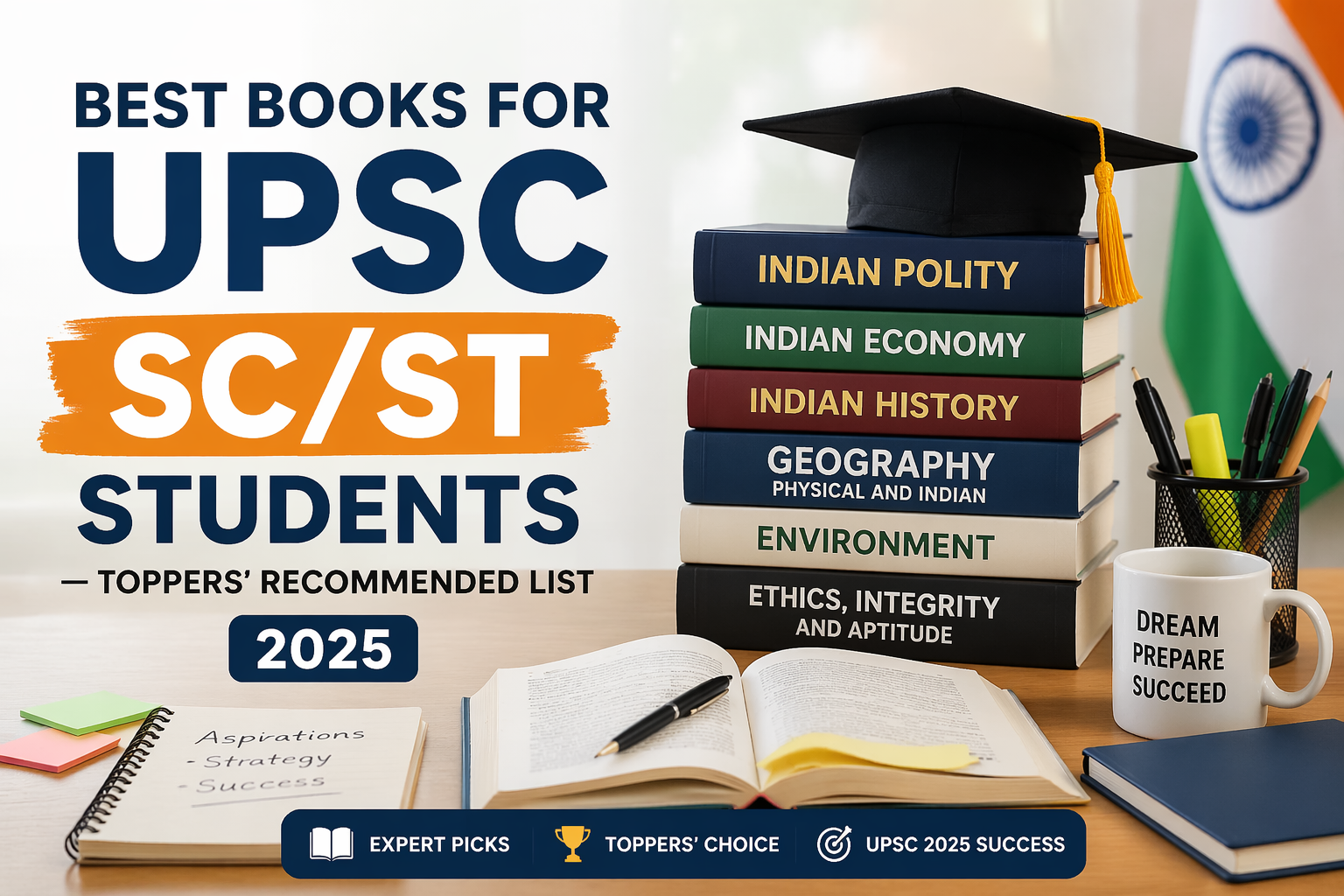
Author’s Note: Most “UPSC booklist” articles online are copy-paste generic lists that completely ignore the unique position of SC/ST aspirants. This article is different. It is built specifically for Scheduled Caste and Scheduled Tribe candidates — accounting for your extended preparation window, financial realities, recommended optional subjects, and the specific topics where you have a natural edge. Every book recommendation below is backed by UPSC toppers’ testimony, and where relevant, mapped to SC/ST-specific advantages.
Why SC/ST Aspirants Need a Different Booklist Approach
Here is the honest truth: the standard “best books for UPSC” list is written for a general category candidate who often has access to Delhi-based coaching. If you are an SC or ST aspirant, your situation is different — and your book strategy should reflect that.
You may be a first-generation aspirant without a family library or coaching background. And if you choose the right optional subject — more on this below — you can leverage your lived experience of tribal and marginalised community realities into a scoring advantage.
This “best books upsc sc st students” list is built for that reality.
The Golden Rule: One Book, Ten Times — Not Ten Books, Once
Before listing the books, internalize this principle that UPSC toppers repeat year after year: reading fewer books thoroughly and revising them repeatedly beats collecting a massive library. Five books read five times are worth more than fifty books read once.
Do not buy every book on this list in Week 1. Build your reading sequentially — foundation first, then reference books, then optionals.
Part 1: The Non-Negotiable Foundation — NCERT Books (Class 6 to 12)
Who Recommends Them: Every single UPSC topper, including AIR 1 Anudeep Durishetty (2017) and AIR 1 Shakti Dubey (2024).
NCERTs are the backbone of UPSC preparation — they provide simple language, strong fundamentals, and clarity across subjects. For SC/ST students from rural backgrounds or regional-medium schools, NCERTs are especially valuable because they bridge any conceptual gaps without requiring English coaching support.
Mandatory NCERT Reading List:
History: Old NCERTs by RS Sharma (Ancient India), Satish Chandra (Medieval India), and Class 10–12 modern history texts
Geography: Class 11 — Fundamentals of Physical Geography; Class 12 — India: People and Economy
Polity: Class 11 — Indian Constitution at Work
Economy: Class 12 — Introductory Macroeconomics
Science: Class 8, 9, and 10 General Science NCERTs
Cost Advantage for SC/ST Students: All NCERT books are freely available as PDFs on the official NCERT website (ncert.nic.in). You can complete your entire NCERT foundation at zero cost.
Part 2: Subject-Wise Best Reference Books for UPSC Prelims & Mains
Polity — The Single Most Important Subject
Book: Indian Polity by M. Laxmikanth
This is universally called the “Polity Bible” and remains the single most important non-NCERT book for UPSC. Every line in Laxmikanth is a potential MCQ in Prelims and a potential Mains question. Do not skip the appendices. For SC/ST aspirants, pay special attention to chapters on Fundamental Rights (Articles 15, 16, 17, 46), Directive Principles, Scheduled Areas (5th and 6th Schedules), and constitutional provisions for tribal self-governance (PESA Act, 1996). This knowledge is directly usable in GS-II Mains answers and the Personality Test.
Supplementary:Introduction to the Constitution of India by D.D. Basu — for candidates who want deeper constitutional analysis, especially useful for Mains answers involving constitutional morality and social justice.
History — Ancient, Medieval & Modern
Modern India:A Brief History of Modern India by Spectrum (Rajiv Ahir) — concise, factual, ideal for Prelims revision
Alternative for Mains Depth:India’s Struggle for Independence by Bipan Chandra — excellent for building narrative answers; covers Dalit movements, tribal uprisings, and the role of marginalized communities in the freedom struggle (a topic SC/ST aspirants can write on with genuine insight)
Ancient & Medieval: NCERTs suffice; supplement with old NCERT by RS Sharma
SC/ST Edge: Indian history is full of tribal resistance movements — the Santhal Rebellion, Birsa Munda’s Ulgulan, the Rampa Rebellion — and Dalit social reform leaders like Phule, Periyar, and Ambedkar. These figures in GS-I Mains. Study them deeply. Your community’s history is examinable content.
Geography
Books:
Certificate Physical and Human Geography by G.C. Leong — highly recommended by toppers for clarity
NCERTs (Class 11–12) for Indian Geography
Oxford Student Atlas — use daily for map-based questions
Economy
Book:Indian Economy by Ramesh Singh
The economy is dynamic — this book covers foundational concepts like GDP, inflation, and fiscal policy, but you must link it with current sources like the Annual Economic Survey and Union Budget. For SC/ST aspirants, chapters on poverty, inequality, tribal land rights, and government welfare schemes are directly relevant to both Prelims and your lived experience.
Environment & Ecology
Book:Environment by Shankar IAS Academy
This remains the best single resource for biodiversity, climate change, environmental laws, and acts. ST aspirants from forest-dwelling communities will find the chapters on Forest Rights Act (FRA 2006), biodiversity hotspots, and tribal ecology particularly resonant — and answerable with real-world examples from your own background.
Indian Art & Culture
Book:Indian Art and Culture by Nitin Singhania
Read selectively — focus on Architecture, Classical Dance forms, Folk Traditions, and Tribal Art. India’s tribal art traditions (Warli, Madhubani, Gond, Dhokra craft) are part of this syllabus, and an ST aspirant writing about these from a lived cultural perspective will craft answers that stand out in Mains.
Ethics, Integrity & Aptitude (GS Paper 4)
Book:Lexicon for Ethics, Integrity & Aptitude by Niraj Kumar
Ethics Paper 4 is one of the most scoring sections and requires connecting definitions to real-world examples. SC/ST aspirants have unique material here — the lived experience of social discrimination, overcoming adversity, and commitment to public service are powerful case study material for ethics answers. No book can replace that. Use Lexicon for keywords and definitions, then build your own examples from community realities.
Current Affairs — The One “Subject” No Book Covers Alone
Sources:
Daily Newspaper:The Hindu or The Indian Express — 45–60 minutes every day
Monthly Magazine:Yojana — covers government schemes, tribal welfare, social justice
Monthly Magazine:Kurukshetra — focuses on rural development, which directly relates to tribal and SC welfare topics
Free Resource Alert: The Ministry of Tribal Affairs website, SC/ST Welfare Ministry portal, and NITI Aayog reports are goldmines of current affairs content specifically relevant to SC/ST policy areas tested in GS-II Mains.
Part 3: The Optional Subject — The Game-Changer for SC/ST Aspirants
This section is where most generic booklists completely fail SC/ST readers. Here’s the critical difference:
Why Anthropology Is the #1 Recommended Optional for SC/ST Aspirants
Anthropology is the most strategically suited optional subject for many SC and ST aspirants, for four concrete reasons:
Concise Syllabus: It can be completed in 4–5 months with consistent effort
Scoring Potential: Diagrams and scientific answers fetch high marks; toppers routinely score 300+ out of 500
Overlap with General Studies: Topics like tribal issues, Indian society, and caste overlap directly with GS-I and GS-II
Lived Experience Advantage: ST aspirants from tribal communities bring an authentic understanding of tribal governance, forest rights, displacement, and cultural practices that enrich Paper II answers in ways textbook candidates simply cannot match
UPSC topper Anudeep Durishetty (AIR 1, 2017) chose Anthropology as his optional and documented his strategy publicly. He specifically recommended a thorough reading of the Xaxa Committee Report for tribal sections of the syllabus.
Best Books for Anthropology Optional (Toppers’ Picks)
Paper I — Physical & Social Anthropology:
Physical Anthropology by P. Nath — simple language, excellent for beginners; covers evolution, race, genetics, and human variation
An Introduction to Social Anthropology by D.N. Majumdar and T.N. Madan — foundational text for kinship, culture, and social organization
Anthropology: An Introduction by Ember, Ember, and Peregrine — globally recognized, clear, real-life examples, recommended by multiple toppers
Paper II — Indian & Tribal Anthropology:
Indian Anthropology by Nadeem Hasnain — the essential book for understanding Indian society, caste, tribes, and applied anthropology; covers caste, village studies, and tribal governance
Tribal India by Nadeem Hasnain — comprehensive coverage of tribes, their problems, displacement issues, and government policies; essential case study material
Xaxa Committee Report (2014) — mandatory reading; this government report on tribal welfare issues is repeatedly referenced in UPSC answers by top scorers
IGNOU MA Anthropology Notes — freely available online; concise, UPSC-relevant, great for revision
Diagram Tip: Anthropology rewards diagram-based answers in Paper I. Practice drawing diagrams of human evolution, skeletal structures, and kinship charts. Neat, labelled diagrams can add 5–8 marks per answer.
Part 4: Free & Low-Cost Resources Specifically for SC/ST Aspirants
The best books for UPSC SC/ST students are not always bought — many are freely available:
NCERT PDFs: Free at ncert.nic.in
IGNOU Study Materials: Free at egyankosh.ac.in — covers Anthropology, Sociology, History, and Political Science at the MA level
Ministry Reports: Xaxa Report, Economic Survey, India Year Book — free government PDFs
YouTube Channels: PMFIAS (Geography), StudyIQ, Drishti IAS, and Vision IAS offer free video lectures that complement books perfectly
Dr. Ambedkar Centre of Excellence (IGNOU DACE): Provides free UPSC coaching for SC candidates — their study materials are available to enrolled students at no cost
Complete Quick-Reference Booklist for SC/ST UPSC Aspirants
Subject
Best Book
Author
Stage
Polity
Indian Polity
M. Laxmikanth
Prelims + Mains
Modern History
A Brief History of Modern India
Spectrum/Rajiv Ahir
Prelims
Modern History (depth)
India’s Struggle for Independence
Bipan Chandra
Mains
Geography
Certificate Physical & Human Geography
G.C. Leong
Prelims + Mains
Economy
Indian Economy
Ramesh Singh
Prelims + Mains
Environment
Environment & Ecology
Shankar IAS Academy
Prelims + Mains
Art & Culture
Indian Art and Culture
Nitin Singhania
Prelims + Mains
Ethics
Lexicon for Ethics
Niraj Kumar
Mains GS-4
Optional (Paper I)
Physical Anthropology
P. Nath
Mains Optional
Optional (Paper II)
Indian Anthropology
Nadeem Hasnain
Mains Optional
Optional (Paper II)
Tribal India
Nadeem Hasnain
Mains Optional
Current Affairs
The Hindu / Yojana / Kurukshetra
—
Daily
Foundation
NCERTs Class 6–12
NCERT
First Priority
People Also Ask: FAQs on Best Books for UPSC SC/ST Students
Q1. Which is the best optional subject for SC/ST students in UPSC? Anthropology is widely considered the most strategic option for SC and ST aspirants due to its concise syllabus, scoring potential (300+ marks possible), overlap with General Studies, and direct relevance to tribal and caste-related content in Paper II. Many toppers, including AIR 1 Anudeep Durishetty, chose Anthropology.
Q2. Is M. Laxmikanth sufficient for Polity for SC/ST UPSC aspirants? Yes, for both Prelims and Mains GS-II, Laxmikanth covers 90% of what you need. SC/ST aspirants should pay extra attention to chapters on Fundamental Rights, Directive Principles, the 5th and 6th Schedules, PESA Act, and constitutional provisions for tribal governance — these are high-yield areas.
Q3. What books should SC/ST aspirants read for tribal issues in UPSC Mains? Nadeem Hasnain’s Tribal India, the Xaxa Committee Report (2014), Ministry of Tribal Affairs annual reports, and Yojana/Kurukshetra magazines are the most important sources for tribal welfare topics in GS-II Mains.
Q4. Are there free UPSC books available for SC/ST students? Yes. NCERTs are free at ncert.nic.in. IGNOU study materials are free at egyankosh.ac.in. The Xaxa Report and Economic Survey are free government PDFs. YouTube channels like PMFIAS and StudyIQ provide free video lectures equivalent to paid coaching content.
Q5. How many books should an SC/ST aspirant read for UPSC? Quality over quantity always. A focused list of 8–12 books, read thoroughly and revised 3–4 times each, is far more effective than collecting 30+ books. With unlimited attempts until age 37, SC/ST aspirants have the advantage of going deep rather than wide.
Q6. Can UPSC Mains be written in a regional language by SC/ST students? Yes. UPSC allows Mains to be written in any of the 22 Scheduled languages listed in the 8th Schedule of the Constitution. Books in regional languages are also available for many subjects — check your state language academy or state textbook corporation websites.
Q7. Is the Bipan Chandra book important for SC/ST UPSC aspirants? Yes, especially for Mains. India’s Struggle for Independence by Bipan Chandra covers tribal uprisings, Dalit social reform movements, and figures like Ambedkar, Phule, and Periyar in ways that SC/ST aspirants can write about with depth and authenticity in GS-I answer papers.
Final Word: Your Reading List Is Your Roadmap — Keep It Lean, Go Deep
The best books for UPSC SC/ST students are not different from the best books for anyone else — but the way you use them must be. You have more time than general category candidates. You have lived experience that makes certain subjects — ethics, tribal welfare, social justice, constitutional provisions — personally meaningful rather than abstractly academic. And you have access to free coaching and scholarship schemes that can remove financial barriers to quality guidance.
Use unlimited attempts wisely. Read deeply. Revise repeatedly. Write daily. And choose Anthropology as your optional if tribal and social issues connect with your lived reality.
The civil services need officers who understand India from the ground up. That is you.
Sources and References: Anudeep Durishetty (AIR 1, 2017) booklist, Anthroholic.com, Vijetha IAS Academy, Vajiram & Ravi, PWOnlyIAS, IGNOU DACE, Ministry of Tribal Affairs (GoI), UPSC Official Website (upsc.gov.in)