He owned 50,000 books, studied 18 hours a day at Columbia University, and changed the course of a nation. Here’s exactly how Dr. B.R. Ambedkar studied — and what every student can steal from his methods.
If you want to learn how to study smart, you don’t need to look at a productivity app or a YouTube hack. You need to look at one man: Dr. Bhimrao Ramji Ambedkar.
Babasaheb Ambedkar didn’t just study hard. He studied smart — with a purpose, a system, and a discipline that most of us today can barely imagine. He faced poverty, caste discrimination, illness, and social isolation. And yet he earned degrees from Columbia University, the London School of Economics, and Gray’s Inn — becoming one of the most educated Indians of his time.
His secret wasn’t just intelligence. It was a method.
This article, “How to study smart like Ambedkar,” breaks down Ambedkar’s actual study methods into practical habits every student — whether you’re preparing for board exams, UPSC, or college assignments — can follow starting today.
Why Learning How to Study Smart Like Ambedkar Actually Works
Before we get into the methods, let’s understand the scale.
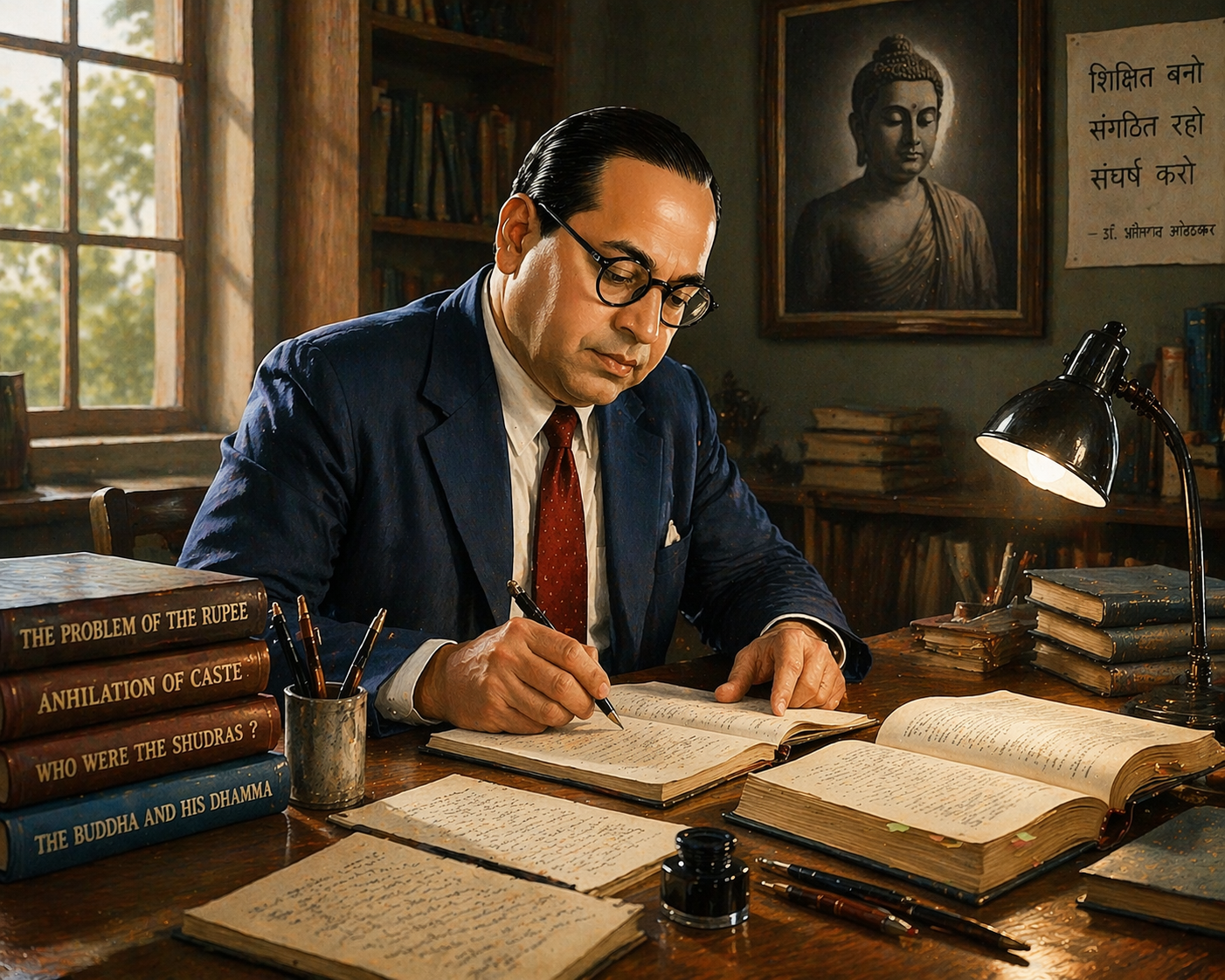
At Columbia University, Ambedkar spent up to 18 hours a day on campus — attending lectures, working in the library, or reading on his own. He ate only one meal a day to save time and money. He was often the last person to leave the library. At his home, Rajgriha in Mumbai, he built one of the largest personal libraries in the world — over 50,000 books.
But here’s what’s often missed: he didn’t just collect books. He engaged with them. Researchers who have studied his personal copies found them filled with underlines, margin notes, and annotations in red, blue, and grey pencil — marks of a man in active conversation with every page he read.
That’s not studying hard. That’s studying smart.
Method 1: Read with a Clear Purpose — Always
Most students open a textbook and read from top to bottom, hoping something sticks. Ambedkar never did this.
He read with a specific question in mind. What does this text prove? Who benefits from this argument? What does this tell me about law, economics, or society?
His reading habit, as documented by scholars who studied his annotations, showed selective and purposive engagement — he focused on chapters and sections that were directly relevant to what he was working on. He didn’t read entire books out of habit. He read strategically.
How to apply this: Before you open any book or study material, write one question at the top of your notes. Study to answer that question. This single habit will cut your reading time and double your retention.
Method 2: Read Across Many Subjects — Not Just One
One of the most remarkable things about Ambedkar’s approach was his refusal to stay in one lane. His personal library covered law, economics, history, sociology, philosophy, religion, politics, and literature. He studied them all.
Why? Because he understood that real knowledge is connected. Understanding economics helped him understand caste. Understanding history helped him understand law. Understanding religion helped him dismantle arguments built on it.
This cross-disciplinary reading made his arguments extraordinarily powerful. When he wrote or spoke, he drew from every field — and no one could easily counter him because he had already read what they were going to say.
How to apply this: If you’re preparing for a competitive exam or college, don’t just study your syllabus in isolation. Read one general book per month — economics, history, psychology, whatever interests you. This background knowledge will connect to your core subjects in ways that surprise you.
Method 3: Question Everything — Including “Authority”
Ambedkar never accepted a text simply because it was authoritative, ancient, or popular. He questioned assumptions. He looked for contradictions. He asked: Who wrote this, and who does it benefit?
This critical reading style is what allowed him to dismantle centuries-old arguments used to justify discrimination. He went back to original sources — primary laws, ancient texts, historical documents — rather than relying on summaries or second-hand interpretations.
As his biography Becoming Babasaheb by Aakash Singh Rathore describes, his time at Columbia, especially under philosopher John Dewey, sharpened his belief that ideas must be tested against reality, not accepted on faith.
How to apply this: When you study any concept, ask: Is this actually true? What’s the evidence? Are there other perspectives? This habit turns passive learning into active thinking — and it’s the difference between a student who memorizes and a student who understands.
Method 4: Take Notes — Real, Useful Notes
Ambedkar was a prolific note-maker. The thousands of annotated books in his personal collection at Rajgriha, Siddharth College in Mumbai, and other locations are proof. He marked what mattered. He returned to important passages. He created a system that his future self could use.
His approach was not about highlighting everything. It was about marking what was worth coming back to — a judgment that required him to actively think while reading.
How to apply this: Stop highlighting entire paragraphs in yellow. Instead, write short notes in the margin (or a notebook) in your own words. If you can’t explain it in your own words, you haven’t understood it yet. This is one of the most scientifically supported study techniques — it’s called elaborative interrogation, and it works.
Method 5: Apply Knowledge — Don’t Just Collect It
Here is the single most important lesson from Ambedkar’s study life: knowledge that isn’t used is knowledge that dies.
Every book he read, every argument he absorbed, went directly into his writing, his speeches, his legal work, and his social activism. He didn’t study to collect degrees. He studied to change things. As a young student in New York, he reportedly had an awakening one night, realising he was wasting his scholarship time socialising. He resolved, from that moment on, to dedicate himself fully to study — not for himself, but for the millions of people waiting for him to return with answers.
He woke up at 5 AM, studied until midnight, and wrote volumes that still shape India’s legal framework today.
How to apply this: After every study session, ask: What will I do with this? Write a summary. Explain it to a friend. Solve a problem with it. Appear for a mock test. Knowledge tested is knowledge kept.
Method 6: Protect Your Study Time Like Your Life Depends on It
At Columbia, Ambedkar ate one meal a day. He sent money home to his family and still found a way to buy thousands of books. He chose the library over socialising, sleep over laziness, and books over comfort.
This wasn’t misery — it was prioritisation. He knew his time in New York was finite and irreplaceable. He acted accordingly.
His biographer CB Khairmode noted that even as a teenager in Mumbai, young Ambedkar used to visit a garden on Charni Road after school hours just to read without disturbance — because his home was too crowded and noisy.
He found a way. Every single time.
How to apply this: Identify your “library” — the time and place where you study best without distraction. Protect it. Tell people around you not to disturb you during that window. Even 2 focused hours of study beat 6 distracted ones every time.
Ambedkar’s Study Methods in a Nutshell
Here’s a quick summary of the habits covered in this article:
Read with purpose — always have a question before you open a book. Read widely — cross-disciplinary knowledge makes you stronger in every subject. Question everything — go to original sources, don’t accept summaries blindly. Take active notes — write in your own words, not just yellow highlights. Apply what you learn — test yourself, teach others, use your knowledge. Protect your study time — treat it as non-negotiable.
Final Thought: What Ambedkar Really Teaches Us About Studying Smart
Ambedkar once said something that every student should tape to their wall: “I measure the progress of a community by the degree of progress which women have achieved.” But he could just as easily have been speaking about individual students when he said, again and again — educate, agitate, organise.
Education comes first. And education, done right, is not about how many hours you sit at a desk. It’s about how deliberately you engage with knowledge, how critically you question it, and how purposefully you use it.
That’s how Ambedkar studied.
That’s how to study smart.
If this article helped you, share it with a student who needs it. And if you want to follow Ambedkar’s path more closely, start by reading one of his own works — “Annihilation of Caste” is the perfect beginning.