If you are an OBC, SC, or ST student preparing for SSC CGL, you already have a built-in advantage before you even open your textbook.
Reserved seats. Lower cut-offs. Age relaxation. Extra attempts.
But most students do not understand exactly how the reservation system works in SSC CGL — and because they do not understand it, they do not use it fully.
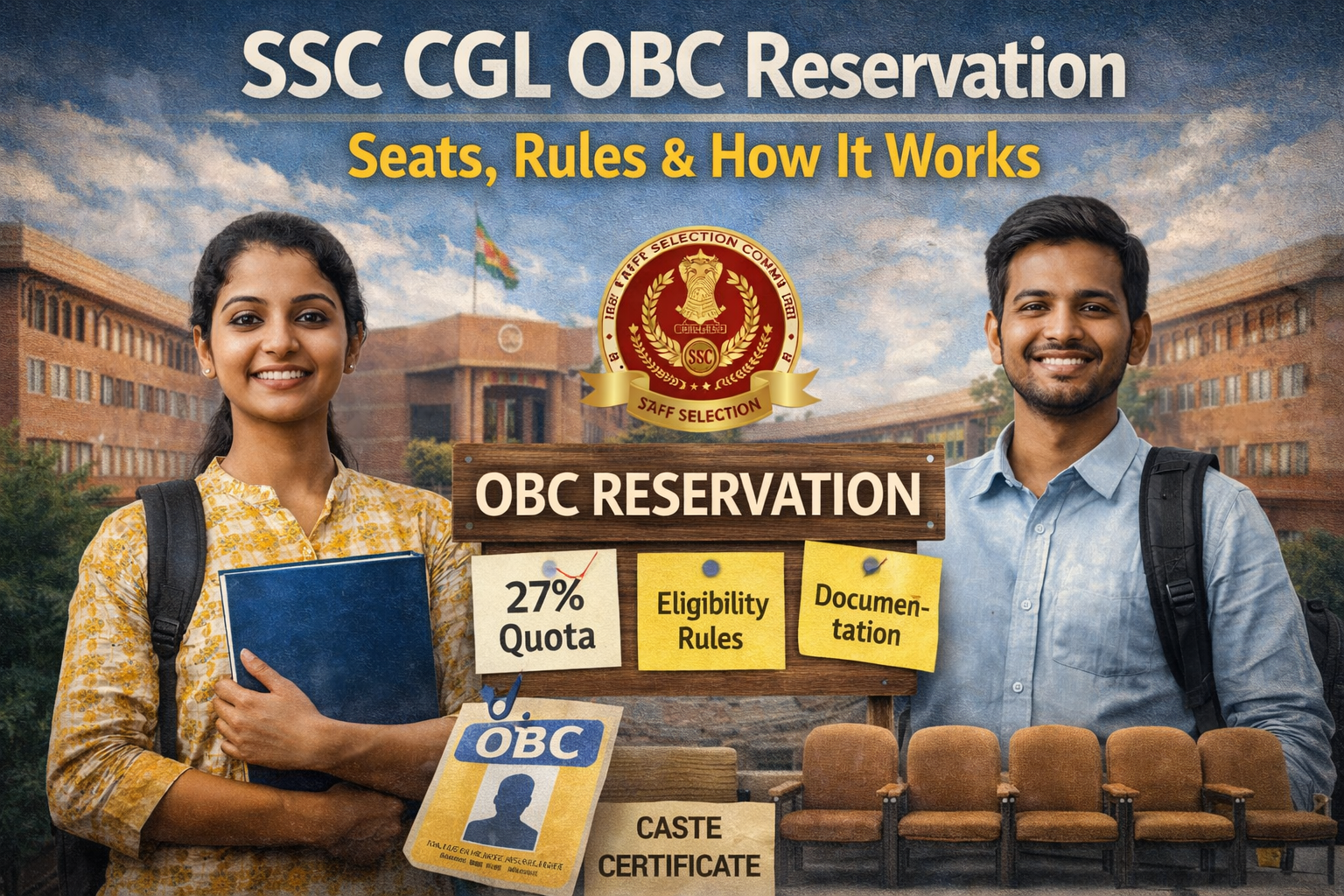
This article “SSC CGL OBC Reservation Seats” explains everything — how many seats are reserved for OBC, SC, and ST students in SSC CGL 2026, how the merit list works, what documents you need, and how to make the most of your category benefits.
1. What Is SSC CGL Reservation? — The Simple Answer
SSC CGL — the Combined Graduate Level Examination — is conducted by the Staff Selection Commission to fill Group B and Group C posts in central government departments.
Like all central government jobs, SSC CGL follows the constitutional reservation policy under Articles 15(4) and 16(4). Total vacancies are divided into reserved and unreserved categories.
SSC CGL Final Vacancies include vacancies for different reservation categories like General (UR), Scheduled Caste (SC), Scheduled Tribe (ST), Other Backward Classes (OBC), and Economically Weaker Sections (EWS).
Think of the total vacancies as a pie. Each category gets a specific slice. OBC gets the biggest reserved slice. SC gets the next. ST gets theirs. EWS gets 10%. The remaining goes to unreserved/General.
2. SSC CGL Reservation Percentage — Category Wise
This is the official reservation breakdown for all central government posts, including SSC CGL:
Category
Reservation Percentage
OBC (Non-Creamy Layer)
27%
SC (Scheduled Caste)
15%
ST (Scheduled Tribe)
7.5%
EWS (Economically Weaker Section)
10%
UR/General (Unreserved)
40.5%
Total
100%
These percentages are fixed by the Government of India and applied uniformly across all SSC CGL posts and departments.
3. How Many Seats Are Reserved for OBC in SSC CGL?
OBC candidates have 27% quota in SSC CGL. In 2023, that translated to 849 actual selections out of 3,145 total.
Let us apply this to the 2025-26 vacancy numbers. SSC CGL 2025 final vacancies have been officially released with 15,130 posts across multiple departments and ministries.
With 15,130 total vacancies, the approximate category-wise breakdown is:
Category
Percentage
Approximate Seats (15,130 total)
OBC
27%
~4,085 seats
SC
15%
~2,270 seats
ST
7.5%
~1,135 seats
EWS
10%
~1,513 seats
UR/General
40.5%
~6,128 seats
For SSC CGL 2026: Around 15,000 to 20,000 vacancies are expected in SSC CGL 2026. The exact vacancy and category-wise breakdown will be released with the official notification.
4. SC and ST Reservation in SSC CGL
SC candidates get 15% reservation — that was 472 selections in 2023. ST candidates receive 7.5% — that was 236 selections in 2023. General category secures 50.5% — that was 1,588 selections in 2023.
SC and ST candidates also get additional advantages over OBC:
Lower cut-off marks at Tier 1, Tier 2, and document verification
5 years age relaxation (compared to 3 years for OBC)
Unlimited attempts (OBC gets only 9 attempts)
No NCL certificate required — unlike OBC, SC/ST category has no income-based restriction
5. EWS Reservation in SSC CGL
EWS (Economically Weaker Sections) reservation of 10% was introduced in 2019 for General category candidates whose family income is below ₹8 lakh/year and who do not fall under SC/ST/OBC.
Important: EWS candidates get no age relaxation — they follow the same 32-year limit and 6-attempt rule as the General category. The only benefit is the 10% reserved seats and a lower cut-off within that category
6. How the Merit List Works — UR vs Reserved Seats
This is the most confusing part of SSC CGL reservation — and understanding it gives you a real strategic advantage.
Around 50% of the total is unreserved, but unreserved does not mean General category only. A person from any category can occupy the seat of General. For example, if there are 10 seats — 5 for UR, 2 for OBC, 1 for SC, 1 for ST, and 1 for PwBD — an OBC candidate who scores high enough to qualify in the UR merit list will be counted in the UR 5 seats, NOT in the OBC 2 seats. This means the OBC 2 seats remain fully available for other OBC candidates.
In simple words: if an OBC/SC/ST candidate scores high enough to be selected on General merit, they are NOT counted against their reserved quota. Their reserved quota remains untouched.
This is called the “Own Merit” rule — and it is excellent news for strong candidates. Score high enough as an OBC/SC/ST candidate, and you get selected on General merit, freeing up your reserved seat for someone else in your community.
7. SSC CGL Cut-Off — Lower for SC/ST/OBC
Reserved category candidates have lower cut-off marks at every stage:
SSC CGL 2024 Tier 1 Cut-Off (approximate):
Category
Cut-Off Marks (out of 200)
General
~160–165
OBC
~155–160
SC
~145–152
ST
~137–145
EWS
~155–158
In the SSC CGL 2024 exam analysis, the SC cut-off was 252 with 7,111 candidates, the ST cut-off was 241 with 3,180 candidates, and the OBC cut-off was 271 with 12,591 candidates.
Lower cut-offs exist at every stage — Tier 1, Tier 2, and document verification. This significantly improves your chances of clearing each round.
8. Age Relaxation for OBC, SC, ST in SSC CGL
Category
Max Age
Relaxation
General
27–32 years (post-wise)
None
OBC (NCL)
3 years extra
e.g., 30 for posts with 27 max
SC / ST
5 years extra
e.g., 32 for posts with 27 max
PwBD General
10 years extra
PwBD OBC
13 years extra
PwBD SC/ST
15 years extra
Note: Age relaxation in SSC CGL is calculated from the maximum age of the specific post you are applying for, not a single universal limit. Different posts in SSC CGL have different maximum age limits (some are 27, some 30, some 32). Your relaxation is added on top of whichever age limit applies to your target post.
9. Number of Attempts — Category Wise
Unlike UPSC, SSC CGL does not officially cap the number of attempts. You can keep appearing as long as you meet the age and eligibility criteria for that year’s exam.
Category
Max Age
Effective Attempt Window
General
32 years
Until age 32
OBC
35 years
Until age 35
SC / ST
37 years
Until age 37
So while SSC CGL has no formal attempt limit, your age limit determines how long you can keep trying. SC/ST candidates get the longest window — 37 years to keep appearing.
10. What Is Horizontal Reservation?
Apart from the vertical reservation (OBC/SC/ST/EWS — which you understand now), SSC CGL also has horizontal reservation within each category.
Horizontal reservation means seats are further reserved for:
PwBD (Persons with Benchmark Disability) — across all categories
Ex-Servicemen (ESM) — across all categories
Women — in certain posts
For example, if there are 100 OBC seats, a certain number within those 100 are reserved for OBC PwBD candidates and OBC Ex-servicemen. The OBC unreserved seats go to the remaining OBC candidates.
11. The NCL Certificate — Most Important Document for OBC
This is the document that most OBC students either forget or get wrong.
To claim OBC reservation in SSC CGL, you must have an OBC Non-Creamy Layer (NCL) certificate. A regular OBC caste certificate alone is NOT enough.
What NCL means: Your family income must be below ₹8 lakh per year, and your parent must not be in a senior government position (Group A or B officer). If your family earns above ₹8 lakh, you fall under the OBC Creamy Layer and are treated as the General category in central government exams like SSC CGL.
Validity of NCL certificate: The OBC NCL certificate must be from within the last 3 years (some departments specify 1 year) at the time of document verification. Get a fresh one if yours is older.
Where to get it: Tehsildar or SDM of your district. The certificate must specifically mention “for central government purposes” — a state-level OBC certificate without this clause is not accepted.
12. How to Check SSC CGL Vacancy for Your Category
Follow these steps to check the category-wise vacancy for any SSC CGL post:
Go to ssc.gov.in
Click the “Notices” tab at the top
Select “Vacancy” from the dropdown
Click the SSC CGL vacancy link
Download the PDF — it shows post-wise and category-wise vacancy distribution
The vacancy PDF clearly shows how many seats exist for UR, OBC, SC, ST, EWS, and PwBD in each post and department. Use this to choose which posts have the most openings in your category.
As highlighted, the post of Office Superintendent under the CBDT, Ministry of Finance, stands out with the highest number of vacancies, making it a strong target for any category aspirant.
13. SSC CGL 2026 — Key Dates and Vacancy
The detailed notification for the Combined Graduate Level Examination 2026 will be released on 31 March 2026 at www.ssc.gov.in.
The SSC CGL 2026 Tier-I Computer-Based Examination is tentatively scheduled from August 13 to August 30, 2026.
Event
Date
SSC CGL 2026 Notification
31 March 2026
Application Begin
31 March 2026
Tier 1 Exam (CBE)
August 13–30, 2026
Expected Vacancies
15,000 to 20,000
Candidates who have qualified for the Tier-II examination will be asked to apply their Option-cum-Preference from 9 March to 12 March 2026 for SSC CGL 2025 — the same process will apply for 2026.
14. Frequently Asked Questions
What is SSC CGL reservation 2026?
SSC CGL reservation 2026 follows the central government’s constitutional reservation policy. Out of total vacancies, OBC candidates get 27%, SC candidates get 15%, ST candidates get 7.5%, and EWS candidates get 10%. The remaining 40.5% goes to the unreserved/General category. For SSC CGL 2026 — with expected vacancies between 15,000 and 20,000 — OBC candidates can expect approximately 4,050 to 5,400 reserved seats. The detailed category-wise vacancy will be published in the official notification on 31 March 2026 at ssc.gov.in.
Does reservation affect cut-off calculation in SSC CGL?
Yes — reservation directly affects cut-off marks in SSC CGL. Separate merit lists are prepared for each category — UR, OBC, SC, ST, and EWS — and each list has its own cut-off. OBC cut-offs are typically 5 to 10 marks lower than General cut-offs at Tier 1. SC cut-offs are usually 10 to 20 marks lower. ST cut-offs are the lowest. This means an OBC, SC, or ST candidate qualifies for the next stage with fewer marks than a General category candidate. However, if an OBC or SC/ST candidate scores above the General cut-off, they are selected on General merit and their reserved seat remains available for another candidate from their community. Two separate merit lists run simultaneously — this is how the system protects reserved seats while rewarding high scorers.
How to get reservation benefits for SSC CGL exam 2026?
To claim reservation benefits in SSC CGL 2026, you must follow these four steps. Step 1 — Select the correct category (SC/ST/OBC/EWS) when filling the SSC CGL application form. Step 2 — Obtain the correct certificate: SC/ST candidates need a caste certificate from the Tehsildar/SDM. OBC candidates need both a caste certificate AND a Non-Creamy Layer (NCL) certificate specifically mentioning “for central government purposes.” EWS candidates need an EWS income certificate. Step 3 — Keep your certificates valid. The OBC NCL certificate must not be older than 3 years at the time of document verification. Income-based certificates should be from the current year. Step 4 — Submit certificates for document verification after qualifying all exam stages. Reservation benefits, including lower cut-offs and reserved seats, are automatically applied once your category is correctly declared and verified.
Is there a state-wise reservation in SSC CGL 2026?
No — SSC CGL follows central government reservation rules, not state-wise reservation.
This is one of the most misunderstood points about SSC CGL. Here is the truth:
SSC CGL is a central government exam for central government posts. It follows the Central List of OBCs — not the State List. This means even if your community is listed as OBC in your state’s list, you can claim OBC reservation in SSC CGL only if your community is in the Central Government’s OBC list.
Similarly, SC and ST certificates must be issued by a competent authority for the state you are domiciled in, and your community must be listed in the Constitutional (Scheduled Castes) Order or the Constitutional (Scheduled Tribes) Order applicable to your state.
Practical examples:
A community listed as OBC in Maharashtra but not in the Central OBC list → Gets NO OBC reservation in SSC CGL
An SC certificate from UP is valid for SSC CGL if the caste is in the UP SC schedule → Gets SC reservation
A Gujjar candidate in Rajasthan (listed as OBC in the state but not on the central list in some categories) → Must verify against the Central OBC list
How to check: Visit the National Commission for Backward Classes website at ncbc.nic.in → “Central List of OBCs” → Select your state → Search your community name.
There is no state-wise quota in SSC CGL. All OBC/SC/ST seats are filled from a national merit list within each category — not state by state.
Conclusion
The reservation system in SSC CGL is not charity — it is a constitutional promise that Dr. B.R. Ambedkar built into India’s framework to correct centuries of educational and social exclusion.
27% for OBC. 15% for SC. 7.5% for ST. Lower cut-offs. Age relaxation. Extra attempt years.
These benefits exist because communities were deliberately excluded from government jobs and education for generations. They exist so the government workforce looks like India, not just one part of it.
Your action plan for SSC CGL 2026:
Step 1: Check the SSC CGL 2026 notification at ssc.gov.in when it is released on 31 March 2026.
Step 2: Download the category-wise vacancy PDF. Find posts with maximum OBC/SC/ST openings in your preferred departments.
Step 3: Get your NCL certificate (OBC) or caste certificate (SC/ST) — valid and current.
Step 4: Prepare seriously. Use the lower cut-off as a safety buffer — not as a reason to prepare less.
Step 5: Score high enough to make the General merit list — use your reserved seat as insurance, not as your ceiling.