Getting your scholarship rejected after weeks of waiting is one of the most frustrating experiences a student can have.
You filled the form. You uploaded the documents. You waited for months. And then — rejected.
The worst part? In most cases, it was a small, fixable mistake. Not wrong eligibility. Not a government decision against you. Just one document mismatched, or one step your college skipped.
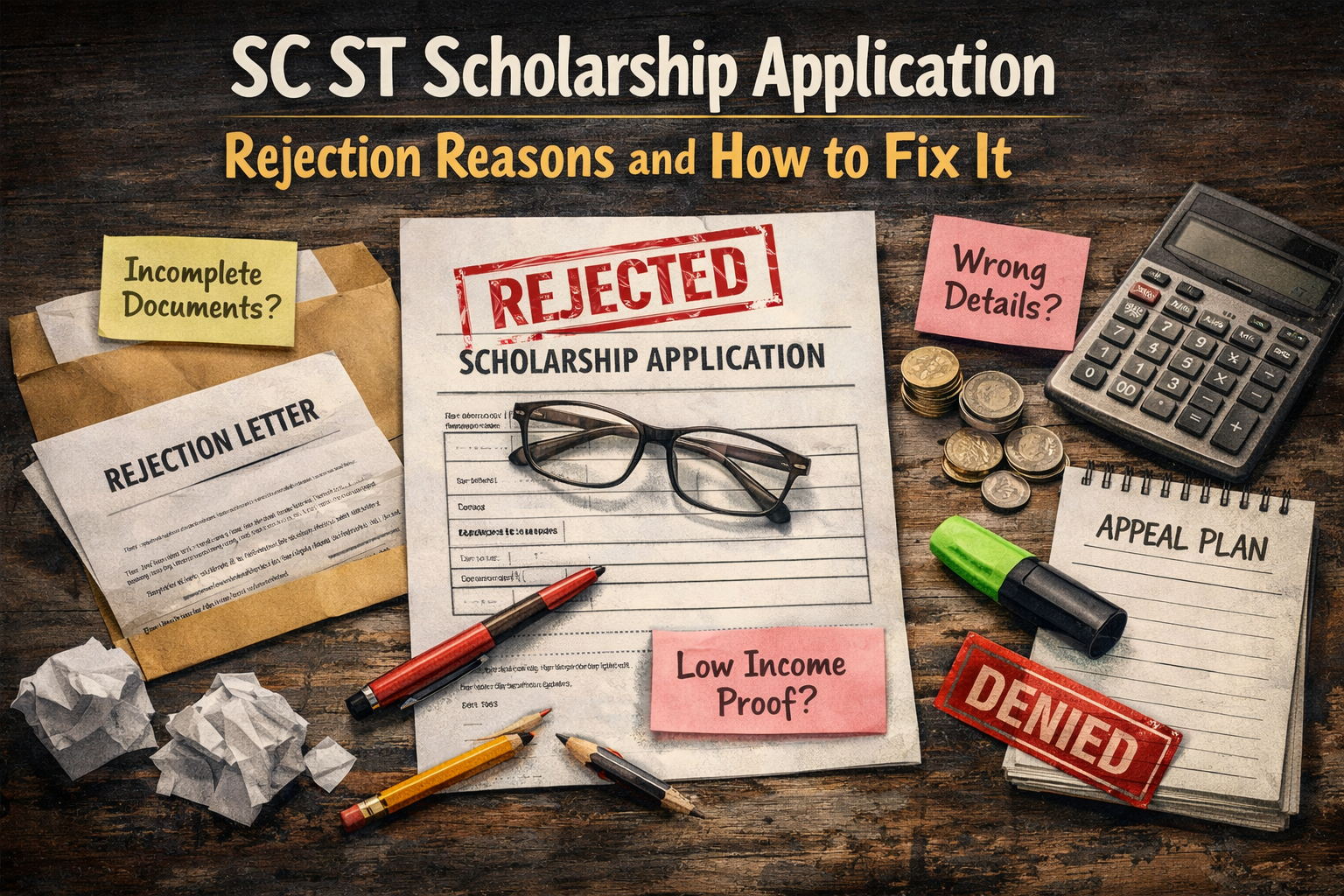
This article tells you every SC ST Scholarship Application Rejection Reasons and exactly how to fix each one before your next application.
Yes. After the final submission, editing is not allowed. If your application is rejected, you must check the reason for rejection and correct it in the next application cycle.
Rejection happens at three different stages:
Stage 1 — Institute Level: Your college’s nodal officer rejects or sends back your application
Stage 2 — District/State Level: The DNO or SNO flags a problem after college verification
Stage 3 — PFMS/Payment Level: Money bounces back even after approval, due to bank issues
Even after successful institute and state verification, the NSP system performs final-level checks involving PFMS, UIDAI, income databases, and scheme-specific eligibility rules. If any mismatch is detected, the NSP scholarship will be rejected after verification of the status is applied.
Understanding which stage your rejection happened at helps you fix the right problem.
2. The 12 Real Rejection Reasons
Common reasons include income above the eligibility limit, wrong category selection, duplicate application, or missing documents.
But there are 12 specific reasons. Here is every one of them.
3. Reason 1 — Name Mismatch Across Documents
The single most common rejection reason.
Incorrect or mismatched details in documents are one of the most common reasons for application rejection.
Your name must be identical across all four documents:
Aadhaar Card
Caste Certificate
Marksheet
Bank Passbook
Even small differences — “Ram” vs “Ramu,” “Mohammad” vs “Mohammed,” a missing middle name — cause automatic rejection at the PFMS or UIDAI verification stage.
How to fix it: Before applying, place all four documents side by side. Compare the names character by character. If there is any difference, correct it at the source before submitting. Aadhaar name correction: resident.uidai.gov.in. Caste certificate correction: Tehsildar’s office.
4. Reason 2 — Bank Account Not Aadhaar-Seeded
Your scholarship money travels through DBT (Direct Benefit Transfer), which works only if your Aadhaar number is mapped to your bank account at NPCI.
Your scholarship money is sent via Aadhaar, not your account number. Go to your bank branch physically. Ask for the “NPCI Seeding Form” (also called the DBT Consent form). Once the bank staff links your Aadhaar to the NPCI mapper, it takes about 4 to 5 days for the “Failed” status to turn into “Success.”
How to fix it: Visit your bank branch with your Aadhaar card. Ask specifically for the “NPCI Aadhaar Seeding Form.” Submit it. Wait 4–5 days. Then check the seeding status at the NPCI BASE platform before re-applying.
5. Reason 3 — Institute Verification Not Done
This is the rejection reason that is not your fault — but still kills your application.
Institute Nodal Officer (INO) verification is mandatory, and without it the scholarship cannot be processed.
After you submit on NSP, your college’s INO must verify your application online within the deadline. The DNO / SNO / MNO verification stage is currently OPEN and will close on 15 January 2026 for most central scholarship schemes. If your application status is showing “Under Verification”, “Pending at Nodal Officer”, or “Defective”, this is the final stage before payment processing. Missing this stage may result in rejection or delay.
How to fix it: The day you submit your application, walk to your college’s scholarship office. Do not email. Go in person. Show them your Application ID. Ask them to verify before the deadline. Follow up every week.
If your INO is unavailable, contact the Principal’s office or Office Superintendent and submit a written request mentioning: Application ID, scheme name, pending institute verification, and reason for urgency. Also, raise a grievance on the NSP portal explaining that the INO is unavailable.
6. Reason 4 — Defective Application Not Corrected in Time
If your status shows “Defective,” it means a verifying authority found an error and sent your application back for correction.
The defective correction window has already closed on 31 December 2025. No fresh document upload is allowed now unless specifically reopened by the authorities.
For future applications — log in to NSP immediately when the status turns Defective. Read the exact reason. Correct and resubmit within the correction window. Missing this window means waiting for the next academic year.
How to fix it: Check NSP status weekly. Set a reminder. The moment your status changes to “Defective,” — act the same day.
7. Reason 5 — Wrong Scheme Selected
Many students accidentally select the wrong scholarship scheme — applying for an OBC scheme as an SC student, or choosing a minority scheme when they do not qualify.
Wrong category selection is one of the common reasons for rejection.
How to fix it: Use the “Scheme Eligibility” filter on the NSP homepage before applying. Enter your category (SC/ST/OBC), state, income, and course level. The portal shows only schemes you are genuinely eligible for. Never guess.
8. Reason 6 — Duplicate Application
You can apply for multiple schemes, but if you are selected for more than one central scheme, you will have to choose only one. Holding two central government scholarships simultaneously is generally not allowed.
If you get selected for an NSP scholarship (like the National Merit) and an SSP scholarship, the system will eventually flag the duplicate. The system auto-rejects one of them — usually the latter one.
How to fix it: Apply for one main scheme first. Only consider a second scheme if the first explicitly does not cover the same cost (e.g., one covers tuition, another covers hostel). Read each scheme’s concurrent scholarship rules.
9. Reason 7 — Income Certificate Is Old
This is the most common renewal rejection reason.
Your income certificate must be from the current academic year. Using last year’s certificate — even if it looks the same — is a valid rejection ground.
How to fix it: Every year, get a fresh income certificate from your Tehsildar or Circle Officer before the scholarship window opens. Do not wait. Get it in June when the new academic year starts.
10. Reason 8 — Caste Certificate Expired or Invalid
Some states require caste certificates to be renewed periodically. If yours has expired, your application is invalid.
In Maharashtra, a Caste Validity Certificate from the Caste Scrutiny Committee is required separately from the regular caste certificate. Many Maharashtra students get rejected for missing this second document.
How to fix it: Check your caste certificate’s validity date. If expired — visit your Tehsildar and renew it before applying. Maharashtra students — apply for both the Caste Certificate AND the Caste Validity Certificate.
11. Reason 9 — Income Above Eligibility Limit
Income above the eligibility limit is one of the common rejection reasons.
Most SC/ST Post Matric scholarships require a family income below ₹2.5 lakh/year. If your income certificate shows more, your application is rejected automatically.
How to fix it: Check the income limit for your specific scheme before applying. If your income is above ₹2.5 lakh, you may still qualify for schemes with higher income limits (Central Sector Scholarship: ₹4.5 lakh, AICTE Pragati for girls: ₹8 lakh, Top Class SC: ₹6 lakh). Apply for the scheme that matches your actual income.
12. Reason 10 — Blurry or Large Document Uploads
Scanned documents that are too dark, too light, blurry, or over 200 KB in file size are flagged as invalid during processing.
How to fix it: Scan documents in good lighting with a flat, stable surface. Compress files at tinypng.com (images) or ilovepdf.com (PDFs). Each file must be below 200 KB in PDF or JPEG format. All four corners of the document must be visible.
13. Reason 11 — Dormant or Closed Bank Account
Bank account not linked to Aadhaar, name mismatch between the application, Aadhaar, and bank records, incorrect IFSC Code, or the bank account being closed or dormant are all PFMS-level rejection causes.
Even if your application is approved, money will not reach a dormant account.
How to fix it: Visit your bank before applying. Make sure: the account is active with a recent transaction, a minimum balance is maintained, KYC is complete, and Aadhaar is seeded. If the account is dormant, reactivate it by depositing any amount.
14. Reason 12 — Unrecognised Institution
Your college must be registered on the NSP portal and recognised by UGC, AICTE, or the relevant statutory body. If it is not listed, your application cannot proceed past the institute verification stage.
How to fix it: Before applying, search your institution’s name on the NSP portal under “Institute Search.” If it does not appear, ask your college administration to register on NSP immediately. This process takes time, so check early in the academic year.
15. What to Do After Rejection — Step by Step
Step 1: Log in to scholarships.gov.in with your OTR ID.
Step 2: Go to “Application Status” — read the exact reason for rejection. Screenshot it.
Step 3: Fix the specific problem listed (wrong document, expired certificate, bank seeding, etc.).
Step 4: If the correction window is open, upload the corrected document and resubmit.
Step 5: If the window is closed, prepare all the correct documents now and apply them in the next academic year cycle.
Step 6: Raise a formal grievance on NSP if you believe the rejection was incorrect.
16. How to Raise a Grievance on NSP
If you believe your rejection was an error, you can formally challenge it.
Go to scholarships.gov.in → Click “Grievance” → Select your scheme → Describe your problem with your Application ID → Submit.
When calling, always have ready: your Application ID, OTR number, registered mobile number, and a screenshot of your rejection message. This speeds up resolution significantly.
17. Frequently Asked Questions
Why was my SC ST scholarship rejected?
The most common reasons for SC/ST scholarship rejection are: name mismatch between Aadhaar and other documents, bank account not Aadhaar-seeded for DBT, institute verification not completed by college within deadline, defective application not corrected on time, wrong scheme selected, duplicate application, outdated income certificate, expired caste certificate, income above scheme eligibility limit, blurry or oversized document uploads, dormant bank account, and unrecognised institution on NSP. Check your status on scholarships.gov.in to see the exact reason for your application.
What to do if my scholarship is rejected?
Log in to scholarships.gov.in and read the exact rejection reason from your Application Status. Fix the specific problem — correct name mismatches at source, renew expired certificates, activate your bank account, or contact your college for institute verification. If the defective correction window is still open, upload corrected documents and resubmit. If it is closed, prepare all the correct documents now and apply them fresh in the next academic year. For unfair rejections, raise a grievance at scholarships.gov.in or call the NSP helpdesk at 0120-6619540.
Can I reapply after scholarship rejection?
Yes — but only in the next academic year’s application cycle. Once the correction window closes for the current year, no changes can be made. Use the rejection reason to fix your specific problem. Gather all correct and updated documents. When the portal opens for the next cycle (typically June–July), apply again with the corrected information. Do not waste the next cycle by making the same mistake.
What is a defective application on NSP?
A “Defective” status on NSP means a verifying authority — your college’s nodal officer or district officer — found an error in your application and sent it back for correction. It is not a final rejection. You have a limited correction window to log in to NSP, read the reason, fix the problem, and resubmit. If you miss the correction window, the application cannot be processed for that year. Check your NSP status weekly after submitting so you never miss a defective notice.
Conclusion
A rejected scholarship is painful. But it is almost never permanent.
Careful filling of the application form and timely follow-up with the institution can reduce the chances of rejection.
In 12 years of SC/ST scholarship programmes, the most heartbreaking cases are always the same: students who were fully eligible, fully deserving — but lost their scholarship because their name had a different spelling on two documents, or their college forgot to click a button.
You now know every reason. You now know every fix.
Before your next application — use the documents checklist, check your Aadhaar-bank seeding, walk to your college scholarship office, and check your NSP status every single week after submitting.
Dr. Ambedkar built Article 46 so that the government must promote the educational interests of SC/ST communities. This scholarship money is your constitutional right.